On a crisp morning in the Peloponnesian landscape, the sun's first rays softly brush over the ancient hills near the citadel of Mycenae. The air is tinged with the aroma of Mediterranean wild herbs, rustling gently in the early breeze. This picturesque scene, however, hides a story of ancient martial prowess buried beneath the earth for over three millennia. In 1960, a team of archaeologists excavated a chamber tomb that had silently watched over its secret near the village of Dendra. There they discovered a relic from a bygone era—a nearly complete suit of bronze armor that seemed more a relic of myth than history itself.
Known today as the Dendra Panoply, this armor was unlike anything previously unearthed from the Bronze Age. Comprising meticulously crafted bronze plates, the panoply was a testament to the Mycenaeans' metallurgy skills, cultures that thrived around 1450-1400 BCE. This period predated the famed Roman legions and the Hellenic hoplites by nearly a millennium, a surprising testament to the sophistication of early Greek warfare. Yet when first examined, scholars and enthusiasts alike could not fathom a warrior engaging in combat wearing such a formidable, and seemingly cumbersome, suit of armor.
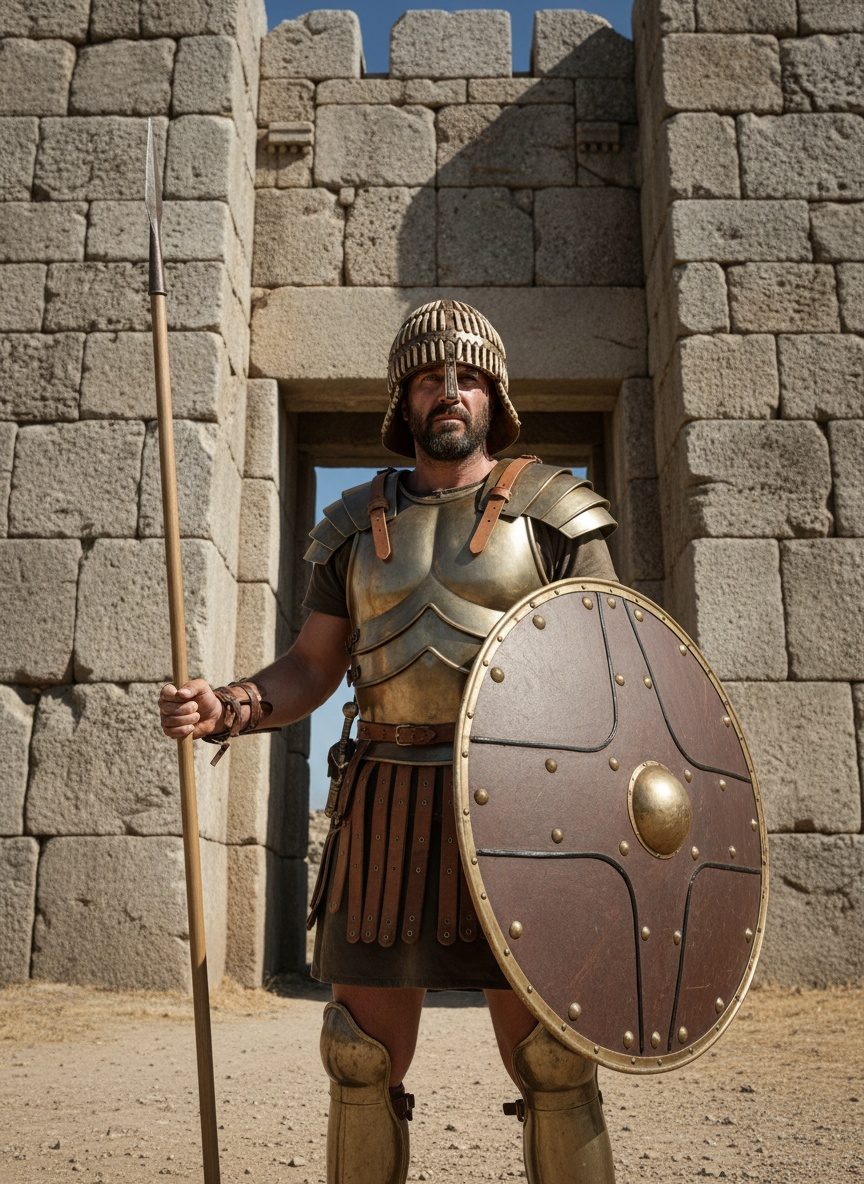
To picture the armor is to imagine a complete metallic shell, with its shape molded to fit the contours of the human form, combining protection and intimidation. The glinting bronze plates were fastened together with leather straps, covering the torso, shoulders, and legs. The design, which included a neck guard and articulated joints, suggested an understanding of human anatomy that one would scarcely credit to an era often shrouded in mystery. Even the helmet, an impressive full headpiece, bore an intimidating crest, likely mirroring the visage of a ferocious warrior chief—a symbol befitting the Mycenaean society renowned for its warrior culture, as echoed in the tales of Homer's epics.
This groundbreaking discovery fundamentally shifted perceptions of Mycenaean warfare. Until then, the ornate weaponry and sprawling fortresses of this ancient culture had largely been regarded as ceremonial, treasures befitting noble burials rather than tools of war. It was assumed that such armor was too unwieldy for practical use on the battlefield, relegated in scholarly circles to discussions of status and ritual. However, the Dendra Panoply began to challenge these long-held assumptions.
For years, the Dendra armor was displayed as an anomaly of ancient craftsmanship, existing more in the realm of academic wonder than as an answer to practical martial applications. However, recent reenactments have breathed new life into our understanding. Modern volunteers, driven by curiosity and courage, have donned replicas of the panoply, stepping into the boots of a Mycenaean warrior. These experiments, conducted on the fields of Greece under the watchful scrutiny of historians and archaeologists, have offered new insights into its design and functionality.
Participants found the armor to be surprisingly maneuverable despite its weight. The articulated joints and expert weight distribution allowed for a greater range of movement than previously thought. As volunteers sparred and maneuvered, it became evident that the panoply, rather than a mere showpiece, was a formidable battlefield asset. It could absorb and deflect blows that otherwise might have been fatal—a crucial advantage in the brutal melee combat that marked ancient warfare.
This discovery has significant implications for our understanding of Mycenaean society. It challenges the notion that technological sophistication in arms and armament only came with later empires. The Dendra Panoply, buried near the very heart of one of Greece's most storied cultures, suggests that these people were not only fierce warriors but also engineers capable of crafting protection that was both functional and formidable.
The Dendra Panoply, with its intricate design and hidden history, forces us to reconsider the capabilities of early civilizations. It rekindles a narrative that perhaps many others, not just the Mycenaeans, possessed skills and knowledge that have been lost to time. The replications and tests done today connect us with the past, drawing a direct line from the ancient to the modern, reminding us of the warrior ethos that echoes through the annals of history.
As we theorize about this remarkable armor's place in history, its unearthing provokes a deeper appreciation for the complexities of ancient societies. The Dendra Panoply serves not only as a doorway into the mysteries of Mycenaean life but also as a challenge to reimagine past narratives. By doing so, it emphasizes that history, as we know it, is not static but a dynamic interplay of discovery and reevaluation. With each excavation, each test and theory, the past whispers ever so slightly louder, urging us to listen to its stories and broaden our understanding of human ingenuity.