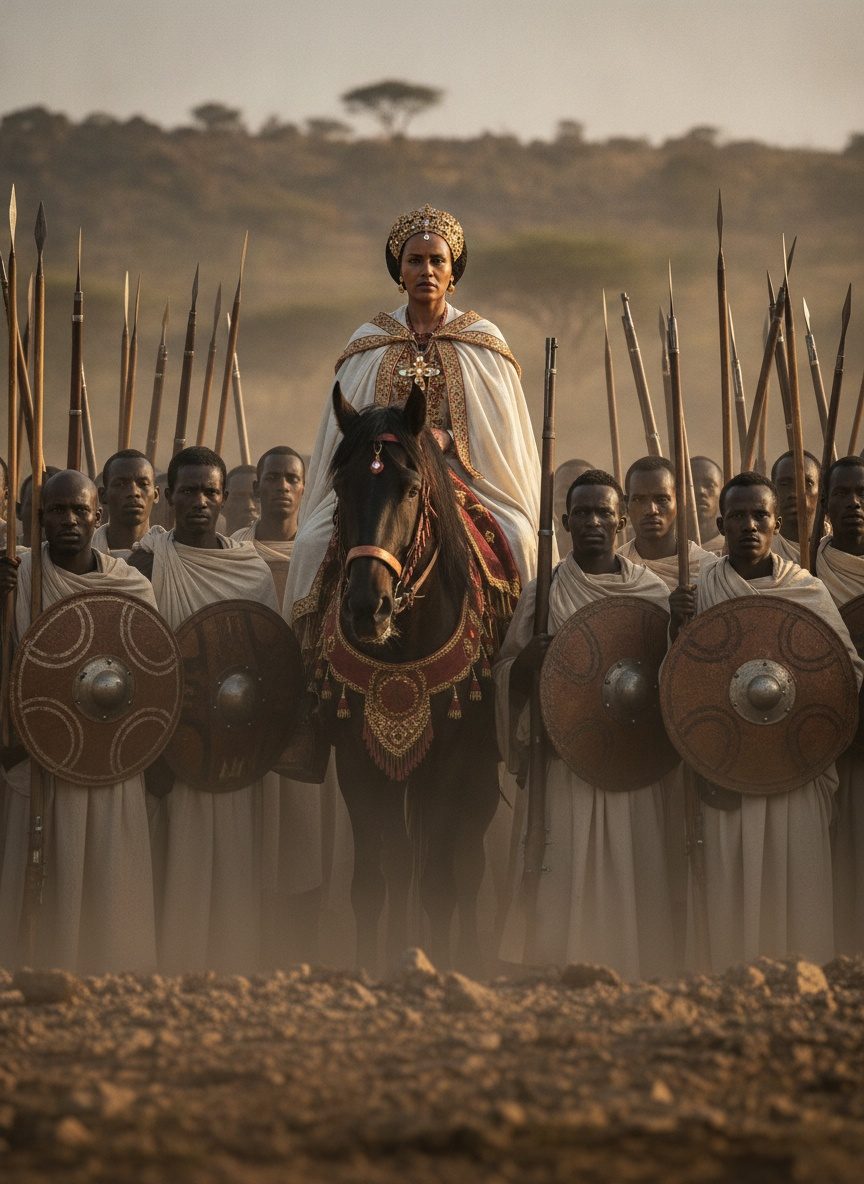
The dust rose thickly from the trampling of a hundred thousand feet. The midday sun blazed unmercifully overhead as Emperor Menelik II reined in his horse, surveying the army that now assembled before him. But even as the Emperor gathered his forces, it was the steady, unwavering eyes of Empress Taitu Betul that sent a quiver of readiness through the ranks. She had been the rallying cry, the voice that swayed hearts and drew warriors to the battlefield. Her presence did far more than bolster the emperor's ranks; it ignited a fire in the souls of those who answered the call to defend their homeland.
The Call to Arms: A Nation Mobilized
In the late 19th century, Ethiopia stood as one of the last bastions of independence in a continent rapidly succumbing to European colonial powers. Italy, nursing ambitions of an imperial presence in Africa, set its sights on Ethiopia in 1895. With an invading force well-supplied and confident in their European military prowess, they marched with the intent of drawing Ethiopia into their colonial fold. Yet, they underestimated the strength of a nation bound not by resources or modern weaponry, but by unity and determination.
As Emperor Menelik II assessed the looming threat, he called upon every corner of Ethiopia, beckoning his people to rise and defend their sovereignty. Yet, the spirit and fervor that sparked this rally owed much to Empress Taitu. A woman of formidable intellect and courage, she was no mere consort. From the heart of Addis Ababa, her voice carried across hills and valleys, lambasting those who would dare remain idle as foreign boots threatened their sacred soil. "Shame on those who stay home," she famously declared, stirring a sense of duty and urgency.
Her words were not just rhetoric; they were a rallying cry backed by her own actions. Empress Taitu took an extraordinary step in raising her regiment, leading as a beacon of determination and resilience. Her influence was particularly pivotal in mobilizing the Oromo, Amhara, and Tigray forces, transforming disparate groups into a formidable national army. As men and women from diverse ethnic backgrounds gathered to pledge their allegiance, it became clear that Ethiopia was not merely a collection of territories but a unified front against invaders. Their target was clear: Adwa, where one of history’s most significant battles would unravel.
Adwa: The Fight for Freedom
The night before the Battle of Adwa was alive with anticipation. The air was electric, filled with a sense of destiny among the gathered Ethiopian fighters. Warnings were whispered among ranks about the precision and power of the Italian artillery, yet hope drowned out fear. The memory of Empress Taitu’s rally resonated, her unyielding spirit a constant presence alongside the emperor himself.
The first light of dawn marked the rapid ascent of Menelik’s forces towards the strategically significant hillocks of Adwa. As dawn broke, shots echoed across the slopes. The Italians, accustomed to quick victories, soon found themselves engulfed by the unyielding assault. Ethiopian warriors, familiar with the terrain and fortified by an unwavering purpose, tore through their ranks. What the Italians had perceived as an easy campaign swiftly unraveled into chaos.
Notable in this melee was Empress Taitu herself, who rode into the thick of battle, a symbol of unity and indomitable will. Her presence was more than symbolic; it spurred the soldiers onward, her resolve contagious. Reports from the battlefield recount how her regiment turned the tide at critical junctures, a testament to her strategic acumen. The myth of European invincibility crumbled as Ethiopian forces surrounded and routed their foes, capturing valuable supplies and artillery.
By the end of the day, the cost was heavy for the Italians, who endured a staggering defeat. For Ethiopia, however, the victory at Adwa was transformative. It was a testament to the power of collective resistance, where courage overcame intimidation and unity dispelled division. The triumph resonated far beyond the Ethiopian highlands, challenging assumptions of racial superiority that were prevalent across colonized lands.
Beyond the Battlefield: Legacy of Resilient Leadership
As the dust settled and the battlefields quieted, the reverberations of Adwa extended beyond military might. It was a turning point, signaling not just a preservation of independence but an assertion of African agency on the global stage. Adwa became a symbol of anti-colonial resistance, inspiring future generations across continents to rise against imperial domination.
At the heart of this narrative looms Empress Taitu, whose strength did not dim with victory. She persevered alongside Menelik, navigating the complexities of newfound respect and geopolitical intrigue. Taitu's role ensured that Ethiopia was perceived not as an outlier but as a sovereign nation worthy of equal footing amidst the international community. Her leadership was instrumental in negotiating favorable terms during peace talks, ensuring that the dignity of her people and the integrity of the nation remained untarnished.
The story of Adwa offers a profound lesson on the power of unity and courage. It reminds us that leadership is not merely about command but about inspiring others to transcend fear and embrace sacrifice. Though Empress Taitu Betul’s name may not be as globally recognized as that of her European contemporaries, her impact endures, her story a beacon of what it means to lead with heart and unwavering conviction. In a world still wrestling with the wounds of its colonial past, the legacy of this empress on horseback, riding into the fire, continues to inspire.