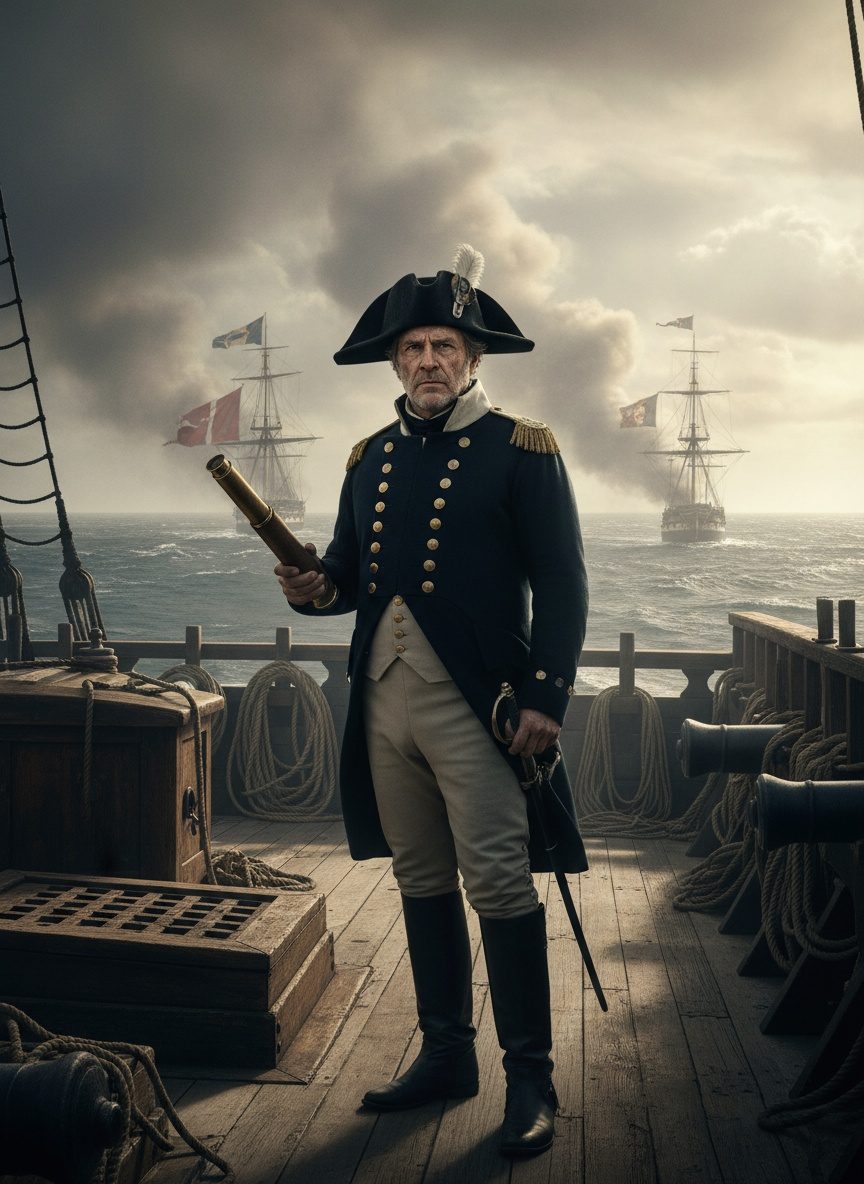
He was born to a lower-tier aristocracy on a tiny island. Yet Napoleon Bonaparte would command the fates of millions upon millions of Europeans.
A Conqueror's Achilles Heel
As the turn of the 19th century began to favor his ambitions, Napoleon Bonaparte rose like a comet across the European political sky. By 1807, he reached the zenith of his command, controlling territory that spanned from the Iberian Peninsula, through the heartlands of Germany, to the far reaches of Poland. This staggering hegemony, unparalleled since the Roman Empire, cemented his reputation as an unstoppable force on land. Yet, for all his soldiers could achieve—and they achieved much indeed—one insurmountable barrier remained. Napoleon could never break the ironclad rule of the sea held by Britain's Royal Navy.
Controlled by a relentless surge of naval might and protected by the waters of the English Channel, the power of Britain was vexing for the emperor of the French. The Royal Navy was far from an unblemished juggernaut. It was battered from decades of warfare, its ships had seen more salt-washed destruction than ceremonial paint, and its sailors were often thought more pirate than soldier. Financially, it strained under an overextended web of imperial commitments. Yet, it was precisely these sailors and their indomitable spirit that defied the terrestrial triumphs of Napoleon. Without the Royal Navy standing as an unrivaled bulwark, the map of Europe would have sung to a very different tune: one orchestrated in Paris, not London.
Napoleon understood all too well the implications of such naval dominance. The infamous Battle of Trafalgar in 1805 highlighted this vividly. Even though Nelson’s tactical victory left Britain scrambling for political stability, it simultaneously annihilated the possibility of French naval supremacy for years to come. The realization that his mighty armies, proficient at crushing the forces of Austria, Prussia, and even Russia, were impotent against Britain's naval power, left Napoleon’s dreams hemmed in by the coastlines of the continent he so effectively subjugated.
Illusions of Grandeur at Sea
Frustration festered every time Bonaparte glanced across the Channel. His journey from rock-strewn Corsica to the heights of power was repeatedly blocked by the waves of the Atlantic. To the people of Europe, he was a revolutionary hero, a brilliancy ordained to streamline the chaos of the era into a single, ordered empire. The possibilities unfurling before him were vast. A master stroke could have opened the way for his ambitions across the Atlantic, spreading the Napoleonic Code not just to the lands of ancient civilization but to the newborn nations on the American continent.
Yet, every ocean was patrolled by the seemingly omnipresent British ships. Parallel to his own land conflicts, the British naval forces engaged in constant skirmishes and formidable blockades. They strained supply lines and stymied the flow of Colonial and foreign resources upon which Napoleon relied. The blockade of European ports was a devious initiative designed to suffocate France economically. It effectively isolated Napoleon's empire even as he stood ready to conquer further. There was never a grand invasion fleet poised to sail for North America, but that specter haunted the ambitions of every European power interested in the New World, a testament to the shackles imposed by British naval hegemony.
Napoleon's own attempts to revitalize the French Navy were dynamic yet consistently underwhelming. His push for naval vessels worthy of the Grand Empire faced countless obstacles: a lack of trained seamen, the harrowing repairs necessary for fleets long in neglect, and the undeniable brilliance of British seafaring. This impotence on the seas makes the planning of the Continental System all the more remarkable, as it demonstrated the lengths to which Napoleon would go to assert control where his fleet could not sail. It was a tribute to British endurance that this grand initiative, too, faltered in the face of Britain's nautical guardians.
The Empire that Could Have Been
Those sweeping tides and the naval ledger remained in Britain's favor, drawing an invisible barrier Napoleon could not breach. Had the fleets been mutually stunned to silence, who knows what paths history might have followed? Could Napoleon have waged war across the Atlantic, extending his hand into the New World, altering the course of emerging nations? Would the vast resources he might seize propagate faster across his empire, staving off future defeats?
We ponder how Napoleon’s ambition may have remolded not only Europe but global power structures. Intriguingly, the British Royal Navy's iron chokehold did not rest upon pure military dominance; it wove elements of international economic policy, the iron industries of northern Britain, and logistical innovation. Ironically, Napoleon found himself trapped not by physical borders or political maneuvering, but by this blend.
Without Britain's navy, the winds might have carried echoes of “Vive l'Empereur” across the Atlantic, changing the language of commerce, colonization, and conflict. Yet, in a twist that history alone can deliver, Napoleon remains a towering symbol of land-based conquest—his maritime dreams tantalizingly out of reach. His era challenges us to contemplate what might have been, a reminder of the delicate balances upon which the fates of civilizations often rest. In many ways, the real victor of the Napoleonic wars needs no statue, for the vastness of the seas remains its greatest monument.