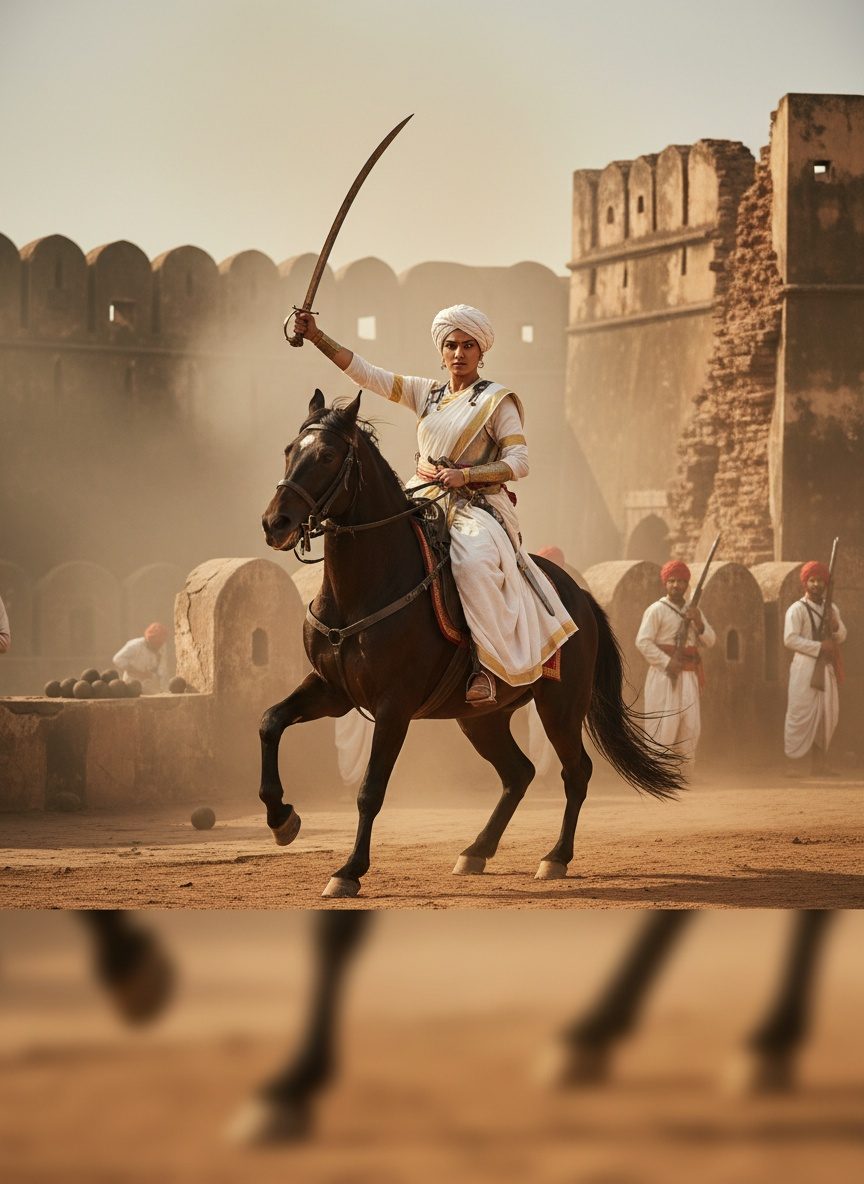
June 1857. The crackle of gunfire pierced the early morning silence around Jhansi.
The Siege Begins
The year of 1857 marked a turning point in the history of colonial India. Among the tumultuous events that unfolded during the Indian Mutiny — known to some as the First War of Indian Independence — few stories resonate with as much passion and defiance as that of Rani Lakshmibai of Jhansi. The young widow found herself thrust into turmoil as tensions between Indian sepoys and British forces escalated. Her kingdom, an oasis of defiance, faced British demands for surrender. The rumblings of war had reached Jhansi, and the British expected her to capitulate. Instead, she chose rebellion.
Jhansi, a small but strategically important princely state, had long held the watchful eyes of the British Empire. After the death of her husband, Maharaja Gangadhar Rao, Lakshmibai became the regent for the adopted heir, Damodar Rao. Her position, precarious at best, became untenable when the British East India Company refused to recognize her son's legitimacy and moved to annex Jhansi under the Doctrine of Lapse. The mutiny of 1857 presented her with an unexpected opportunity to resist colonial authority.
Forging a Fighting Spirit
The Rani's defiance was not simply born out of desperation; it was a calculated and courageous act of leadership. As the British forces tightened their siege on Jhansi, she took unprecedented steps to prepare for the inevitable confrontation. Within the city's walls, Lakshmibai gathered her household and armed every man and woman who could wield a weapon. She was not merely a figurehead; she became the very heart of the resistance.
Her efforts extended beyond merely arming her troops. With unparalleled determination, she trained an army of women, teaching them the art of warfare she herself had learned. The women of Jhansi, inspired by their queen, took up swords and shields, readying themselves to protect their homes and their honor. This extraordinary force of women warriors was a testament to the Rani's ability to inspire and lead in a time when most would have succumbed to fear.
The city of Jhansi became a bastion of loyalty to their Rani. Under her command, the walls of the fort resonated with the drilling sounds of preparation, their vigilant watch keeping the British at bay a while longer. The indomitable spirit of the Rani and her followers was a spark of hope amid the dark days of the Mutiny.
The Fall of Jhansi
As the siege wore on, the British forces, led by General Hugh Rose, grew more relentless in their assault. The cannons thundered incessantly as the walls of the city, still resilient, began to crumble under the constant barrage of firepower. Yet, the Rani's resolve never wavered. She defended her kingdom with a tenacity that defied her adversaries' expectations.
On a fateful day, as the walls of Jhansi finally succumbed to the superior British artillery, it seemed the end was inevitable. But instead of surrendering, Lakshmibai mounted her horse, strapped her son to her back, and prepared for one final act of defiance against the invaders. Sword drawn and courage ablaze, she rode through the smoke and chaos, a solitary figure cutting through the ranks of surprised British soldiers.
This harrowing ride through enemy fire was more than a mere escape; it was a powerful symbol of her unyielding spirit. Her image, aloft on horseback, became etched into the memory of all who witnessed it — a vivid reminder of resistance against tyranny and colonial oppression.
A Legacy in Defiance
Rani Lakshmibai's story did not end with the fall of Jhansi. Her escape became the stuff of legend, and she continued to inspire resistance even as the tide seemed to turn irrevocably against the rebelling forces. The British Empire, though ultimately successful in suppressing the Mutiny, could not erase the impact of her bravery from the hearts and minds of the Indian people.
What stands out about Lakshmibai is not just her valor, but her ability to wield the force of her own narrative in a deeply patriarchal society. A widow in her twenties, her political acumen and tactical prowess challenged both British imperial expectations and societal norms of what a woman could achieve. Her story, often overshadowed by the broader narrative of the Indian Mutiny, is a stirring reminder of the complexity and nuance in stories of resistance.
The tale of Rani Lakshmibai is not one written merely in the textbooks of history; it is carved into the very identity of a nation rebelling against subjugation. Her life exemplifies the fierce determination of those who dare to challenge the chains of oppression — and it serves as a powerful reminder that history is often shaped as much by those who stand defiantly against the tide, as by those who are swept along in its wake.