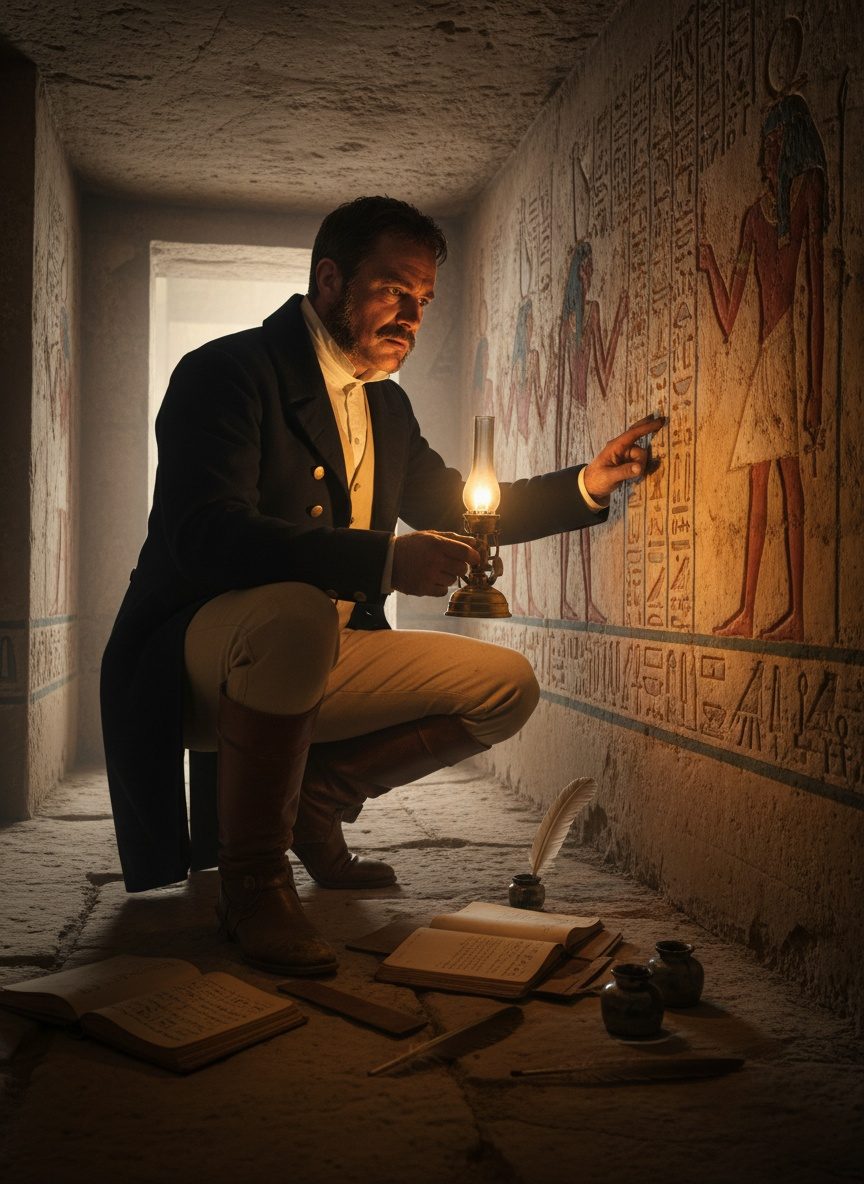
The light of a dim oil lamp flickered against ancient stone, revealing traces of color that had withstood the sands of time. In 1821, atop the cliffs of Thebes, Henry Salt found himself in a world that had lain untouched for millennia. The walls around him, painted with intricate depictions of gods and pharaohs in hues of blue, red, and gold, seemed to breathe stories of an empire long vanished. With an unwavering determination, Salt traced the lines of history with his eyes, knowing he would share these wonders with Britain and forever change the world's understanding of ancient Egypt. But why did a British consul care so deeply about this buried past? And how did his clandestine mission reshape history as we know it?
The Enigmatic Consul
Henry Salt was no ordinary diplomat. Born in 1780 in the small English town of Lichfield, Salt initially dabbled in art before turning to diplomacy. By 1816, he was appointed as British Consul-General in Egypt. Despite tumultuous political landscapes and the strife of the Napoleonic Wars, Salt’s fascination with the secrets of the Nile never waned. His tenure in Egypt seemed serendipitous, providing him with unprecedented access to treasures that captured the imaginations of armchair archaeologists across Europe.
Unlike many of his contemporaries, Salt's excursions into the realms of the dead were driven not by the allure of gold or priceless artifacts, but by a deep-seated passion for cultural preservation. In a time when tomb raiders scavenged for sellable relics, Salt's intent was almost revolutionary—a testament to his vision of using diplomacy to bridge past and future.
The Discovery Deep in Thebes
Thebes, known today as Luxor, was a cornerstone of ancient Egyptian civilization. Its sprawling necropoli—Valley of the Kings and Valley of the Queens—held secrets many foreign adventurers only dreamed of unearthing. Yet, in October of 1821, Salt was allowed a rare glimpse beneath the surface. Aided by local laborers and an inherent knack for negotiation, he gained entry to a tomb sealed since the days of the pharaohs.
Within those cool, shadowed chambers, echoing with the whispered past, Salt beheld a vision from the earth's earliest dynasties. Despite the low light and heavy air, the intricate visual saga told on those walls sparked his imagination—a gallery of divine art and priestly script. Here, Salt made a critical choice: instead of pursuing physical relics for transport, he meticulously copied every fresco and hieroglyph. His collection of these images would become a foundational asset in the study of Egyptology, unveiling narratives no living eyes had seen for centuries.
Bringing the Nile Home
With his prized sketches in hand, Salt returned to the bustling heart of Victorian Britain. Unlike today, reproductions and copies were the primary means of academic exchange. These vivid illustrations were a boon for European scholars and laymen alike, curious about the mythic past of the enigmatic East. By the 1820s, "Egyptomania" was gripping the West, fueled by Salt’s revelations.
The public's appetite for all things Egyptian was insatiable, spanning from fashion to architecture, its influence littered across British society. Scale models of obelisks adorned gardens, and Egyptian motifs swept through design trends. Salt's illustrations played a pivotal role in this fascination, offering a tangible, educative glimpse into an ancient world. For a keen-eyed inspector in the museum's echoing halls, each line and curve told a story of kingly valor, sacred rites, and the divine interplay of life and death.
The Controversial Mission
Despite his good intentions, Salt's work did not go without criticism. To some, his actions were deemed another form of colonial exploitation—a case of foreign powers intruding upon, and profiting from, Egypt's heritage. Yet in hindsight, his mission also signified a key moment of cultural preservation. Straddling the line between explorer and academic, Salt left a legacy that saw the relics of Egypt honored as treasures of human history, not plunder for private collections.
In later years, pioneers like Jean-François Champollion, who famously cracked the Rosetta Stone, would build on the foundations laid by Salt. His meticulous documentation paved the way for academic inquiries that might otherwise have remained ensnared beneath the drifting sands of time and neglect.
Why Henry Salt Matters Today
In the grand tapestry of history, Henry Salt was a weaver of stories untold. His respectful approach to archaeology and tenacious dedication to preserving Egypt's monumental legacies remind us of the importance of cultural stewardship. In a modern world grappling with its own issues of heritage and conservation, Salt's chronicles highlight the delicate balance between exploration and exploitation.
Today, as archaeologists continue to unearth Egypt's mysteries with ever-advancing technology, they echo the careful practices and reverence for authenticity that Salt instilled. His indelible mark on the world of Egyptology sheds light on the significance of interpreting and respecting the stories crafted by civilizations long past. Applying these lessons, society can foster a global culture of preservation, cherishing the diversity of our shared human journey.
So, when we glimpse the faceless Sphinx or step into the formidable shadows of the pyramids, let us remember Henry Salt—a diplomat who dared to unveil the mysteries of the ancients, not for war, but for wonder.