
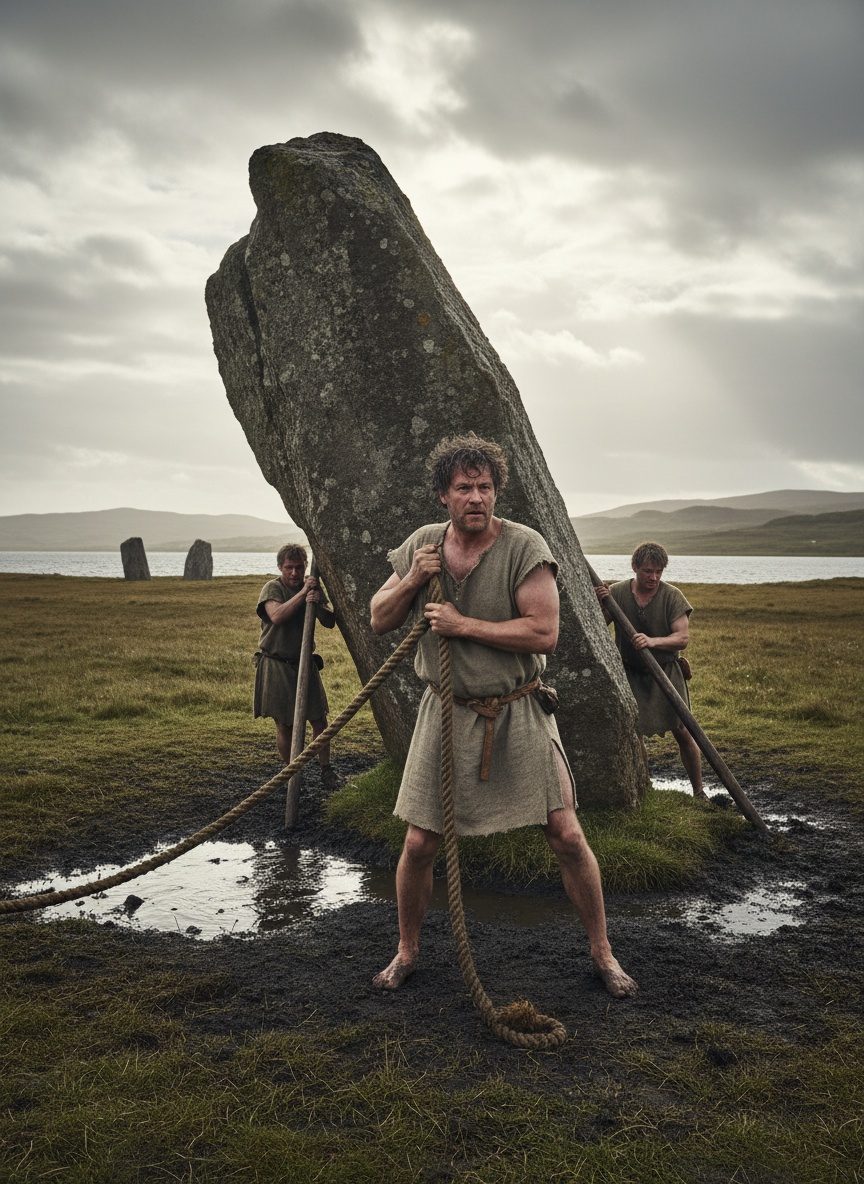
Deep within the swirling mists of Neolithic Britain stands a remarkable testament to human ingenuity and determination. Over 5,800 years ago, a community on the Orkney Islands raised the Stones of Stenness, a mystical circle of towering stones that predates the iconic Stonehenge by five centuries. Despite its ancient majesty, the story of this stone circle remains shrouded in the shadows of history, waiting to be unveiled and appreciated for its ingenuity and dedication. Let us journey back to a time when bone and wood were the only tools, and will alone moved mountains.
The Dawn of Monolithic Ambition
Picture the windswept Orkney landscape around 3800 BCE. The delicate hues of dawn illuminate the horizon as a silent gathering—an entire community—convenes by the shores of Loch Stenness. These Neolithic farmers, clad in simple garments crafted from animal hides, stand shoulder to shoulder, united by a singular purpose.
Without the luxury of metal tools or the wheel, these early engineers harnessed bone, wood, and muscle to sculpt their landscape. One monumental effort took center stage: the erection of the Stones of Stenness. Looking to the heavens, their aspirations were etched in the very fabric of the earth as they heaved enormous slabs of sandstone upright into the biting northern gales. Each stone, an imposing monolith, was a testament to their drive to transcend the ordinary, to connect with the earth, the sky, and the spiritual world.
Mysteries of the Stones
The Stones of Stenness, standing at a staggering height of up to 6 meters (almost 20 feet), originally comprised 12 stones in a broad circular formation, although only four remain today. The site includes an encircling ditch and bank, an altar-like hearth, and a central stone—a configuration steeped in ceremonial significance.
Archaeologists have attempted to decode the enigmas surrounding this ancient circle. Could it have been a celestial observatory, aligning with solstices to mark the turning of seasons? Or perhaps it was a place of ritual and worship, a stage for rites now lost to time? Some scholars suggest that these stones were signposts in the spiritual landscape, a Neolithic expression of humanity’s timeless quest for meaning.
Interestingly, the Stones of Stenness embody a sophisticated understanding of geometry. The circle’s diameter is precisely uniform, a mysterious mathematical feat achieved thousands of years before the reign of Pythagoras. This suggests a community with advanced knowledge, one that could calculate and execute such a precise plan with rudimentary tools.
The People Behind the Stones
Who were the intrepid builders of this ancient circle? The Orkney people of this era were skilled farmers and stone workers, weaving their existence from the land's raw materials. They cultivated barley and wheat, tended cattle and sheep, and lived in communal harmony within sturdy stone dwellings—a lifestyle fundamentally connected to both nature and community.
The creation of the Stones of Stenness was undoubtedly a collective effort, requiring not only muscle but also intricate planning and collaboration. By pooling their collective knowledge and labor, the Orkney farmers executed an engineering marvel that would stand for millennia. These stones reveal the enduring human drive to leave a legacy—to create a narrative carved not in words, but in stone.
Guardians of Time
Despite millennia of weathering by Scotland’s harsh climate, the Stones of Stenness stand as custodians of time itself. Legend weaves a mysterious tapestry around these stones—stories of hauntings, curses, and ancient spells that jar the modern senses. Yet, these tales underscore the stones' ongoing cultural resonance, their ability to inspire generations with wonder and reverence.
Through the ages, the circle was both revered and reviled. For centuries, it was revered as part of the sacred Orkney landscape. Yet, as religious tides changed, these stones were seen as pagan aberrations by some. In the 19th century, a misguided local sought to demolish them, dismantling several stones before being stopped—a near loss highlighting how precarious our link to the ancient past can be.
Rekindling Connections to an Ancient Legacy
In a world racing towards the future, the Stone Circle of Stenness stands as an anchor, rooting us in a shared history of human creativity and perseverance. Perhaps its greatest legacy is its power to remind us that innovation and wonder are woven into the very fabric of human existence. These stones whisper stories of a time when humanity's physical world and spiritual realm intertwined—a phenomenon we continue to grapple with today.
As modern society strives to tame the natural world and advance through technology, the Stones of Stenness offer a poignant reminder of the artistry and scientific acumen of those who came before us. These stones mark the dawn of architectural ambition, echoing the ancient Orkney spirit that ventured beyond what was possible and embedded meaning into the very earth.
Though the site may not yet share the renown of Stonehenge, with each discovered story, the Stones of Stenness inspire curiosity and wonder. They urge us to look beyond the obvious, to unearth the stories hidden in the earth beneath our feet, and to cherish the legacies that have shaped humanity. For these stones are more than guardians of the past—they are harbingers of adventure, beckoning us to discover the stories they hold within.