In the simmering heat of the Egyptian desert, where time itself seemed etched into every stone, an unlikely hero emerged from the mists of the nineteenth century. In 1826, an unassuming Scotsman named Robert Hay arrived on the sunbaked banks of the Nile, armed with no more than paper, ink, and an insatiable curiosity. Unknown to those around him, this lone artist was about to embark on a mission that would preserve some of Egypt’s most cherished hieroglyphs and temple engravings — many of which were already falling prey to the relentless advance of time and treasure hunters. Hay’s journey of documentation was a profound act of preservation that left a legacy we still treasure today.
The Arrival of Pioneer: Robert Hay's First Steps into Egypt
Robert Hay, born in Edinburgh in 1799, was a man of diverse interests and remarkable insight. By the tender age of 27, he had already journeyed to Malta as an aspiring artist and officer in the East Norfolk Militia. Yet, it was the enigmatic allure of Egypt that captured his imagination and led him to the storied land of pharaohs. In 1826, Hay stepped into a world where the sands whispered secrets of dynasties long past, trying to hold onto their tales against the ravages of time.
Initially, Hay was drawn to Egypt by a desire to sketch its enchanting vistas and colossal ruins. However, witnessing firsthand the extent of plundering and destruction led him to refocus his mission. The lure of ancient stones became a calling, urging him to produce a collection of images that went beyond the aesthetic — instead capturing an archaeological truth that would soon be lost to time and misguided treasure hunters.
Pencils Against Dynamite: The Battle for Preservation
During Hay's sojourn, from 1826 to 1838, Egypt was a playground for European seekers of antiquity. Enthusiasts of Egyptian culture such as Giovanni Battista Belzoni and Henry Salt were voraciously extracting artifacts for museums and private collections. Many temples faced disintegration at the hands of dynamite as project developers pried away ancient stones, while local souvenir hunters chipped away intricate carvings to sell to the highest bidder.
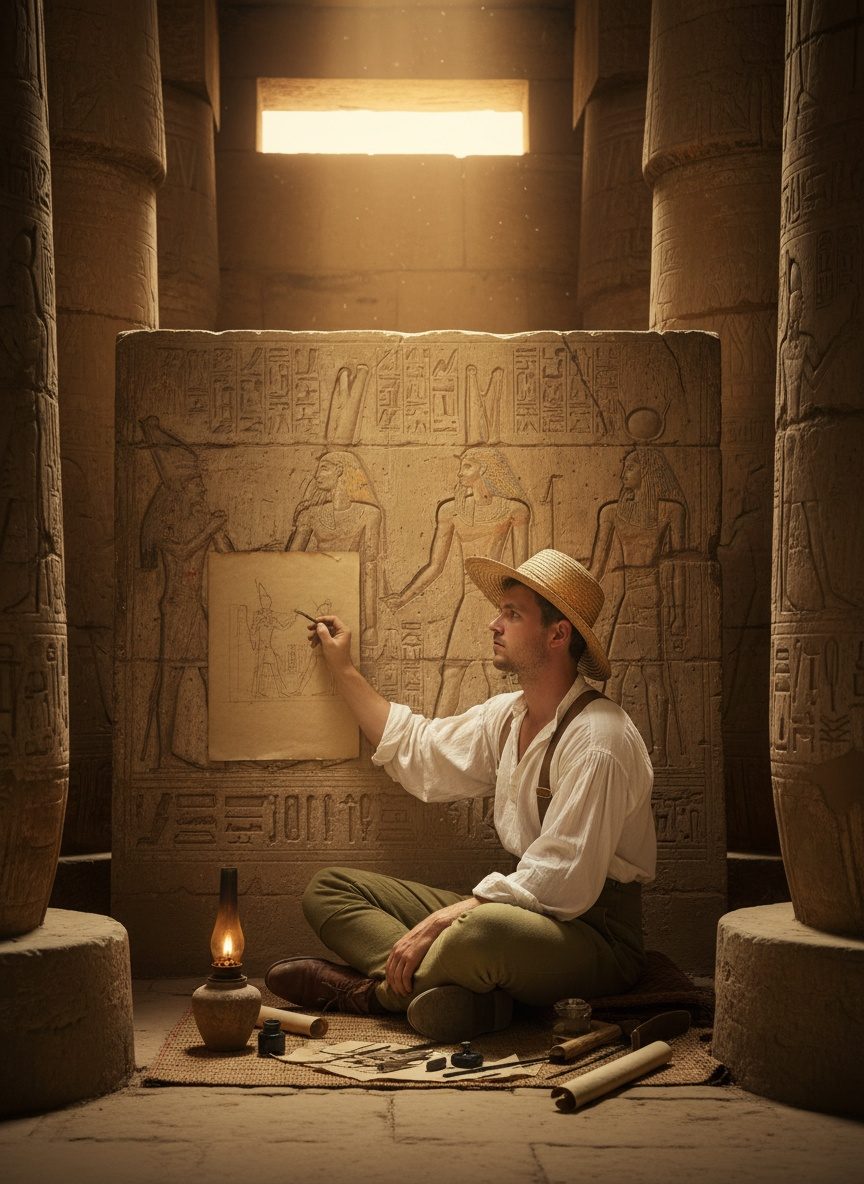
Robert Hay, with his artist’s perspective and scholar’s dedication, recognized the impending loss of these cultural artifacts. Stationing himself in places like Thebes, Karnak, and Abu Simbel, he meticulously sketched and recorded inscriptions, details, and hieroglyphs using methods such as hand-drawn diagrams and watercolors. Often enduring harsh conditions, Hay's tireless work offered a rare, detailed snapshot of ancient Egyptian art as it existed in situ over 180 years ago.
The Team of ‘The Great Expedition’
Determined to cover a broad scope, Hay built a small but dedicated team, including fellow Scotsman Joseph Bonomi, architect S.B. Gliddon, and the talented draughtsman John Gardner Wilkinson, who would rise to fame as a prominent Egyptologist. Together, they formed a vibrant and productive group, referring to their mission as “The Great Expedition” — determined in spirit to defy the sweeping tide of destruction.
Their goal was not merely to replicate what had been done — they aimed for thoroughness. Over the course of eleven years, Hay produced an astonishing number of artworks and notes, many of which continue to provide valuable insights into the construction and iconography of ancient Egypt. His work was not solely an endeavor of preservation but a bridge that connected past to present, providing resources that would be vital for future archaeological study.
Surprising Discoveries and Lasting Legacies
One of the most striking achievements of Hay's expedition was his documentation of Karnak’s Hypostyle Hall, the massive columns of which were inked with stories of ancient rulers. Robert Hay's attention to detail was such that even the smallest of inscriptions was captured with absolute precision. Moreover, he recorded areas like Medinet Habu, the Valley of the Kings, and the great platforms of Luxor, which held stories that were then buried under sand-laden deserts.
Though many of Hay’s sketches remained unpublished during his lifetime, they later became instrumental to renowned Egyptologists. His work was preserved in an extraordinary set of volumes housed today at the British Library and the Griffith Institute. In these archives, generations of scholars have accessed Hay's drawings, marveling at the rich documentation of Egyptian history that might have otherwise been lost forever.
The Timeless Importance of Robert Hay’s Work
What started as an artistic journey transformed into one of archaeological urgency, and with it, Robert Hay pioneered an unexpected legacy. His documentation illuminated not only the grandeur of the past but underscored the moral impetus for preservation amid relentless cultural appropriation. Hay’s efforts resonate in contemporary discussions about the protection of heritage sites threatened by both human activity and natural decay.
In a world where the past is at constant risk of being erased, Robert Hay's story broadcasts a timeless reminder: that each stone, each inscription, however small, holds invaluable narratives of humanity's grand tapestry. As stewards of history, we have an obligation to safeguard these relics. In doing so, we honor not just the memory of ancient civilizations but the dedication of pioneers like Hay, whose art and resolve saved Egypt's ancient stones for generations to come.