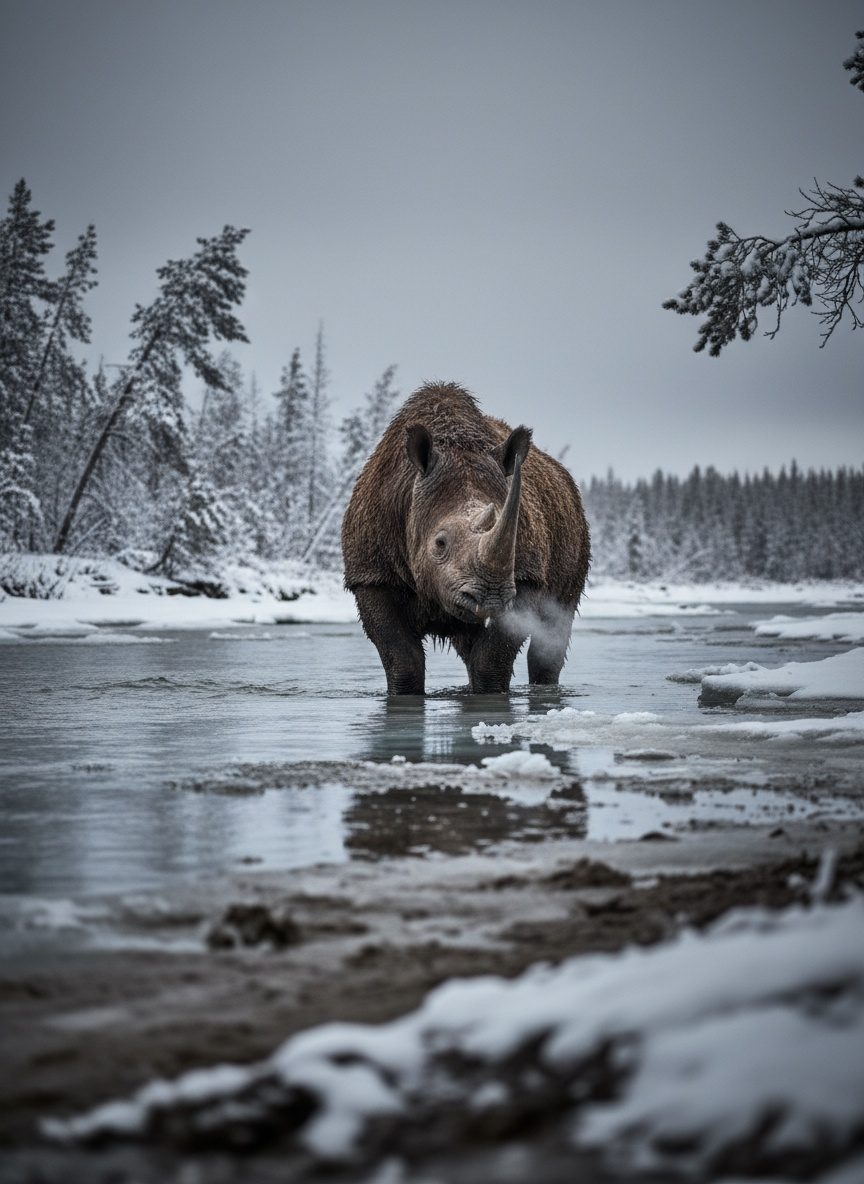
The young woolly rhinoceros died 35,000 years ago. But its discovery was a revelation about a world long gone.
This remarkable tale begins in the harsh, frozen expanses of northeastern Siberia, where the modern world meets the eons-old secrets buried beneath its seemingly eternal ice. It was here, amidst the biting winds and boundless white, that climate change revealed something extraordinary—a juvenile woolly rhinoceros, almost entirely preserved, slumbering in the permafrost like a time capsule from the Pleistocene Epoch. This specimen—a creature that roamed the Earth when our species learned to survive in a world shared with Neanderthals—had been locked in the ice for millennia, offering a rare, tangible connection to an era almost inconceivably distant from our own.
Found with its fur, skin, horn, and even soft tissues astonishingly intact, the rhino's resurrection from its icy tomb has provided scientists and historians with an unprecedented glimpse into the past. Just imagine it: the permafrost's steady relent over tens of thousands of years, the secrets and stories frozen within, finally being drawn back to the surface as the planet warms. Yet, it also begs the question—what event led to this young creature’s entombment so long ago?
In a time before agriculture, before pyramids rose in Egypt or oxcarts rumbled through Mesopotamia, the woolly rhinoceros thrived across the hauntingly desolate tundra landscapes of ancient Siberia. The juvenile, like others of its kind, would have roamed the open steppe, grazing among the mammoth herds and nomadic groups of early humans and their now-extinct cousins. These animals were perfectly adapted to the frigid conditions; their dense coats and stocky bodies shielded them from the icy winds that swept through the region, making them as much a part of their environment as the mountains or the frozen rivers that defined the landscape.
Despite its natural resilience, the juvenile's encounter with fate proved inescapable. Perhaps it waded into a river swollen with meltwater, or veered too far across a patch of thin ice. Perhaps a sudden storm descended, shrouding sky and land in a blinding white. Whatever the circumstances, it found itself engulfed by the frosty embrace of the tundra. The body vanished into the permafrost’s eternal grip, where temperatures remained cold enough across epochs to preserve the precious details that would emerge thousands of years later.
The reappearance of the woolly rhinoceros in contemporary times offers compelling evidence of just how quickly our world is changing. The thawing permafrost that released it is a stark reminder of these shifts—a reminder embedded in the very land that witnessed the story. With soil once frozen solid now melting, the walls separating bygone eras from our present-day realities are literally dissolving beneath our feet, transforming the tundra into a vast archive suddenly flung open for examination.
Yet, few could have predicted the level of preservation obtained. Often consulted by the stewards of ancient knowledge, the perfect preservation of woolly animal specimens—even the strands of hair on their mammoth-like frames—is far more than an unearthing of bones and sinew; it serves as a direct glimpse into the bodily existence of these long-lost creatures. Every preserved fiber becomes a witness, every strand a storyteller speaking silently of untouched wildernesses to scientists who thirst for insight into a lifeway previously kept hidden by time.
What the juvenile rhino cannot tell us through ancient DNA, it shares through context. Evidence of its life adds shades to our imaginations, enabling the reconstruction of ecosystems and perhaps even interactions that may parallel our species' initial steps into the agricultural age. Exploring the food chains and habitats they inhabited further crystallizes the picture—a primeval dance not far removed from contemporary contests of survival and adaptation. In piecing together these narratives, we may well discern lessons and insights applicable to our own increasingly precarious existence, as we become acutely aware of our impact on the planet we call home.
These creatures of the Pleistocene were not isolated phenomena; they were part of a dynamic global tapestry permanently transformed by an ice age that creeps further into present-day discourse. From the evidence frozen alongside the young rhinoceros, we gradually see the broader world emerging—a realm shared by hunting bands and the last of their Neanderthal counterparts, a world poised on the precipice of monumental change.
As we consider the juvenile woolly rhinoceros, we are reminded of the natural fragility that ties all Life’s ages together. From the distant past, this silent testimony surfaces as our shared world serpentines into an uncertain future. The clockwork nature of Earth’s cyclical play, the rise, and fall of great ice sheets and temperate valleys, echo with every chisel of thawing earth.
The story of the young woolly rhinoceros is more than a tale of an ancient animal unearthed. It is a haunting reminder of enduring Nature’s temperament—a montage of survival and vulnerability etched deep within an ancient, yet ever-altering planet. As the permafrost releases its secrets, we are tasked with deciphering the messages of a shared history—a history ripe with lessons, cautionary tales, and unimaginable wonders across the frozen silence of time now whispering loudly in our ears.