The January wind gnawed at exposed skin, its bitter cold slicing through the layers of tattered uniforms worn by the prisoners at Stalag IX-A. The sky above was vast and grey, a blanket of gloom that settled over the barren German landscape, where snow had long since turned to mud beneath the footsteps of marching boots. Even the air seemed muted, absorbing the sharp clang of metal gates, the distant barks of guard dogs, and the shuffle of weary men. Yet, in the midst of this desolation, a quiet act of defiance was about to unfold, one that would ripple through history with the subtle strength of a whispered prayer.
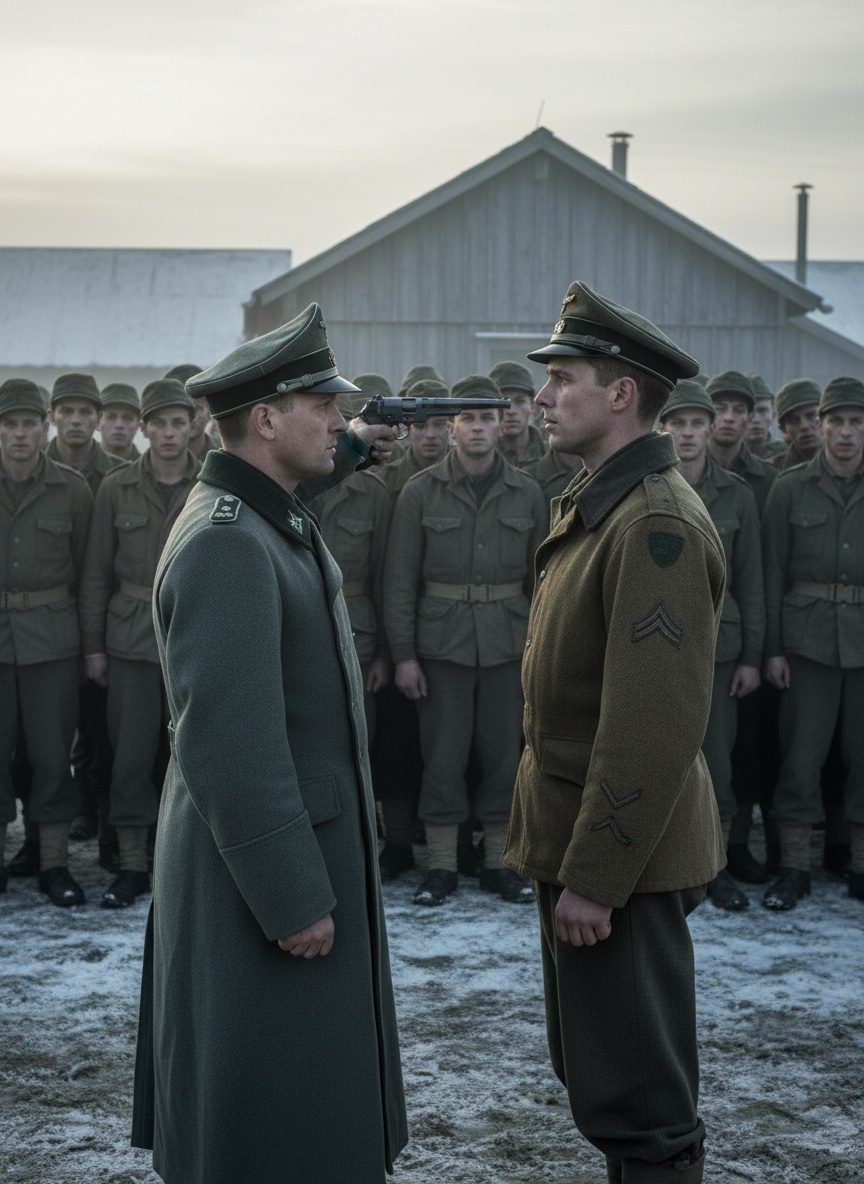
As the day broke on January 27, 1945, the prisoners of war—1,292 American soldiers—stood assembled in the open field of the camp. Their breath came out in spectral clouds, punctuating the cold with each exhale as they faced what had become an all too familiar routine. But this time, the stakes were higher. The Nazi commandant, a man as cold as the Luger pistol strapped to his waist, paced before them with a directive that could seal their fate. He demanded that the Jewish soldiers step forward, separating themselves from their comrades, an order that promised a path to certain doom.
In the ranks stood Master Sergeant Roddie Edmonds, a man of unyielding resolve and quiet leadership. At that moment, under the watchful eyes of the enemy and amidst the suppressed murmurs of the men who looked up to him, he made a decision that would test the very limits of courage. Edmonds, who held the highest non-commissioned rank among the prisoners, faced a choice that was binary in its simplicity but profound in consequence.
With a firm and steady voice, Edmonds issued a counter-order, directing every American prisoner to step forward. His call echoed across the yard, defying the chill, defying fear. And slowly, deliberately, each man obeyed, rising to the silent challenge set before them. It was an act of solidarity that transcended individual survival, a collective stand in the face of tyrannical division. All 1,292 soldiers stood as one—United States soldiers, refusing to betray their brothers, refusing to yield to hatred.
The commandant halted, his gaze sweeping the assembled ranks as disbelief flitted across his features. His eyes narrowed with fury, and in a swift, practiced motion, he drew his Luger. The gun's sleek, chilling barrel found its target, resting against the forehead of Edmonds, who stood unmoved, his steadiness unswayed by the weapon that threatened his life. Silence descended as if the air itself had been sucked into the void, leaving only the stark scene to play out. Edmonds, eyes steady, heart resolute, spoke into the stillness.
"We are all Jews here," he stated, his words clear and unwavering in their defiance. The truth of his declaration hung suspended, a bold proclamation that defied the venom of discrimination, standing on the principle that transcended the moments of survival—the principle of shared humanity.
The commandant, his authority questioned, applied pressure on the trigger, digging the cold metal of the Luger into Edmonds' skin. Yet, it was in this moment of utmost tension, where the weight of life and death balanced upon a hair's breadth, that Edmonds channeled the power of international law. Calmly, he reminded the commandant of the Geneva Conventions, the rules of warfare that bound even this place of suffering to certain standards. He warned that the commandant would face the ire of history, a reckoning in war crimes trials that would surely follow Germany's defeat.
For a moment, the world teetered on a precipice. Time itself seemed to pause as the commander considered his options. But then, something imperceptible shifted—a recognition that the eyes of the world, of justice, perhaps even of conscience, were watching. The tension dissolved as the commandant slowly lowered his weapon, the decision made not in words but in a reluctant concession to a moral authority he could not wield.
The pistol returned to the holster. The collective breath released. In the space of that moment, the prisoners of Stalag IX-A had reclaimed their dignity, their sense of unity affirming a profound truth: that the bonds of brotherhood, once forged in the fires of hardship, could withstand the harshest grips of oppression.
This story, often lost amidst the grand narratives of World War II, reminds us of the courage found in small acts of resistance, the power of standing united against inhumanity. It speaks not only of Edmonds' bravery but of a shared commitment to principles greater than oneself. In a stark yard on that January day, amid the chill of war's winter, the human spirit found warmth in unity.
Edmonds and his men were liberated months later, but what endured was more than just their survival. It was their shared assertion that when faced with the darkest face of evil, the light of courage and unity prevails. Their stand was a resistor’s triumph, a testament that echoes through time—it is the story not taught in schools, but one we carry nevertheless, each step forward emboldening the next generation to stand undivided in the face of hate.