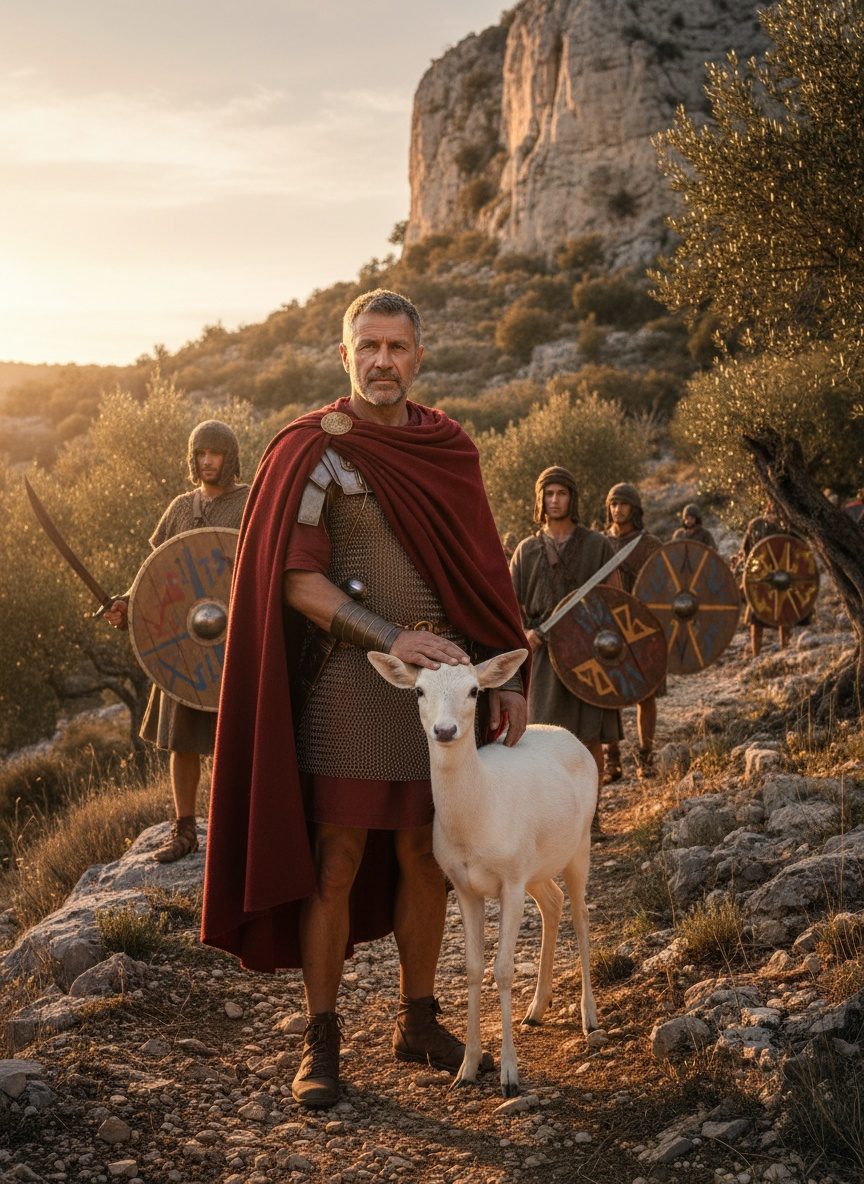
80 BC. A gentle wind stirred the Iberian forest, rustling the leaves in a soft, whispering chorus. Beneath the towering trees, a crowd of rugged warriors and settlers watched with wonder. At the center stood Quintus Sertorius, a Roman general turned rebel, holding a creature both pristine and powerful—a white deer. Its alabaster coat shimmered against the dappled sunlight, and its presence was nothing short of miraculous to those gathered.
The deer was no ordinary beast. To the Iberian tribesmen, it was the living embodiment of divine will, a creature believed to carry messages from the goddess Diana. And Quintus Sertorius knew precisely how to leverage this belief. With the deer by his side, Sertorius wove a tapestry of faith and foresight out of the natural awe it inspired, transforming it into a strategic asset more astonishing than any might known to Roman legions.
In those days, Sertorius found himself as a man without a country, rebelling against the very Republic that had once celebrated his military genius. The Roman state was entrenched in its ways, powerful and expansive, but often blind to the values and cultures of the lands it sought to conquer. Sertorius stood apart with his vision, seeing in the diverse warrior groups of Iberia not just subjugates, but potential partners against the monolithic might of Rome.
Sertorius was not a man to underestimate his foes. The Iberian tribes were known for their fierce independence and unrivaled knowledge of their land. He recognized their potential as not merely mercenaries, but allies whose skills and loyalty could counterbalance Rome’s iron clutches. In unity, Sertorius saw hope, and so he courted the Iberian leaders with a brand of leadership unfamiliar to Rome—a partnership grounded in mutual respect and trust. Attracting their allegiance required more than military prowess; it required a belief in something greater than both Rome and the scattered tribes.
Thus, the white deer was more than a symbol. It was a shrewd piece of political theater. Sertorius claimed that the deer whispered divine revelations into his ear, foretelling victories and reassuring his men that their cause was divinely sanctioned. The brilliant strategist he was, Sertorius harnessed the power of myth and faith. He understood that belief could not be wielded with force but rather cultivated with care. It bound his soldiers as no chain could and gave each battle they fought a sense of cosmic inevitability.
The Roman Senate, back in Rome, was not distant enough to ignore the unusual nature of Sertorius’s uprising. Reports filtered back to the capital about the general who had not only managed to hold his ground in the rugged Iberian landscape but had done so by winning the hearts and minds of Rome’s former adversaries. They heard of the white deer, though such tales seemed absurd to the pragmatic senators. What could a creature, so entwined with legend, do against the disciplined legions of Rome?
Yet, fear crept into their deliberations. Rome was a Republic tenuously balanced upon its military conquests and the loyalty of its far-flung territories. Sertorius's success threatened foundational assumptions about power and control. He didn’t conquer with the might of a god but guided with the light of belief—a far more subversive and enduring force. His collaboration with the Iberians challenged the Roman method of domination, where might was supreme and local cultures subsumed.
Each victory Sertorius scored struck deeper into the heart of Roman pride. It was not mere defiance but a demonstration that Roman imperial domination was not infallible. In the hills and valleys of Iberia, Sertorius built a new society from the roots up—bureaucracy and governance with Iberian influences intertwined with Roman structures. Sertorius’s de facto state functioned with a formidable semblance of autonomy as they struck fear into the invading forces, making the land an impenetrable fortress of mutual respect and allegiance.
The struggle raged on, a tale as relentless and rocky as the mountains in which it was fought. The deer stood by Sertorius through tribulations and triumphs, becoming part of his very identity, an emblem of this extraordinary rebellion. Rome, unwilling to let a renegade general set such a precedent or undermine the power of the Republic, intensified their efforts to quell Sertorius's rebellion. They sent legion upon legion, commanders battled for glory, but none could squash the spirit that imbued the Iberian resistance.
In the end, it was a betrayal from within that sealed Sertorius’s fate, a conspiracy borne of envy and ambition rather than Roman might. His death spoke volumes about the fragile nature of human alliances, yet it did nothing to erase what he had accomplished. Sertorius left behind a legacy of what could have been—a bridge between cultures at odds, a philosophy of partnership over oppression, and the tale of a white deer that echoed long after his demise.
Why does this story matter today? It offers lessons on leadership and unity in the face of overwhelming adversity. Sertorius crafted a vision that transcended mere rebellion against a monolithic power. Instead, he demonstrated how trust and shared belief could forge bonds stronger than chains of oppression. In the curious tale of Quintus Sertorius and his white deer, we uncover a narrative of unity that aimed to bridge vast divides, showing a path where strength lies in understanding, not merely dominance. It’s a story that whispers across time, reminding us that even in the heart of conflict, there are avenues toward a more inclusive future if only one dares to seek them.