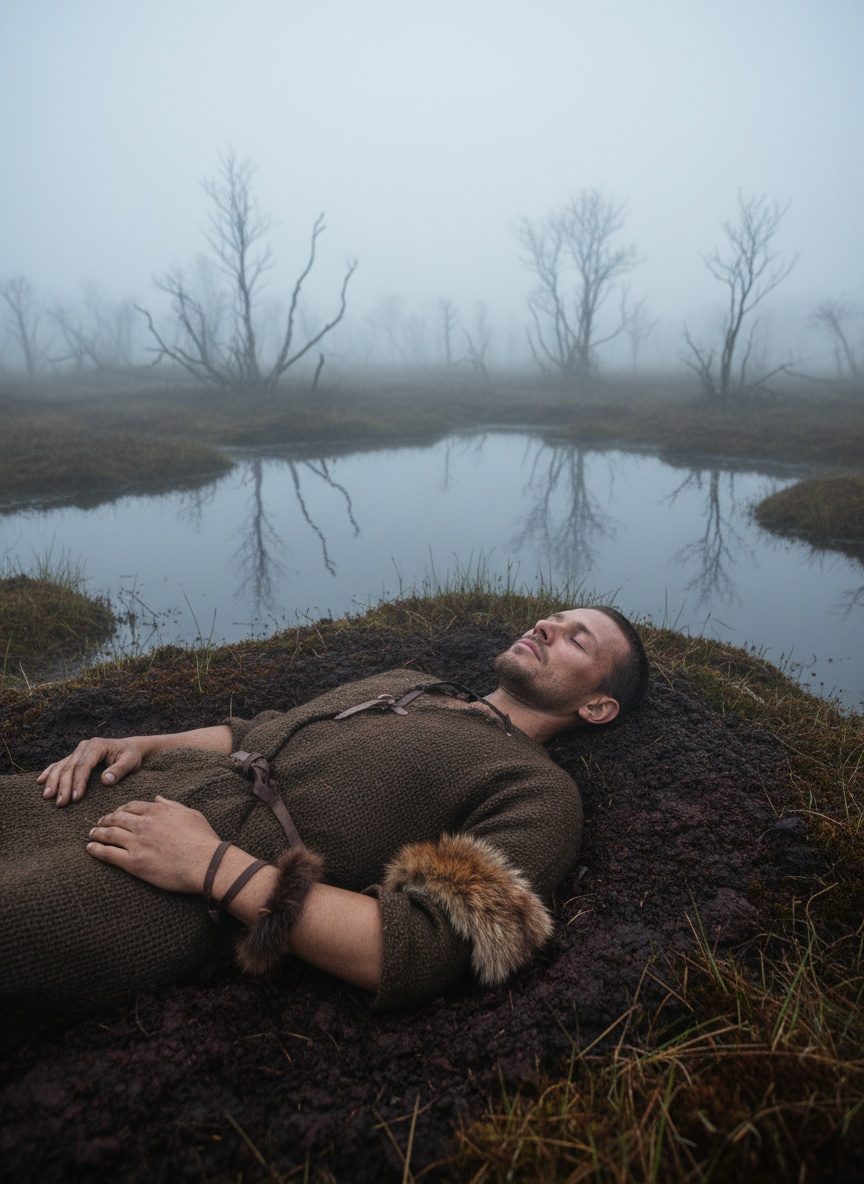
He was nearly two thousand years old and had eaten his last meal. Yet, he had never seen sunlight after being laid to rest in the depths of a peat bog. What lay below the surface of Lindow Moss in Cheshire stunned Britain in 1984, offering a chilling glimpse into the shadowy practices of Iron Age civilization.
A Surreal Discovery
In the summer of 1984, a peat cutter working in Lindow Moss felt his machinery jolt and stop. As the workers dug around to locate the problem, they stumbled upon a human leg, and further excavation revealed a remarkably preserved body. It was not the first time a peat bog had given up its secrets, but this discovery was different. It soon became clear that this was not just a grave; it was something else entirely.
The body had lain in the acidic, oxygen-poor environment for approximately two thousand years. Immersed in the dark, dense bog, the man's features were eerily intact, his hair auburn, his skin preserved, and his final meal still detectable in his stomach. The circumstances of his preservation turned him into a largely forgotten postcard from the past — a time capsule from Iron Age Britain. But it was how he died that transformed him into a mystery that has captured imaginations for decades.
The Triple Death Ritual
The Lindow Man, as he came to be known, was not a casualty of nature or fate. His death bore the hallmarks of deliberate ritualistic intent. A closer examination of the remains revealed that he had sustained a head wound, was garroted with a sinewy cord until his trachea splintered, and finally, he was drowned in the bog's murky waters. Such a confluence of lethal blows suggested something more ceremonial than sinister.
This type of execution has been hypothesized as a "triple death" ritual, a practice thought by some archaeologists to involve a combination of three different fatal acts. Some suggest that these acts were symbolic, possibly made in reverence to deities associated with earth, water, and sky — a macabre harmony meant to secure favor from the celestial and earthly realms. Yet, while this hypothesis paints a vivid picture, scholars can only speculate about the precise beliefs and motivations that led to such a death.
Unmasking the Unknown
Who was the Lindow Man? Why had he met this elaborate and final fate? These questions add layers to the enigma. The truth is, little is known about him. Estimates place his age in the twenties, and examinations have revealed a reasonably good state of health earlier in life. His nails, manicured, led some to suggest he may have held a societal position that excused him from labor-intensive duties. Was he a revered figure, a chieftain, or perhaps a Druid sacrificed for the greater good?
Even his last meal, consisting of grilled grain and seeds, holds fragments that both whisper and withhold secrets of his last day. What has been learned suggests he lived in a structured, agricultural community with a deep spiritual core. Yet, he remains frustratingly silent on the specifics of his identity and role within that society. The bog granted him preservation but not the voice to tell his own story.
The Tale We Can Tell
Iron Age bog bodies like the Lindow Man serve as rare windows into ancient European past. They offer material culture where writing or records have not survived, leaving experts to piece together narratives from fragments of information. Bogs have a unique ability to preserve organic matter, providing a stark contrast to the often-looted archaeological sites we more commonly rely upon. However, they fundamentally challenge historians by preserving so much of the physical amidst so little context.
Today, Lindow Moss stands as a rich archaeological resource and a reminder that some human stories will continue to elude the full light of understanding. These forgotten individuals, literally bogged down in secrecy, compel us to question what rituals and beliefs might eventually outlast us only through detached fragments. As historians and scientists probe deeper into the past, the tale of the Lindow Man captures our fascination with what remains unsaid. It quietly dares us to acknowledge the full breadth of human history — a tapestry woven with as many mysteries as truths.