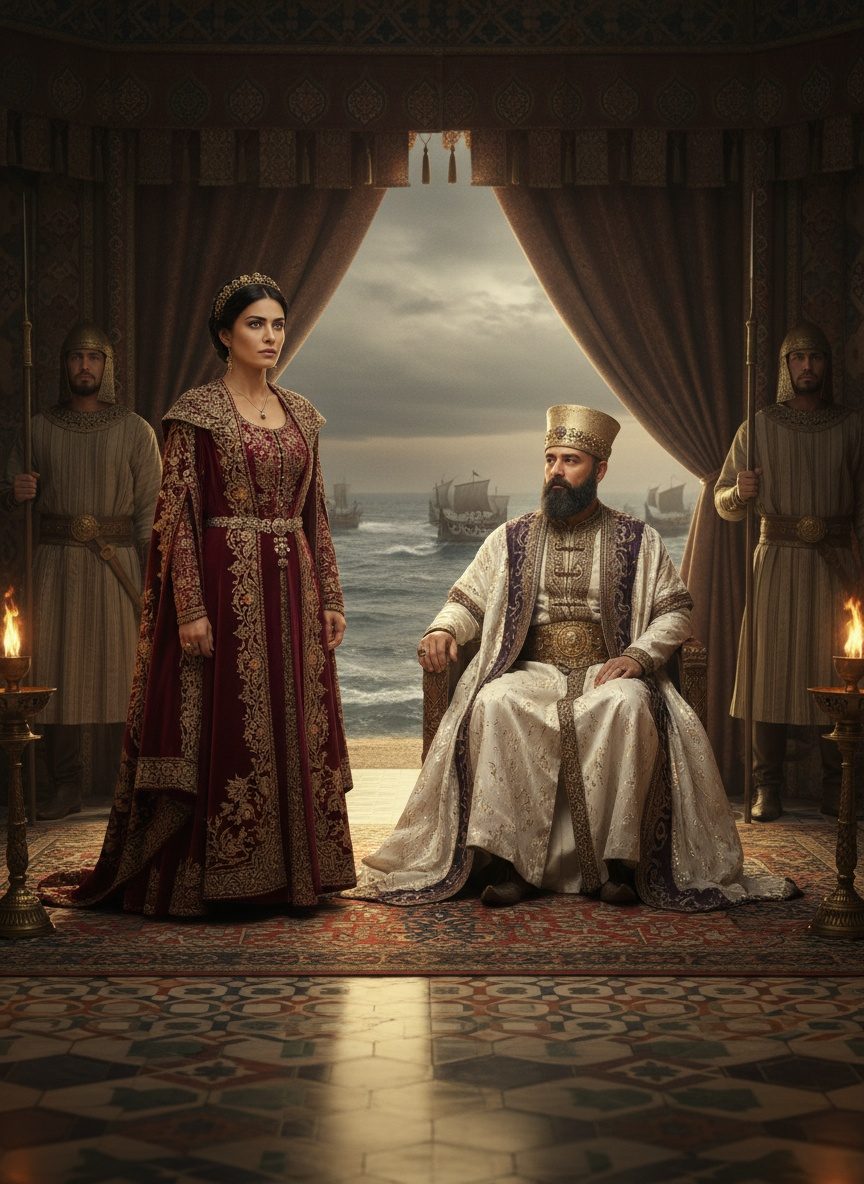
He never left the monastery grounds. Yet he spoke with the world.
The Unassuming Scholar of Jarrow
Close your eyes and envision the early medieval world of 672 AD. Amid the rolling hills of Northumbria, nestled near the coastline, stands a small but significant monastery. This is where a young boy named Bede, with empty hands but an insatiable hunger for knowledge, arrives. Most children of this era are destined for lives defined by the toils of the earth, but Bede's journey takes a remarkably different path. The boy who journeys to the twin monasteries of Wearmouth and Jarrow emerges as one of the brightest lights in a world frequently shrouded in darkness. This is where Bede embarks upon a life of religious dedication and scholarly pursuit—a life that, though physically constrained, achieves boundless intellectual reach.
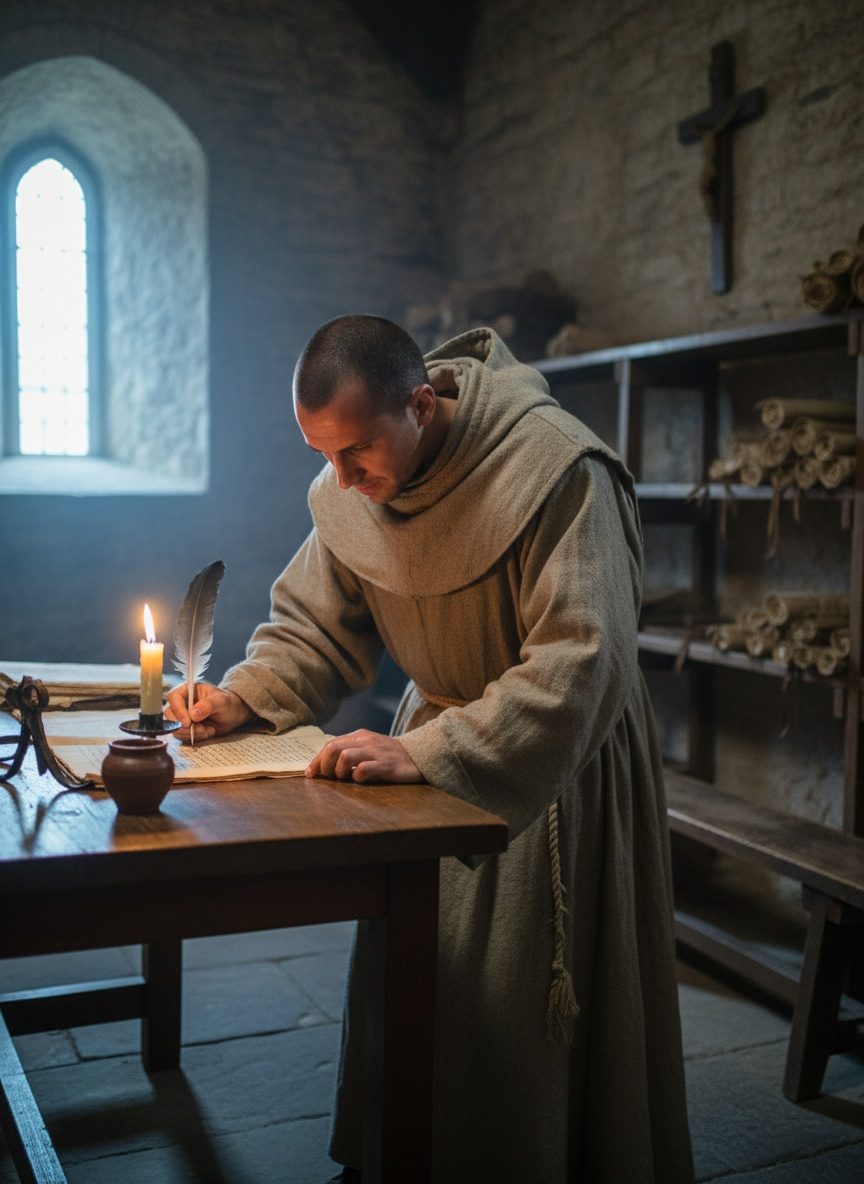
Bede enters the monastery at just seven years old, a child leaving behind a world of pastoral scarcity to embrace the quiet, contemplative life of monastic learning. The interiors of the monastery are cloaked in the warm, flickering glow of candlelight—a humble setting for what would be a groundbreaking journey of scholarship. Here, amidst the routine of prayers and chants, Bede indulges his curiosities. Though his life is seemingly confined within the monastery’s stone walls, Bede's access to knowledge is unparalleled. The monasteries house rich collections of manuscripts, painstakingly copied and preserved, a treasure trove of classical and Christian scholarship accessible only to a selected few. This young monk is fortunate, but more important, he is destined for a monumental impact.
The Creation of a Universal History
Bede’s world may have been bounded by the stone walls of Wearmouth-Jarrow, but the manuscripts on its shelves reveal to him the vast scope of existence—from ancient Roman chronicles to the nascent European civilizations. Inspired by what he reads, Bede's own pen begins to craft new narratives. His magnum opus, the "Ecclesiastical History of the English People," not only chronicles the conversion of England to Christianity but also lays the foundation for the very concept of English history itself. This remarkable work, completed in 731 AD, is one of the first to employ the method of historical narrative that seamlessly integrates ecclesiastical events with social, cultural, and political contexts.
Within this text, Bede introduces innovative methods of dating events, notably the Anno Domini system, which becomes a universal standard for defining the years across diverse cultures. His thoroughness stands out—no simple recounting of events, Bede’s history is a confluence of earlier sources critically examined and interconnected. This meticulous approach ensures that his work endures, translated and transmitted across Europe, illuminating historical methodology for centuries to come. Just as the candlelight enabled Bede to peer into the manuscripts, his historical insight offers a lens through which future generations can view the past.
The Scholar Who Brought Science to Scriptures
While Bede's contributions to history are unparalleled, his intellectual reach extends far beyond a single discipline. A paragon of medieval scholarship, Bede is equally a theologian, a scientist, and a dedicated teacher who wove together these diverse threads into a unique tapestry of knowledge. In his treatises on the calculation of Easter—considered an essential task in his time—Bede exhibits a firm grasp of astronomy and mathematics. His "On the Reckoning of Time" is an intricate mix of calendar science, explaining both the natural phenomena of tides and the measurement of time through solar and lunar cycles.
This text demystifies knowledge that was once arcane, reconciling natural phenomena with theological principles. In mapping the movement of celestial bodies and the reckoning of time, Bede is also asserting that understanding the universe is integral to understanding divine will. His scientific musings do not overshadow his devotion, but instead, illuminate the natural world as an extension of religious truth. Such intellectual adaptability makes Bede revolutionary, a figure whose works defy the categorizations and restrictions of his own age.
The Monk Who Educated Europe
Though Bede never roamed beyond Northumbria, the ripple effect of his scholarship is felt across Europe and beyond. From the classrooms of charlemagne's court to the libraries of distant abbeys, his texts become central to the curriculum of medieval education. Monasteries throughout Europe replicate the model of learning and teaching epitomized by Bede. His works traverse lands and languages, from Anglo-Saxon England to the Byzantine scholars of the east. He provides a bridge—a shared educational foundation that transcends local disputes and linguistic barriers.
In his final days, Bede continues to teach, dictating meditations to his pupils as he lies ill, knowing that his voice will continue to resonate long after it falls silent. His intellectual legacy is profound, a guiding light for the scholastic tradition that follows. In an age where oral transmission often means the loss of history, Bede’s writings preserve knowledge with an unyielding clarity—a rare and precious endeavor. His monastery, once a small hub of learning in Northumbria, becomes the beacon from which a renaissance of insight radiates.
The story of the Venerable Bede is a testament to the sweeping impact of one dedicated life. Bound by geography but unlimited in his thirst for knowledge, he exemplifies how intellectual pursuits can transcend physical confines. Bede's life calls to us as a compelling reflection on the lasting power of scholarship and faith intertwined, illuminating the world in ways that still affect our understanding of time, history, and humanity.