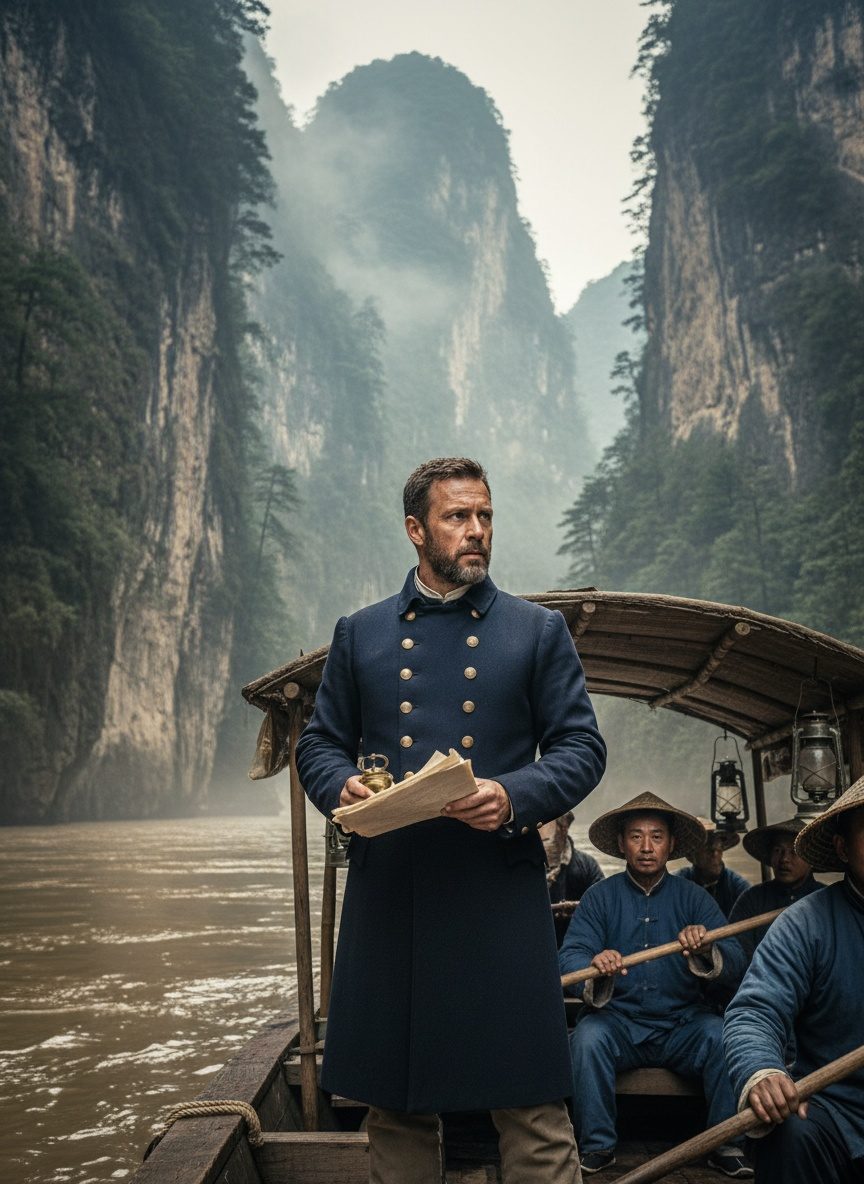
The Yangtze River was an enigma. Lieutenant Thomas Blakiston decided to unravel it alone.
The Dragon's Throat Beckons
In 1868, Lieutenant Thomas Blakiston, a British naval officer of undeniable resolve, embarked on a journey few dared to consider. The Yangtze River, known as Chang Jiang in China, stretched over 6,300 kilometers, winding through mountains and gorges that had long evaded the compass of outsiders. Chinese sailors had named its most treacherous stretch the Dragon's Throat, a fitting moniker for waters so fierce that even local navigators preferred to keep a respectful distance.
Without diplomatic support or the backing of a colonial mission, Blakiston's venture was an audacious gamble. The Qing Dynasty maintained a wary stance towards foreign entities, and the vast expanse of inland China remained largely shielded from Western eyes. Nonetheless, armed with only rudimentary equipment and a handful of companions, Blakiston purchased a traditional Chinese junk boat to navigate the uncharted waters. The sheer scope of his mission was staggering: mapping a river whose depths and dangers were grounded more in myth than in measurable fact.
As Blakiston and his crew pressed forward, they were met with a symphony of natural challenges. Monstrous whirlpools threatened to swallow them whole, and swirling mists often cloaked the rocky passes ahead. The landscape transformed with every bend, revealing sheer cliffs that mirrored the river's restlessness in their imperious heights. Despite the ever-present possibility of a fatal misstep, Blakiston meticulously documented each feature of the river, his keen eye translating the chaos around him into intelligible charts.
Paddle in Hand, Fate in Balance
Blakiston's journey was as much a battle of wills as it was a test of endurance. While the river's physical challenges were monumental, the sociopolitical climate added a layer of complexity that could not be ignored. Westerners were still regarded with suspicion in the interior of China; the Opium Wars had left a bitter legacy and a populace wary of outsiders' intentions. Yet Blakiston managed to forge a path where diplomacy, albeit on a personal scale, proved his most valuable currency.
Engaging with local villagers, Blakiston relied on gestures and the universal language of goodwill to secure the provisions and guidance essential to his mission. It was in these exchanges that Blakiston gleaned insights beyond his maps. He observed the rhythms of river life, the intricate dance of fishermen casting nets, and the echoing chants of trackers as they pulled laden boats upstream with muscle alone. Each interaction provided not only vital information about the river but also an appreciation for the vibrant mosaic that was rural China.
Indeed, the very act of paddling upstream became a metaphor for Blakiston's endeavor. For every meter gained, the river seemed to push back with double force, testing not just his navigational skill but his resolve. Yet, amid the sprays of the water and the cries of local boatmen, the maps began to take form. Slowly, a clearer picture of the Dragon's Throat emerged, one that could be shared with the world beyond.
Maps That Shaped Understanding
After months of relentless exploration, Blakiston returned from the Yangtze, his sketches and notes blooming into the first detailed map of this legendary river. His work was not merely a triumph of cartography; it was a window into a world that had previously eluded the West. For the British Empire and its burgeoning global interests, the maps represented opportunities in trade and diplomacy, illuminating a passageway into the heart of a geographically and strategically vital region.
Blakiston's efforts extended beyond mere discovery; they offered bridges between disparate cultures. By rendering the mystical tangible and the unknown known, he contributed to a shift in how the Western world viewed China — not as an impenetrable labyrinth but as a land of potential. Yet even with this framework, the river remained its own entity, an ever-changing force that defied full comprehension. Blakiston's maps were a starting point, an invitation to further inquiry and exchange.
Today, as we retrace such historic undertakings, the story of Blakiston is a reminder of the individuals who dared to look beyond the horizon, who ventured without certainty into the unfamiliar. In an age defined by rapid global interconnectedness, reflecting on journeys like Blakiston's serves as a testament to the enduring human spirit — to the curiosity that propels us toward understanding and the courage to embrace the unknown.