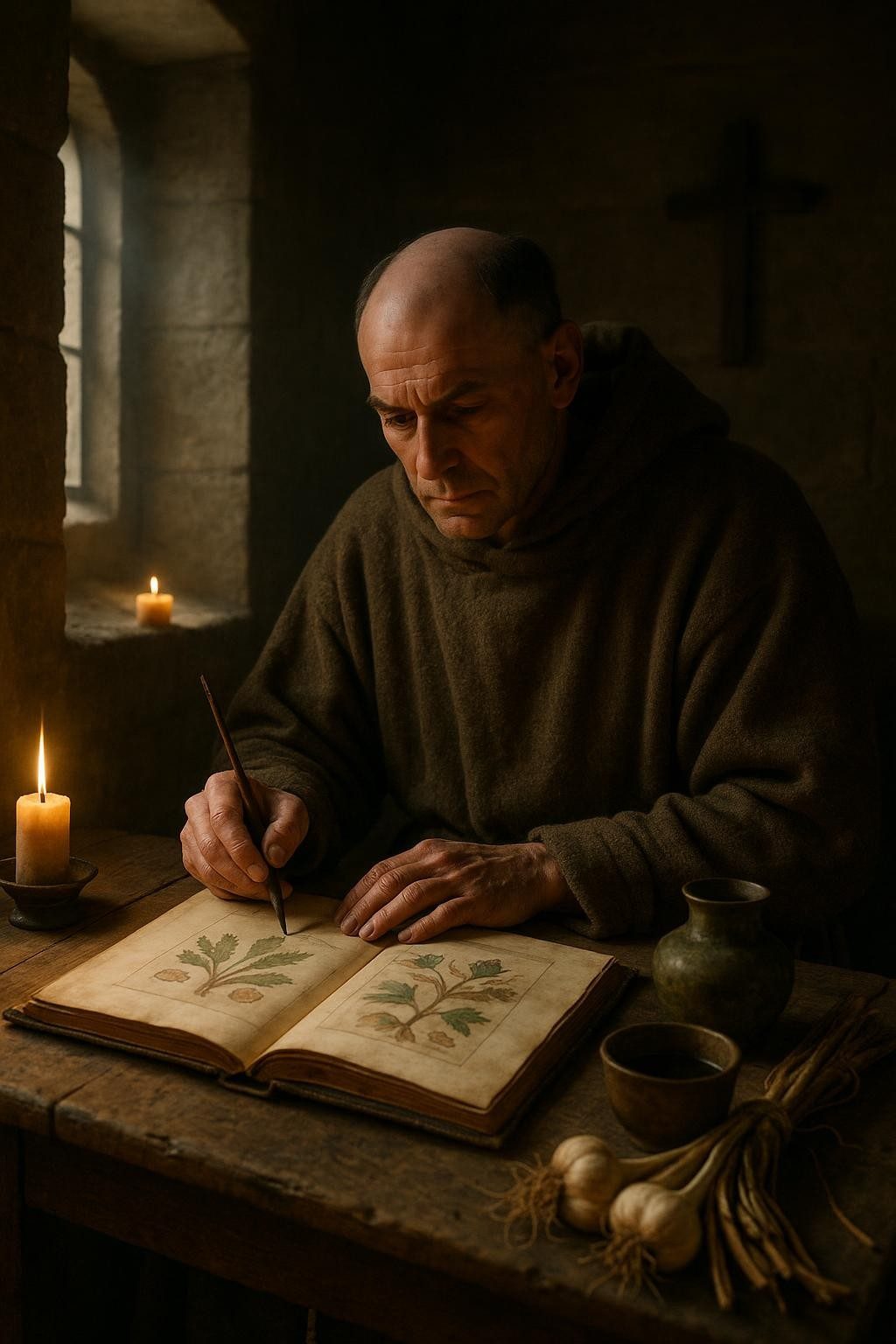
The pungent aroma of garlic mingled with the earthy tang of leeks as the monk carefully crushed them with a pestle and mortar. The ingredients released their potent smells, filling the dimly lit stone chamber with the promise of ancient remedies. In a brass vessel, meticulously chosen, the monk combined the mixture with a precise measure of wine, eying the thin stream of liquid as it merged with the minced bulbs. The final ingredient, a curious dollop of ox bile, glistened under the flickering candlelight, hinting at its mysterious role. As the concoction was set aside to rest for nine days, the monk could hardly have imagined that this simple act of alchemy would resonate through more than a thousand years of history.
Across the English landscape, around the year 950 CE, the wide-eyed boy assisting the monk in the scriptorium of Bald's ancient monastery observed in silence. The boy had seen this ritual repeated numerous times, but today, a thought tugged at his curiosity: Why wine? Why ox bile? In an era when illness could claim lives with little warning, the monk's remedy was a beacon of hope, as enigmatic as the hallowed texts surrounding them.
Leechbooks, as they were called, were compilations of remedies that drew upon the combined knowledge of herbalists and healers from across the known world. The leather-bound volume, its pages a patchwork of ink and parchment, was a testament to the human struggle against unseen foes. The recipe that inspired the boy to question—and centuries later would confound the scientific community—was encoded among these pages, handwritten by an anonymous hand that only wanted to heal.
Fast forward to 2015, when scientists at the University of Nottingham, intrigued by tales of medieval wisdom, dared to recreate the remedy word for word, ingredient for ingredient. The exactitude with which these modern alchemists undertook their experiment was nothing short of a dedication to history itself. As the garlic and leek mixture mingled in the brass cauldron, watched over by sterile laboratory lights instead of flickering candles, the magic began anew.
When the concoction met its adversary in the form of methicillin-resistant Staphylococcus aureus, or MRSA, the results were as astonishing as they were humbling. This superbug, infamous for its resilience to antibiotics, met its match in a recipe penned during a time when humoral theory and herbal remedies held sway. The medieval medicine eradicated 90% of MRSA bacteria—a triumph shocking enough to reverberate through the corridors of both historical and scientific communities.
Yet, the true marvel lay not only in its efficacy but in the deep well of knowledge from which it sprang. Garlic, revered not just in Anglo-Saxon England but across various ancient cultures, always stood as a bulwark against disease. Its compound, allicin, known now for potent antimicrobial properties, was perhaps just as recognized then for its holistic benefits. Leek and wine also bore their attributes, but the enigma was ox bile—a substance that, though understood for its digestive functions by modern science, was ingeniously commandeered by the monk to enhance microbial potency through unknown synergy.
These elements embodied the practical learning of an era. Without the benefit of microscopic analysis or chemical breakdowns, the medieval healer relied on empirical results, passed down through oral history and transcribed into tomes. The brass vessel, not just chosen for tradition, was recognized later for its antimicrobial properties, adding yet another layer of wisdom from the past.
The implications of this discovery stretch far beyond the walls of the monastery. They challenge our assumptions—our feeling of superiority over ancient intellect. In a world where antibiotic resistance poses a daunting threat to modern medicine, simplicity may conspire with the past to produce solutions that defy technological complication. We learn that dismissing the past for its lack of scientific rigor can be a grave mistake.
This timeless wisdom, scribbled on ancient parchment by a monk with long-forgotten hopes, reminds us of the intermeshing paths of history and progress. In the dimly lit scriptorium where a boy first questioned his master's remedy, and in the bright laboratories of Nottingham where modern science embraced medieval heritage, we see a continuum that speaks to the enduring quest of humanity. It tells us to look backward not for nostalgia, but for understanding, offering the insight that solutions can sometimes be found by revisiting our earliest chapters.