1230. The early morning sunlight glimmered over the savannah, casting long shadows that danced with the possibilities of a new day.
In the ancient city of Niani, nestled within the vastness of what would grow into the Mali Empire, a young prince’s struggle unfolded. Where the steppe met the vast horizon, the whispers of destiny coursed through the air. Sundjata Keita, barely more than a tall child, lay on the ground, his legs as unyielding as they had been since birth. For years, he had been the subject of ridicule, not just from palace whispers but from the relentless murmurs of his rivals who questioned his legitimacy and mocked his future as a leader.
Yet, those who doubted him had not reckoned with the depths of will that resided within this immobilized boy. His mother, Sogolon, wept for him. Her tears were not solely for his inability to stand but for the cruel laughter that reverberated through the halls of power. Her despair was the keg upon which the fire of determination would soon ignite.
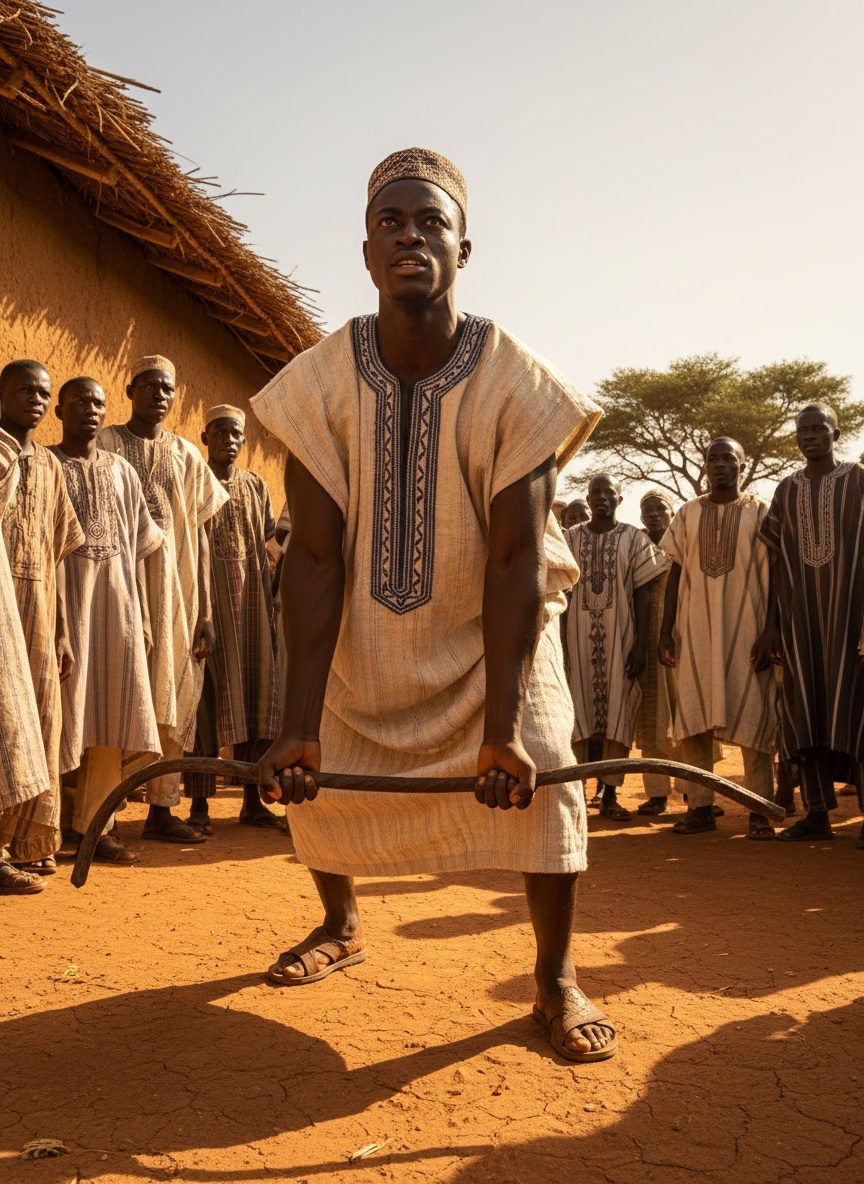
One morning, seemingly like any other, the air of inevitability thickened around Sundjata. A strange sense of foreboding, or perhaps hope, awoke with the prince as he lay observing the world that continued without him. On this day, something whispered within his spirit, a burning compulsion that he could no longer ignore. With a resolve that drowned out the laughter echoing in his memory, Sundjata reached out, his fingers discovering the cool, solid strength of the iron rod. It was a tool, now turned into a harbinger of change.
To many, the scene might have appeared simple — a boy crawling towards the seemingly insurmountable. But in that moment, the earth seemed to pause in anticipation. He gripped the iron tightly, his muscles taut with concentration, the cool metal warming to his touch. And then, as breaths caught in suspended animation, the unimaginable occurred. The rod, an unwavering support, bent under Sundjata’s determination. Against all odds, the young prince arose, casting aside the disbelief of those who had derided him. The earth beneath his feet felt different — it was no longer an observer to his humiliation but the foundation of his newfound hope.
This moment marked not just a personal triumph but the beginning of a monumental shift in history. The boy who had once only seen the sky from the ground was now destined to unite kingdoms, merge cultures, and forge the greatest empire Western Africa would ever witness. But the road before Sundjata, like the winding Niger River, was filled with unpredictable currents and treacherous passages.
His journey began with the reclamation of his birthright. His rivals, who had grown accustomed to exploiting his perceived weakness, soon learned to fear the resolve of a man who had conquered his own frailty. Through alliances carefully forged and battlegrounds carefully chosen, Sundjata demonstrated strategic brilliance that belied his years. He gradually gathered followers, admirers drawn by his vision of unity and prosperity — a tapestry woven with threads of strength and justice.
The political landscape of medieval West Africa was a tapestry of fiefdoms and rich cultures, each a fragment of a larger quilt that would become the Mali Empire. Sundjata saw opportunities not in subjugation, but in synthesis, creating an empire that was as diverse as it was expansive. Under his leadership, the Mali Empire blossomed, stretching its territorial grasp across gold-laden lands and through the heart of trade routes that pulsed with the vibrant life of African commerce.
Niani became a beacon, a capital of burgeoning hopes and dreams. The city transformed, and with it, the empire’s borders swelled, swallowing adversaries who once ridiculed the idea of unity. Sundjata’s governance was marked not merely by conquest but by fostering a fertile ground for culture, the seeds of which would bloom across centuries.
Through Sundjata’s vision, the Mali Empire became known not just for its wealth, but for its intellectual vibrancy. The corridors of power were lined not just with statues of warriors but with scholars and sages who thrived under this golden era of peace and prosperity. From the oral histories recited around flickering fires to the written scripts sewn into scrolls, Sundjata’s reign preserved the narratives and knowledge of his people.
The legend of Sundjata gripping the iron rod is thus not just a tale of physical triumph over adversity but a powerful metaphor for the resilience of human spirit and the boundless potential to transcend circumstances. It is a story that transcends its era, an echo rippling through time, speaking to all those who face overwhelming odds with grit and determination.
As the sun sets on the narrative of Sundjata Keita, it leaves behind an indelible mark, a reminder that legacies are not just born in the halls and courts of established power but often rise from the most unexpected of places. His story is a beacon across ages, whispering the truth that whether in medieval Mali or any corner of the world, the greatest potency lies not merely in strength of limbs but in strength of purpose.