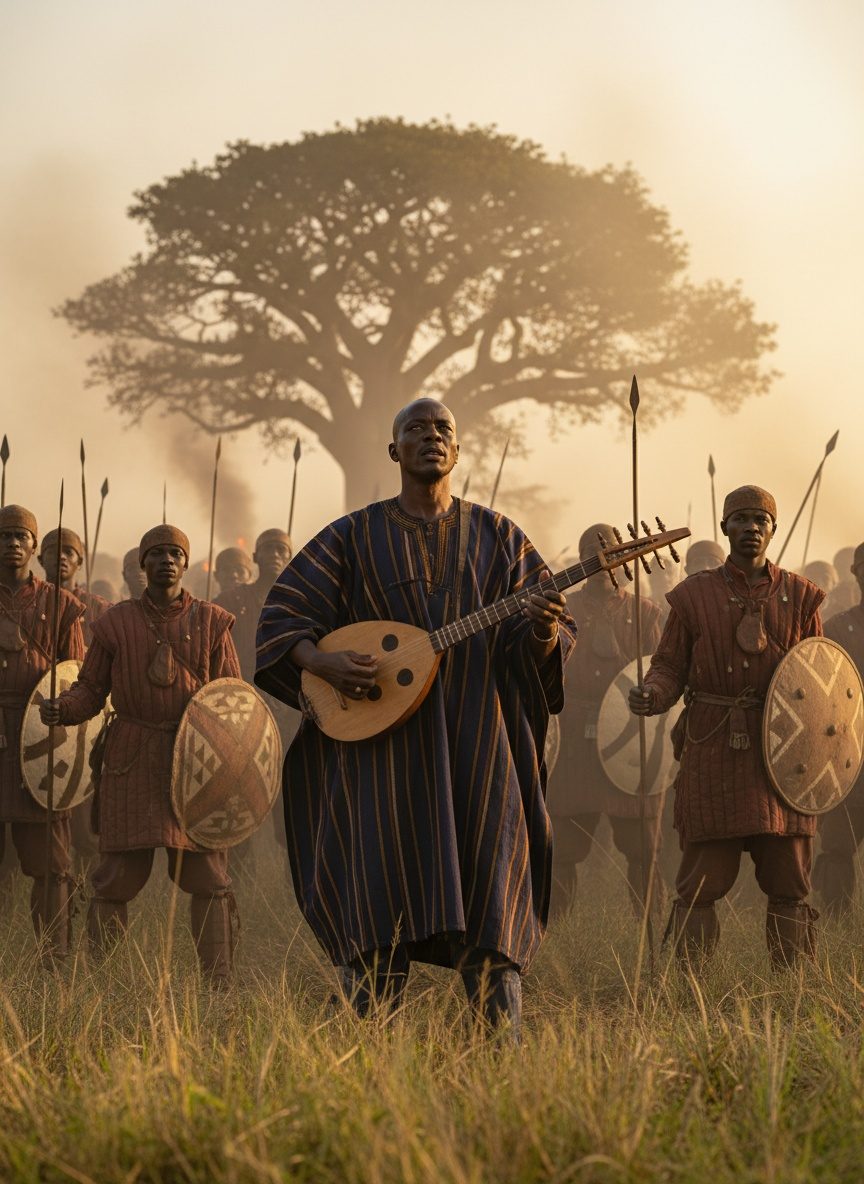
The warm air carried the scent of burning incense as Balla Fasséké stepped into the circle of warriors, his presence commanding immediate attention. The silence grew thick as the griot prepared to weave the epic song that would echo through the generations — the Kouroukan Fouga. Sunlight glinted off the iron armor of the Mandé warriors, still flecked with the dust of battle. Moments earlier, they had vanquished the tyrant Sumanguru at Kirina, securing their place in history. Now, as if the earth itself were holding its breath, Balla Fasséké’s voice rose, binding triumph to future, myth to reality.
The Griot and His Power
In West Africa, the griot was more than just a storyteller. These oral historians served as the living memory of their people, entrusted with passing on the stories, laws, and vital knowledge that shaped the identity of their civilization. Balla Fasséké, griot to the great Sundiata Keita, was a maestro of this ancient art. His every word resonated with weight, and in the unfolding silence after Kirina, his voice was both a balm and a call to arms.
As Balla Fasséké began the Kouroukan Fouga, the warriors listened not as a conquered people seeking guidance, but as victors ready to be molded by a new vision. The griot's song was not just poetry but a blueprint of coexistence and governance meant to sustain the burgeoning Mali Empire. Each verse laid a foundation for a new societal structure — a constitutional melody that balanced power, justice, and human rights.
A Song of Governance
The Kouroukan Fouga sung by Balla Fasséké was unprecedented: a comprehensive charter that promised rights and delineated duties among the Mandinka clans. It was revolutionary not just in its content but in its delivery, coming as a sung proclamation rather than written scripture. In a time and place where oral tradition reigned supreme, this was nothing short of transformative.
With each verse, Fasséké recounted laws that would guide the empire from that day forward. The charter emphasized unity and fair distribution of resources, promoting a system of checks and balances among the clans. It underscored the importance of agriculture and trade in cementing the empire's prosperity, ensuring each community's well-being while integrating them into a cohesive whole.
Beyond Borders: Echoes of the Charter
The Mandinka people's innovations under the Kouroukan Fouga rippled through West Africa and beyond. This charter laid the groundwork for the famed wealth and cultural prosperity of Mali, drawing travelers and scholars to its capital, Niani. Sundiata Keita's empire thrived on the stability this grand song provided, its echoes visible in the renowned intellectual centers like Timbuktu centuries later.
Knowledge exchange flourished; traders carried the messages of the Kouroukan Fouga across the Sahara as they bartered salt and gold, inadvertently spreading the ethos of the charter to kingdoms beyond. The Mandé social stratifications inspired by the song held sway, influencing neighboring regions’ political structures and cultural philosophies.
The Lasting Legacy of a Griot’s Voice
The significance of the Kouroukan Fouga lies in its living continuity, a reminder of the griot Balla Fasséké's genius. This ancient charter is heralded as one of the earliest constitutional frameworks in human history, and its story survived not in libraries but through the lips and voices of the griots who came after him. They ensured the principles of unity, fairness, and just rule were not forgotten, maintaining the legacy of the Mali Empire long after its political structure dissolved.
What makes Balla Fasséké's song remarkable is not just its historical weight but also its embodiment of oral history’s power to transform. In an era when written documentation was rare, the griot’s voice became an eternal ledger, his words a testament written in air and memory, not stone. For the Mandé and their descendants, the Kouroukan Fouga remains a spiritual and cultural anchor, a blueprint for governance that outlasted kingdoms. It’s a poignant reminder that sometimes, a song is all it takes to etch an empire's laws upon the hearts and minds of its people, forever remembered in the vibrant tapestry of oral tradition.