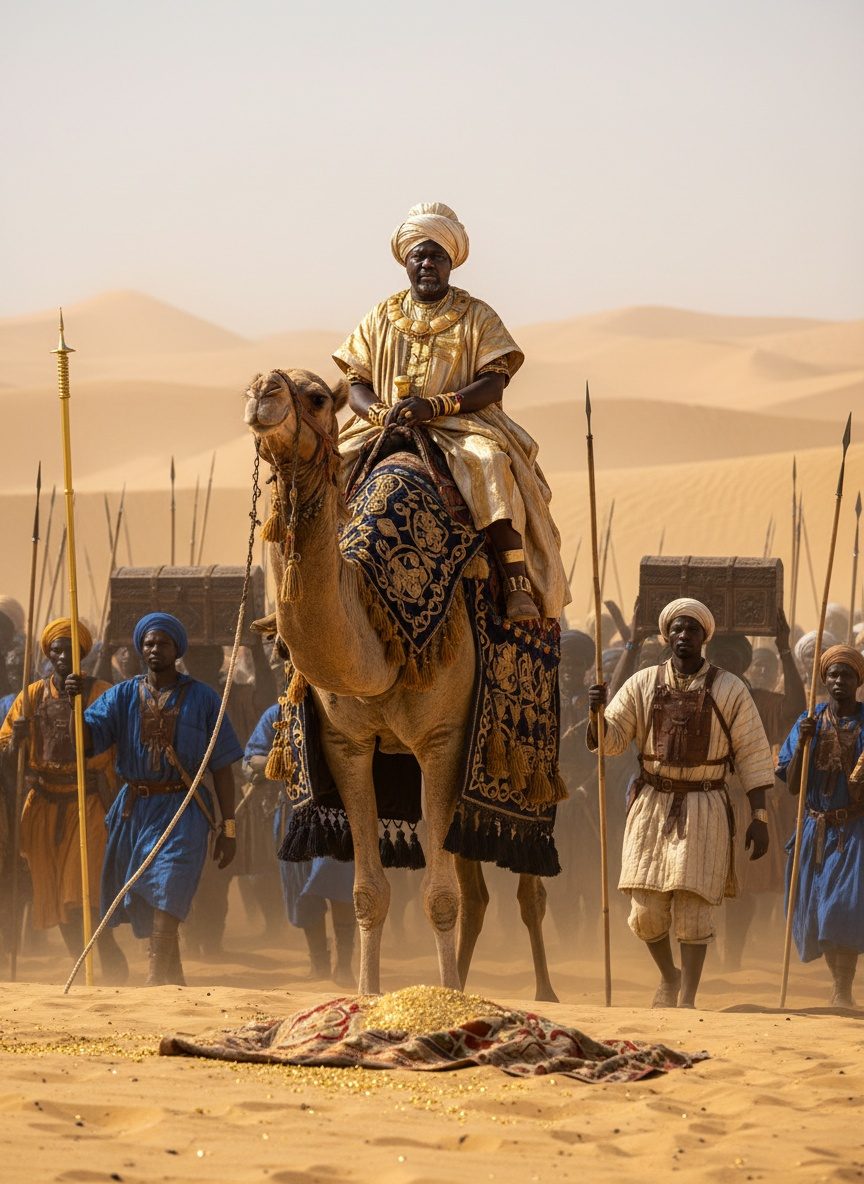
1324. The Saharan sun bore down relentlessly, a golden haze shimmering across the dunes.
In the heart of West Africa, the Kingdom of Mali thrummed with an energy few could fathom beyond its borders. Amidst the bustling markets of Niani, the capital, the air was thick with the scent of spices and the vibrant sounds of traders bartering their wares. Merchants, travelers, and scholars gathered, drawn by the promise of wealth or the allure of the unknown — each a witness to the ascendancy of one of history’s greatest empires. Yet, within this tapestry of prosperity, an often overlooked story unfolds, shadowed by the brilliant luminescence of Mansa Musa’s fame.
Mansa Musa, the tenth mansa or king of Mali, was preparing for his legendary pilgrimage to Mecca, a journey fueled by both piety and political acumen. It was June when his grand caravan began its deliberate march across the vast desert expanses, sparking a saga that would echo through history. Laden with twelve tons of gold, accompanied by a retinue of sixty thousand — a staggering multitude — this royal procession dazzled the world with its scale and opulence.
The king’s departure left Mali under the stewardship of a woman of remarkable skill and subtle influence, entrusted with maintaining the kingdom’s stability and managing its affairs. Though unnamed in the pages of documented history, her role was pivotal. The serene ebb and flow of Mali’s international trade and its internal policies during Mansa Musa’s absence were pointed testaments to her deft governance.
While the details of her actions might seem shrouded in time's embrace, clues can still be gleaned from the continuous flourishing of Mali during Mansa Musa’s absence. The markets of Niani did not falter; their noise did not dim. The fleets of merchants, laden with gold, salt, and ivory, continued their voyages from Kuba to Timbuktu and Gao to Djenne, heralding tales of ventures and riches to distant lands.
In Cairo, where Mansa Musa’s caravan would create an economic ripple that cascaded across the Mediterranean, traders in Mali carried on meticulously under the vigilant eye of the unnamed queen. They spoke with caravansaries, navigated the vast Sahara’s expanse, and pursued opportunities with a tenacity born from centuries of commerce. This was an echo of the queen's shrewd foresight and negotiation skills, ensuring the kingdom's coffers remained full even as Mansa Musa's generosity was unbridled.
Mali’s strategic location at the nexus of trade routes linking the gold-rich hinterlands with the North African markets was a marriage between rich resources and shrewd policies. Here, the queen’s role transcended mere caretaking. She was more than a steward; she was an architect of stability and continuity. Her governance combined diplomacy with intuition, ensuring the kingdom’s traders navigated geopolitical landscapes as expertly as they did the physical expanses.
While her existence is a tapestry of educated conjecture and the few fibers of history’s records, one aspect remains abundantly clear: the scale of Mali’s success required more than gold; it demanded leadership. At a time when a ripple in economic waters could lead to disaster, the seamless continuity of Mali’s prosperity underscores a leadership as astute as it was discreet.
The veil over her identity represents a wider narrative undercurrents often shadowed by luminaries like Mansa Musa. Women in West African histories frequently emerge in roles of profound significance, wielding power that transcended traditional narratives. They negotiated, led, and influenced — carvings in the pillars supporting vast empires. As tales from the Kingdom of Ghana to Songhai illustrate, women’s roles in these regions were far more substantive than often acknowledged by early European accounts.
Returning to our unnamed queen, her impact reverberated through the practices and policies she instilled, which ensured Mali’s treasury, embassies, and extensive trading networks remained vibrant. Sub-Saharan Africa’s intricate societies thrived under her guidance, with urban centers expanding and knowledge sharing across borders, emboldened by the commerce flowing through Mali’s arteries.
The echo of these past events serves as a reminder of the tacit narratives that history tends to relegates to footnotes. These are stories that defy the monolith of singular great figures and instead herald an era's multifaceted characters. They challenge us to seek narratives that illuminate the spectrum of human contribution across gender, status, and even anonymity.
Recognizing and honoring the legacy of this queen invites broader discussions about the dynamics of historical storytelling. It encourages a celebration of those whose voices didn't echo as loudly through the corridors of time as those like Mansa Musa. In the grander tapestry of Mali’s prosperity, she emerges, not just as a caretaker, but as a vital and equal partner in an empire that shaped the history of a continent.
This tale, interwoven with the richness of Mali’s traditions, speaks to the silent yet powerful figures who ensured that while gold and glory captured the eye, it was the empire they nurtured that sustained the heart of Africa’s golden age. Our task is to unravel these layers, acknowledging the depth of narratives like hers, and ensuring an enlightened gaze upon the fertile past from where we all draw our future.