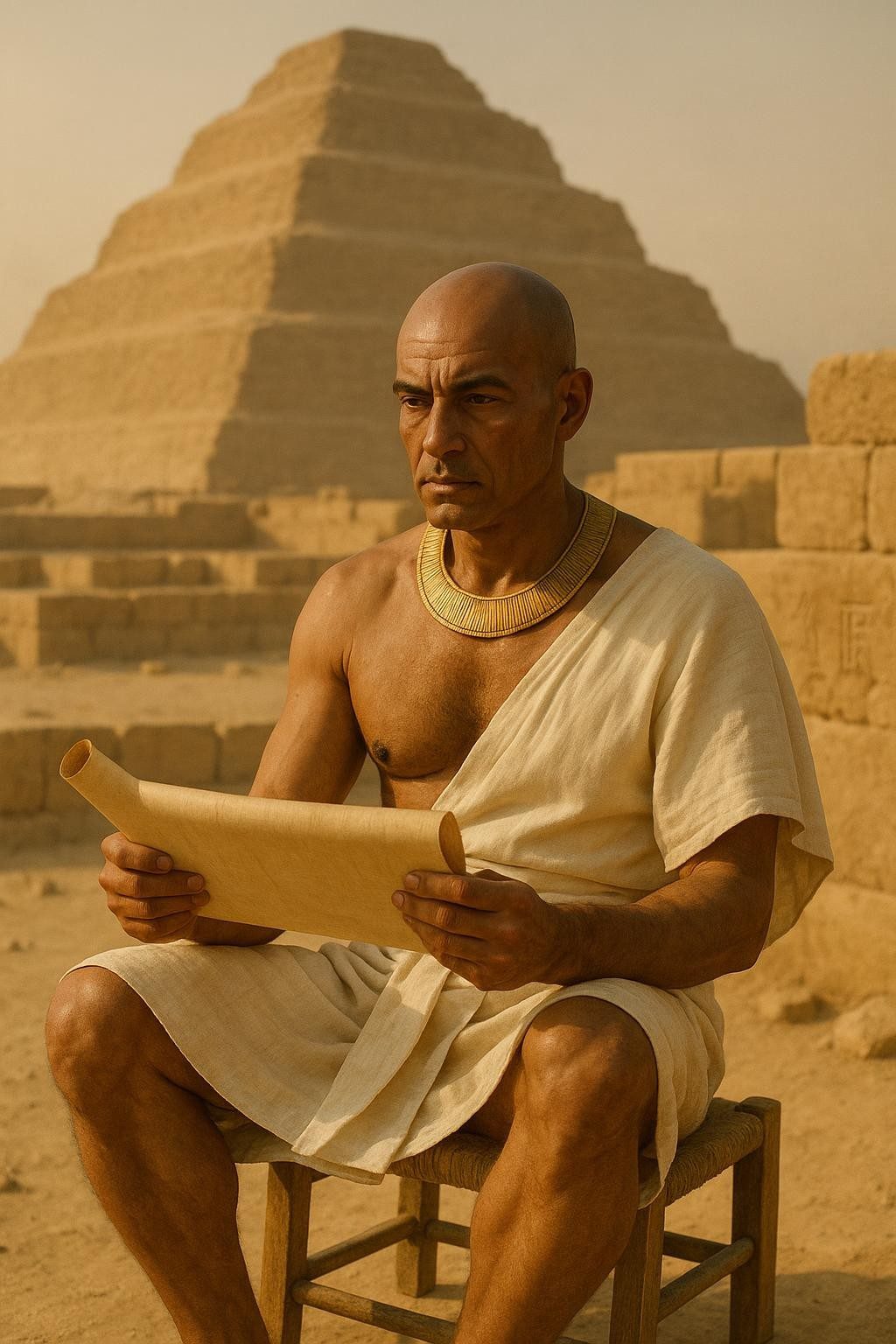
The warmth of the Egyptian sun beat mercilessly against the baked earth of Saqqara, casting long shadows from the towering palms swaying gently in an otherwise still air. This ancient necropolis, a testament to the ingenuity and spiritual devotion of Old Kingdom Egypt, was abuzz with the sounds of chisels on stone and murmured devotions. Amidst this bustling backdrop, one man moved with quiet authority. Imhotep, an architect, physician, and scribe, stood before the pristine limestone surface of a nascent monument—one that would etch his name into eternity.
Imhotep was not born amidst the opulence and intrigue of the royal court. He was a commoner, devoid of titles or noble birth, whose intellect and vision would elevate him to the highest echelons of power in the service of Pharaoh Djoser, the ruler of Egypt. The recognition of Imhotep’s genius began with his revolutionary approach to architecture. The ancient Egyptians had long been skilled builders, crafting impressive tombs from mud bricks. Yet, it was Imhotep who dared to stack stone upon stone, meticulously designing what would become the Step Pyramid—the first grand stone monument in history.
As the pyramid took shape, each sunlit day contributing to its slow ascent, it became clear that its construction was more than a mere architectural endeavor. This was a symbol of Pharaoh Djoser's divinity, a celestial staircase intended to bridge the gap between the human realm and the gods above. Imhotep’s vision was a cosmic endeavor, one which cemented Egypt's belief that its ruler was an intermediary with the divine. This creation, standing stark against the arid landscape, owed its existence to Imhotep—a testament to the transformative power of human ingenuity.
But Imhotep's mastery extended well beyond stone and mortar. In an age where superstition often overshadowed reason, Imhotep pioneered advances in medicine that were revolutionary. Ancient texts—copies of which survived millennia—testify to his role as the first physician whose methods prioritized observation and methodical treatment. He catalogued an array of ailments and prescribed remedies that included both natural and faith-based healing. His writings advocated for the treatment of diseases with an understanding that the body was a system susceptible to the disturbances of daily life.
In his role as high priest, Imhotep manipulated both ink and spirit, harnessing the scribal arts to pen his observations, enabling his knowledge to travel through time. The Temple of Ptah in Memphis would have been filled with scholarly echoes, a haven for thinkers peering into the worlds of both men and gods. This position forged his status as a mediator, not merely between numbers and construction, but between the mortal sick and heavenly health—a unifying blend of rational science and mystical belief.
Centuries passed, the desert sand sweeping across the impermanent and fragile, but Imhotep’s influence only swelled. By the time of the Ptolemaic period, Egyptians looked back upon his legacy with an almost reverent wonder. Without the embellishments of myth, Imhotep’s accomplishments already seemed miraculous. For a man whose life’s work had defied the constraints of his era, only one form of tribute seemed sufficient: deification. Incredibly rare for a commoner, Imhotep was elevated to divine status, joining the ranks of the gods who so often inhabited his thoughts. This canonization was not a mere idealization but a reflection of a society's recognition of a mortal who had touched the realm of the divine through wisdom.
The Egyptian pantheon is storied with deities wielding omnipotent power over the forces of nature, yet it reserved a special place for Imhotep—the healer and architect. Shrines rose in his honor, and he was invoked in prayers as a demi-god who could cure the ailments of the faithful, transcending the limitations of his own mortality through the faith of those who followed. It wasn't simply his corporeal achievements that allowed him to mold his world, but rather his ability to leave a legacy that could bridge the impossibly distant past with realms not yet imagined.
From his humble beginnings emerged a figure capable of shaping the earthly and the ethereal. Imhotep's story is one of profound transformation, not just of his own life or of ancient Egyptian society, but of how knowledge and faith can intertwine, offering mankind pockets of inspiration from which to draw hope in uncertain times. How remarkable, then, that a man so thoroughly ensconced in the pragmatism of construction and medicine should become a deity worshiped for his wisdom, an ordinary human elevated by extraordinary intellect and vision.
Imhotep's story carries importance beyond the dusty echoes of ancient burial grounds; it is a reflection on the power of human capacity to transcend expected boundaries. His life is a reminder that true greatness lies within the grasp of anyone who dares to dream beyond their beginnings. In an age where human understanding continues to expand, Imhotep’s legacy is a timeless beacon, illuminating the profound impact of those who think and build beyond their time. Egypt made him a god, not because he healed the sick or built lasting monuments, but because he showed what happens when a person, against all odds, chooses the audacious path of creation and healing.