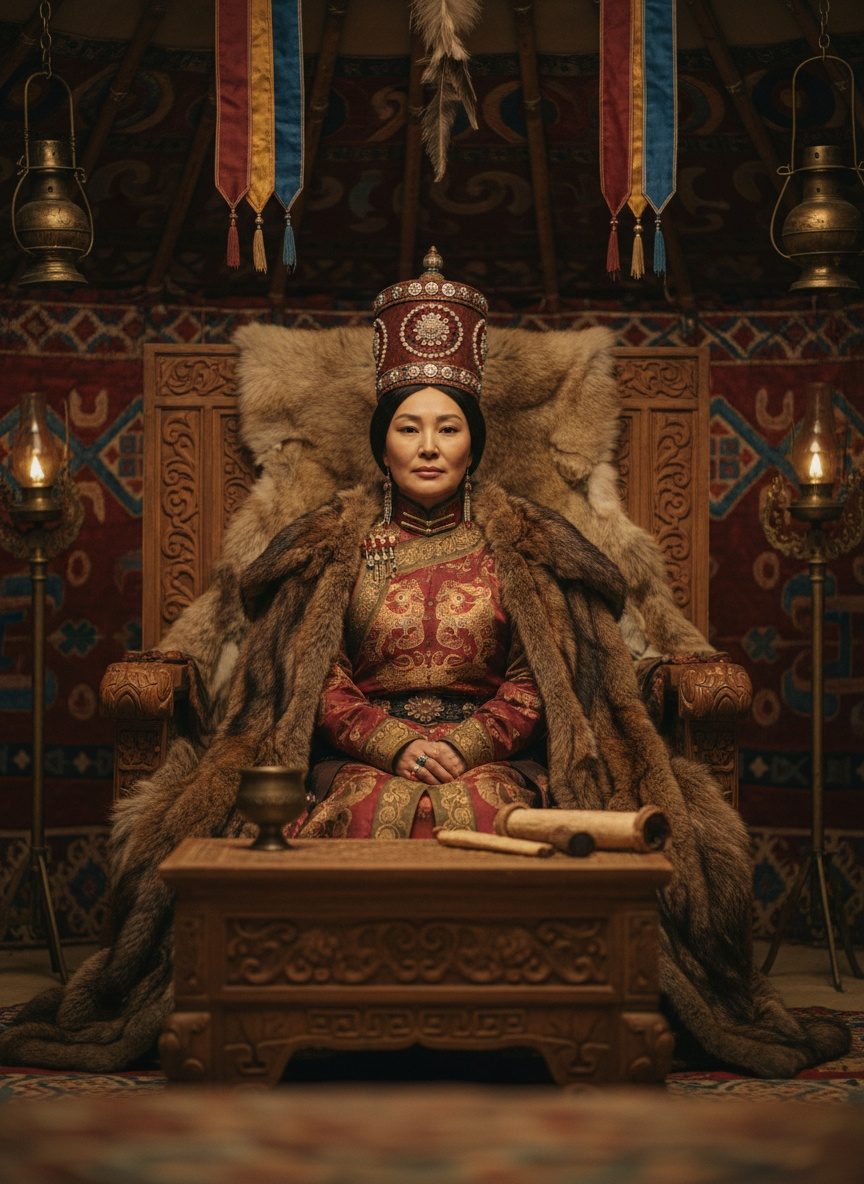
The tent wasn't just flapping—it was thrumming with an urgency that mirrored the chaos beyond its canvas. Sorghaghtani Beki drew the thick wool shawl tighter around her slender shoulders, the same ones that bore the weight of an empire's broken legacy. Her eyes, dark and discerning, scanned the scrolls and maps strewn across the low wooden table. Each parchment hinted at alliances, whispered of betrayals, and promised fortunes. Though thousands of miles separated her from the centers of power in Karakorum and beyond, the real throne of the Mongol Empire resided here, within the confines of her tent.
Stronger Than Steel: A Widow's Resolve
The Empire was unraveling. The air was thick with the tension of contenders jockeying for power, their ambitions igniting like kindling on a bonfire. Sorghaghtani had managed to outlive her husband, Tolui, the youngest son of Genghis Khan, a feat not often accomplished in the brutal political landscape of the Mongol court. Her husband's death could have left her vulnerable, surrounded by opportunistic relatives and his politically hungry brothers, their vision fixated on carving their pieces of territory from the Empire's great expanse.
But she was not a woman given to vulnerability. Raised in the house of her father, Jakha Gambhu, and trained in the art of negotiation and governance, Sorghaghtani’s roots rooted back to the Kereit tribe, once mighty allies of Genghis Khan. Her foundation was solid, her wit sharper than a nomad's arrow, and she wielded it just as effectively. In a patriarchal society that cherished brute force and direct command, she crafted a different path—one of diplomacy, insight, and cunning.
Other Mongol women had carved their place in history through commanding armies or securing tribal alliances through marriage. Sorghaghtani, however, was no conventional warrior, nor a simple matriarch bartering sons for peace. She was a strategist of the highest order. Her primary aim was to ensure her sons not only survived the political maelstrom but also thrived. Her sovereignty was subtle, yet her influence was pervasive. She molded her sons, skillfully navigating them through the treacherous political waters of the time, guiding them with the steady hand of a helmsman steering through a storm.
Mothers of Titans: The Chess Game Unfolds
The horsemen brought tidings, and from their reports, she extracted the truth hidden beneath layers of smoke and mirrors. Between the incessant thunder of hoofbeats and the lightning-like flashes of steel that marked the struggle for dominance, Sorghaghtani was a constant—a mother educating her sons to rule realms yet contested.
Her eldest, Möngke, would eventually ascend as the Great Khan, charting a triumphant yet turbulent course through expanding the empire. Her shrewd political acumen laid the groundwork for his rise, brokering alliances across the vast steppes and establishing connections that would bolster his claim. Equally adept was Hülegü, her second son, whose campaigns in Persia and the Middle East would extend the Mongol influence farther than Tolui had dared dream.
But perhaps it was her silent son, Kublai, who demonstrated her legacy’s true breadth. Cultivating an affinity for Chinese culture and governance under her tutelage, Kublai would reconcile the nomadic Mongol rule with the cultured court of China, eventually founding the Yuan Dynasty. Sorghaghtani's influence in Kublai’s court cannot be overstated, as he listened to counsel that some would dismiss, valuing her insights with the seriousness of a scribe recording history.
Each of her sons held power, their influence spreading like ripples across a pond, reaching distant shores that had once seemed untouched by Mongol intent. She gave them the tools not just to conquer but to govern. In a time when Mongol leadership often crumbled under its own aggressive expansion, Sorghaghtani’s foresight provided a sustainable path, evidencing a deep understanding that holding a territory was more complex than acquiring it.
The Lasting Echoes of a Hidden Ruler
Beneath the starlit canopy of their vast dominion, as other exploits faded into the annals of history, Sorghaghtani’s enduring legacy remained. Her story was not steeped in the heroic charges of battlefield exploits but resided in the quiet strength and shrewd maneuvers that shaped the fate of nations. Even Marco Polo, traveling centuries later, would recall tales that marked her as the wisest of women, a testament to her enduring influence and the breadth of her reputation.
For those who speak of power, Sorghaghtani's story is a reminder that the sharpest blades are not always worn on the belt but rather reside within the mind. She demonstrated that leadership and influence, though seldom visible, can profoundly shape the world trajectory. At a time when kingdoms and khanates rose and fell like ocean tides, her nuanced governance and strategic prowess provided stability and expansion in a fracturing empire.
The chessboard of the medieval world was hers to command, and her game changed the face of nearly every court from the steppes of Mongolia to the sands of Persia. As the echo of hoofbeats faded and the dust settled on yet another Mongol horizon, the world stood as a testament not just to the sons who ruled but to the mother who made it possible. In her silent strength and piercing wisdom, Sorghaghtani Beki carved a legacy, a feat as colossal as the empires her offspring forged.