He lived in a barrel. Yet, he wielded more influence with his words than many Athenian politicians with armies behind them.
The Philosopher of the Sun
Diogenes of Sinope was no stranger to controversy, for he chose to live outside society's norms and comforts with a clarity of purpose few could comprehend. While citizens of Athens bustled about their daily chores, this peculiar philosopher made his dwelling in an empty ceramic barrel in the busy heart of the city. Diogenes, a leading figure of the Cynic school of philosophy, believed that happiness comes from living virtuously in agreement with nature—values that stood starkly against the ambitions of wealth and power that consumed his fellow men.
Renowned for his biting wit and fearless honesty, Diogenes often regarded himself as a "citizen of the world," defying the conventions of the polis, or city-state systems that defined Greek life. By consciously choosing poverty and rejecting material possessions, he hoped to show others the true nature of virtue and freedom. In an era where philosopher-soldiers held sway over Greece, Diogenes chose the sun, the simplest of pleasures, as his greatest treasure. It was during one such sunbath that he would meet a young conqueror whose name would echo through the ages: Alexander the Great.
A Conqueror's Curiosity
It was the year 336 BC. Alexander, fresh from his father Philip II's conquests and with the world at his feet, was a burgeoning legend. His military campaigns would eventually span from Greece to Egypt, and from Persia to the Indus Valley. But on this particular day, in the golden haze of a Greek noontide sun, he had a different conquest in mind. Fascinated by tales of Diogenes’ character and wisdom, Alexander sought him out where the philosopher routinely basked in the warmth of the sun.
The scene was already set to become one of history’s most enduring encounters. Alexander, surrounded by his retinue of soldiers and advisors, approached Diogenes. The world watched, expecting a profound exchange between two of the most influential figures of their time. Perhaps Alexander, in his youth and with a touch of arrogance, saw an opportunity to impress this revered philosopher or even draw wisdom to aid his imperial goals.
The Request
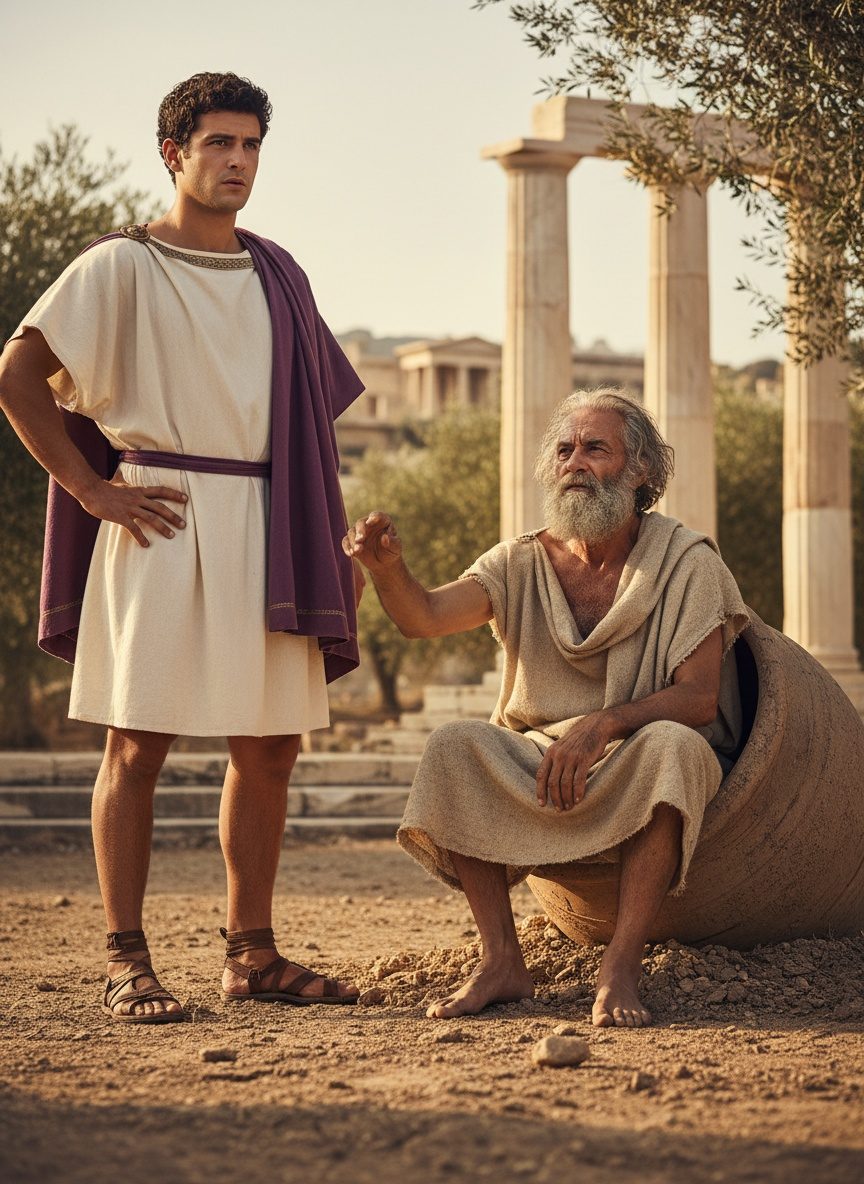
Standing over Diogenes, whose silhouette was barely visible in the sun's glare, Alexander made his offer. With princely generosity, he promised to grant any wish the philosopher might have. It was an open-ended invitation, unprecedented in its potential for power or wealth. Yet, without missing a beat, Diogenes, who lay reclined on the ground, turned his gaze slowly towards Alexander and made his infamous reply: "Stand out of my sunlight."
It was a simple request that packed the punch of a philosophical manifesto. In a single sentence, Diogenes encapsulated the essence of his world view. To him, the shadows Alexander cast, through power and presence, were obstructions to what truly mattered. Sunlight, unobscured and free, symbolized the natural goodness and untainted life Diogenes cherished. His words reverberated as a gentle rebuke to the young conqueror, illuminating the superficiality of Alexander’s triumphs in comparison to the philosopher's inner freedom.
A Lesson in Simplicity
The impact of Diogenes’ words was profound, much like the ripples caused by a single stone cast in a still pond. Alexander, who had faced down enemy armies and spoken to other great minds of Greece, found himself humbled by the simplicity and stark honesty of Diogenes’ statement. Here was a man, garbed in rags, living in a barrel, and yet he seemed to possess a richer sense of self-contentment that outstripped the mightiest empire.
This encounter, brief yet charged with meaning, often served as a parable in philosophical and educational circles afterward. It highlighted the sharp contrast between lives devoted to conquest and achievement versus those aligned with philosophical truth and simplicity. While much of the world might have marveled at Alexander's conquests and strategic genius, Diogenes' response to power and authority echoed across centuries as a testament to the power of living one's truth, unswayed by external prizes or pressures.
Reflections of Power and Truth
So, why does this meeting between a king and a philosopher matter even today? It serves as a reminder of the enduring debate between the transient nature of worldly power and the timeless essence of human values. Alexander would go on to build an empire whose legacy influenced countless generations, yet his encounter with Diogenes is a story that persists in the form of a cautionary tale about hubris and the limits of dominion.
Diogenes, with his biting sarcasm and unyielding integrity, stands as a counterpoint to the allure of power. His interaction with Alexander is immortalized not as a clash of titans, but as a stark moment of philosophical clarity. It forces us to confront what we value most in our lives — the transient achievements that come from outer conquest, or the eternal contentment that is found in inner truth.