The dry, relentless heat of the Egyptian sun bore down on the sandstone walls of the grand palace at Memphis, casting long shadows as the day drew to a close. The sound of the Nile's gentle lapping against the riverbanks was a constant, soothing rhythm, interrupted only by the calls of waterfowl and the murmur of the court gathered inside the palace. This tranquil scene belied the monumental moment at hand: inside the palace, a six-year-old boy, Pepi II, was to be crowned Pharaoh, ruler over the ancient world’s mightiest empire.
The Boy King Ascends
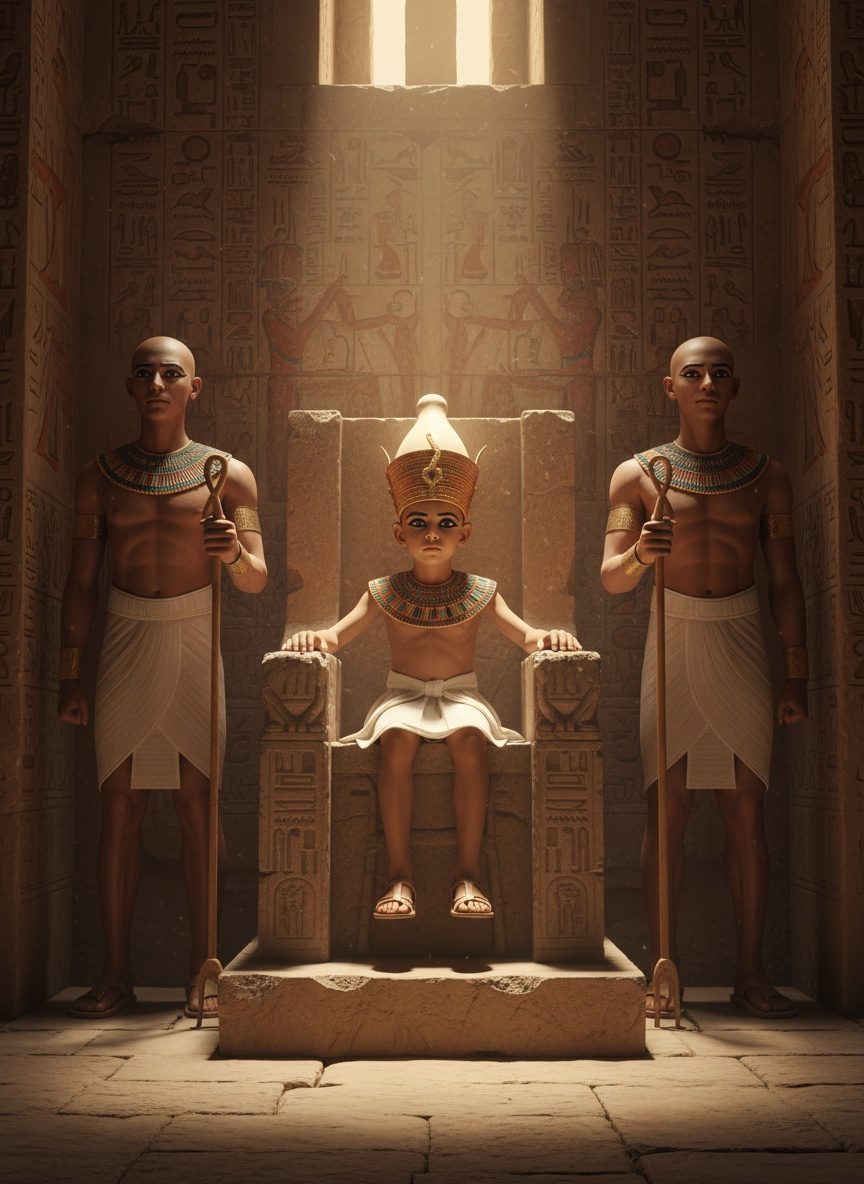
In the heart of the Old Kingdom, around 2278 BC, the corridors of power buzzed with activity as courtiers and priests briskly moved about the grand hall where young Pepi II sat perched on a high-backed throne. His small stature was dwarfed by the immense seat of power he was about to inherit. Though barely old enough to read the decrees that would later define his long rule, the responsibilities of a kingdom were about to rest upon his young shoulders.
For many, Pepi II’s age seemed an insurmountable hurdle. Egypt was a realm of ancient traditions, and a boy on the throne challenged the usual doctrines of wisdom and strength required of a pharaoh. Yet, those around him had no choice but to prepare him for the lifelong burden of rule. After the death of his predecessor, Pepi I, and with the sudden void in leadership, the temples and tombs whispered rumors of a child ruler, one whom the gods themselves seemed to watch over with interest.
The palace itself was a marvel of ancient architecture, its walls adorned with hieroglyphic tales of previous kings' exploits. Outside, across fertile fields watered by the Nile, the pyramids of the ancestors stood testament to the grandiosity and might of Egypt’s dynasties. These stone behemoths would become Pepi's daily view, a constant reminder of the massive expectations awaiting him.
The young king’s tutelage began with vigorous training in statecraft and the divine roles of a pharaoh. Advisors and priests surrounded him, guiding him through the complicated tapestry of politics, religion, and tradition. Yet throughout these early years, only time would tell how a boy would wield the power granted to him by birthright. As the ancient clocks ticked away, Pepi II's journey began—a journey unprecedented in its length and impact.
A Kingdom Etched in Time
As Pepi II matured, so did his understanding of leadership and the nuances of governance. His extended reign allowed him to oversee Egypt for nearly a century, a feat that would outlast any reigning monarch in recorded history. During this era, Egypt flourished as a beacon of success, demonstrating unparalleled accomplishments in art, architecture, and trade. The king presided over an empire that stretched far along the Nile, bound together by the shared Egyptian culture and loyalty to the pharaoh who led them.
But what made his kingdom truly unique were the less-discussed elements nurtured under his rule. Pepi II’s reign saw subtle shifts in the interactions between central power and regional governors, hinting at a delicate balancing act between regal control and local autonomy. The period is believed to have fostered connections from as far away as the Levantine coast, promoting an early exchange of ideas and goods across borders.
Yet, life along the fertile banks of the Nile was not without its challenges. The annual floods did not always bless the fields with predictable abundance. Pepi's administration had to grapple with the daunting tasks of resource management and sustaining the populace. The king’s foresight was often tested during these trying periods, where maintaining a stable and prosperous nation required not only reverence and hope but strategic acumen.
Though insurrections and conflicts marked several phases of his prolonged reign, it is remarkable that Pepi outlived many of his chosen heirs, illustrating the unforeseen burdens of time. The aged king had seen generations pass before his eyes—counselors, generals, and family members who all served and were laid to rest in the elaborate necropolises alongside the ancients. By the twilight of his reign, the borders of Pepi's Egypt had once again become a canvas for new challenges, but the legacy of his administration, dance of prosperity, and resilience in adversity painted a vibrant history far beyond mere calculation.
The Last Pharaoh of a Golden Age
As the sun dipped below the horizon of the Old Kingdom, a transformative epoch drew near its conclusion. Pepi II reigned over a period that historians often describe as the zenith of ancient Egyptian civilization, an era of remarkable construction and grandeur but also the precursor to a decline that foreshadowed the First Intermediate Period. The long life of Pepi, akin to the life cycle of the Nile, rose and receded, embracing both glory and gradual inertia. The landscape of power began shifting even as the elderly pharaoh remained, a living relic of another age.
Pepi II's eventual passing marked the end of a continuous line of succession, severing ties between the stability of the past and uncertainties of the future. The generational gaps carved by his unprecedented rule symbolized the eventual fragmentation of central authority, a labyrinthine legacy that successors would struggle to navigate. His death coincided with dwindling resources and pressures both internal and external, catalyzing Egypt’s shift into a more fragmented state.
Yet, the echoes of his reign linger in the sands of Egypt, layered beneath centuries of human endeavor and exploration. Pepi II’s life is a narrative of endurance and adaptation—a reminder of how individual human experience can mirror and influence the broader scope of human history. Although buried with the forgotten sands of time, his story calls forth the timeless dance of human rule and ambition, the ceaseless quest to leave a mark surpassing the span of an individual life.
In reflecting on Pepi II, we grapple with both the conviction and frailty of human legacies. They remind us that even the longest reign is but a blink in the passage of eternal time, a closing chapter for some, an opening verse for many. Perhaps Pepi’s ultimate legacy is one that encourages us to ponder the true measure of influence—a pharaoh who outlived not just his heirs, but the very world he helped shape, serving as a living bridge between Egypt's ancient glories and its inevitable evolution. In so doing, he entrenches himself in the annals of history, a silent guardian to the lessons of the distant past.