The streets of Athens were cast in deep shadows, the city's iconic limestone structures absorbing the quietude that stretched through the night. As the first light stretched over the Acropolis, the city stirred with the murmur of distant voices. Somewhere in this ancient metropolis, a scene of profound gravity was unfolding. Within the confines of his cell, the renowned philosopher Socrates faced the end of his earthly journey with an uncommon serenity. Condemned to death for his alleged corruption of the youth and impiety, he awaited the dawn with a poignant mix of resignation and defiance.
The Quiet Conspiracy
The air in the prison was thick with anticipation. Outside, Athens continued to claim its place as the cradle of democracy, yet inside these walls, an orchestrated act of defiance was quietly brewing. Among Socrates' friends, a plan had been meticulously laid. They had mustered the courage and resources to bribe the guards and provide Socrates with a means to escape. A boat waited, inconspicuous and ready to deliver him to safety and obscurity.
This wasn't merely a desperate attempt to save a beloved friend; it was an effort to preserve a thinker whose intellect had shaped a generation. Socrates was more than a man; he was a movement born from the spirit of inquiry and debate. However, the philosopher, who spent his life in pursuit of virtue and truth, saw the escape as a betrayal of everything he stood for. To him, the laws of Athens, even when flawed, were an embodiment of social order and justice.
A Night of Reflection
As the night deepened, cool pebbles of ancient dialogue filled the room, warmth spreading from shared memories and philosophies debated over countless symposia. Socrates' disciples and friends, who included the likes of Crito, surrounded him. These were men he had urged to question, to seek truths beneath the veneer of accepted norms. Yet, on this significant night, it was Socrates who offered the final lessons, choosing his own demise as the ultimate act of integrity.
With the profoundness of a man who knew he was on the verge of history's annals, Socrates discoursed on justice and the soul, on life and the acceptance of its inevitable end. His refusal to flee was not just an affirmation of his philosophies but a testament to living a life consistent with his teachings. Escaping would mean discarding those very lessons he had imparted his whole life.
The Dawn of Decisions
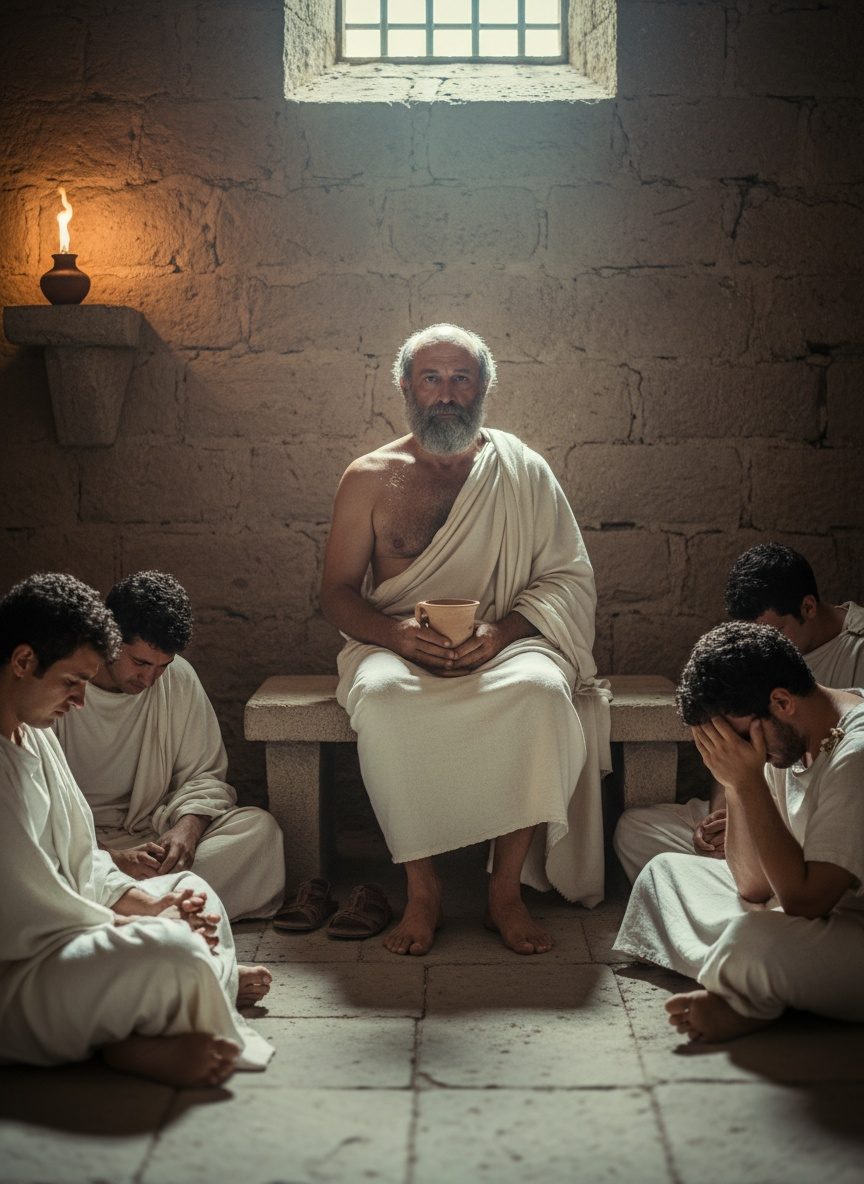
The light outside began to change, the first rays of dawn slipping between the bars of Socrates' cell, painting the walls with strokes of golden morning light. It was time. The guards, now slightly nervous after having accepted bribes, quietly opened the path to freedom. Yet, Socrates sat unmoved, a figure of stoic calm in the hushed tension of the cell.
His friends implored him one last time, but the philosopher smiled wistfully. A man must adhere to his principles, he affirmed, now clearer than ever. Socrates understood that his death, much like his life, would echo through the ages, setting a profound example of moral consistency and sacrifice. This act of ultimate courage was a mirror held up to the society that had judged him — a prophetic reflection of justice, free will, and conscious choice.
The Final Hour
The moment had arrived. With the hemlock prepared, Socrates took it in his hands. To the backdrop of tears and whispered prayers of his followers, he drank from the cup, his demeanor unmoved by the ominous finality of the act. There was no departure from his calm, no wavering in his resolve. He spent the few remaining moments discussing the immortality of the soul, a testament to his unyielding belief in questioning and contemplating until his very end.
Surrounded by those who revered him, Socrates' last breath was not of fear or regret but of completion. He had lived by his principles each day, and now, by those same principles, he embraced his death. In choosing to drink the hemlock, he left behind a legacy not just of philosophical inquiry but of moral conviction and unwavering integrity.
In an era when Athens was grappling with the tension between free thought and social order, Socrates's choice resonates beyond the annals of history. It's a reminder that principles sometimes demand the highest price, yet their true value lies in the willingness to uphold them against all odds. Today, Socrates’s final act of defiance continues to inspire, reflecting the timeless struggle between individual conscience and societal demands.