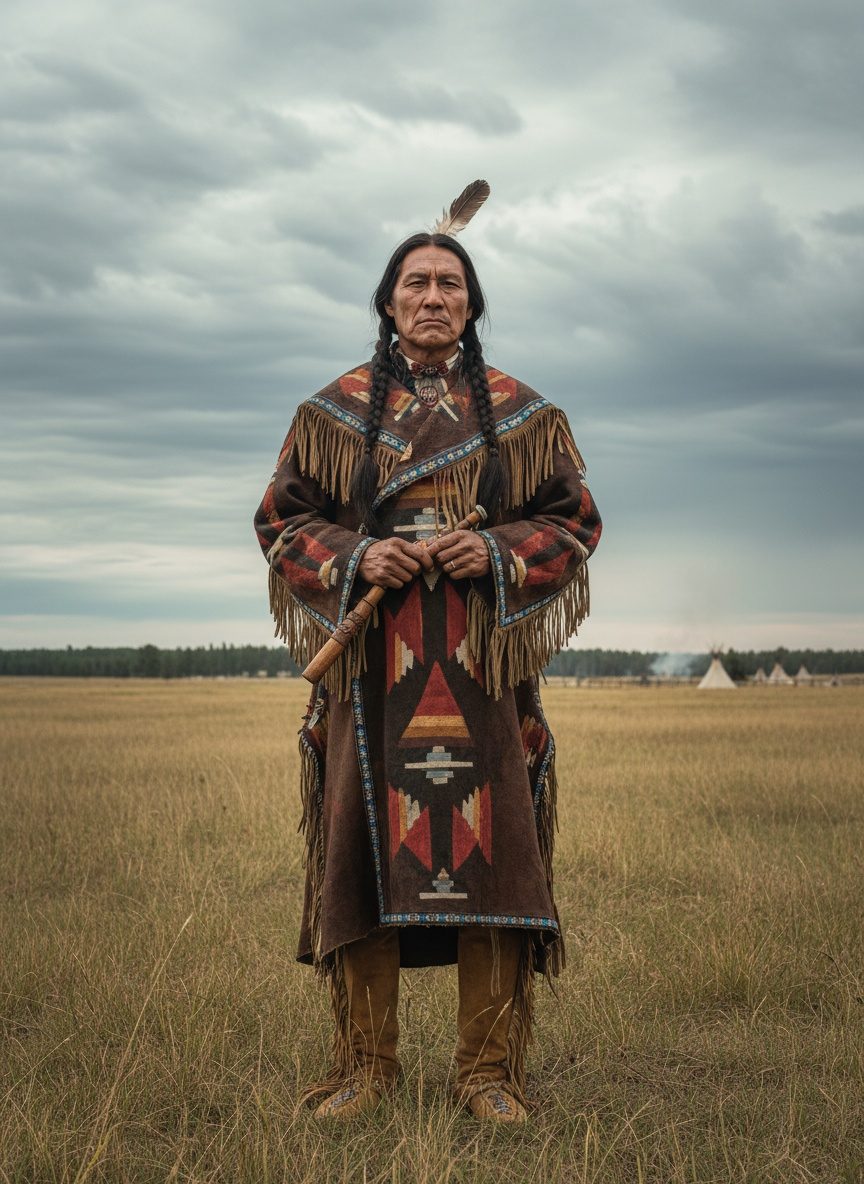
History often casts Sitting Bull as merely a fierce Lakota Sioux warrior. This portrayal misses the fundamental truth of his life: he was a healer first.
The Sacred and the Warrior
Mist rises over the undulating plains, casting a spell of mystery over a young mother cradling her newborn son in her arms. The endless stretch of grasses sways gently, a whisper travelling the land. It is 1831, on the Grand River in present-day South Dakota, and Jumping Badger, later to be known as Sitting Bull, has become a part of this world. From his earliest days, he was immersed in the rich spiritual tapestry of the Lakota Sioux. Long before he ever held a weapon, his hands were those of a healer.
By the age of fourteen, the youth who showed promise in spiritual matters demonstrated equal aptitude on the battlefield. It was in a skirmish against a rival tribe that Jumping Badger earned the name Sitting Bull, symbolizing strength and steadfastness. However, Sitting Bull was never just a warrior. He understood the art of healing, drawing spiritual strength from the sacred power of the Sun Dance ceremony. Thathanka Iyotake—his people’s voice of wisdom and unity.
Throughout his life, Sitting Bull’s role as a healer intertwined seamlessly with that of a military strategist. His spiritual vision allowed him to foresee threats; his skill in rallying his people unified them in the face of encroachment. By 1876, in what would become the most famous battle involving Native Americans in American history, those combined gifts were on full display. With his spirit and direction, the Lakota Sioux and their allies decisively vanquished General Custer’s forces at Little Bighorn. But for Sitting Bull, this wasn’t purely a victory of arms—it was a spiritual triumph foreseen in a medicine dream.
Mounting Pressures and Spiritual Resolve
The shifting shadows of the 1800s crept in on the Lakota Sioux as homesteaders, miners, and others laid claim to the Plains. For nearly thirty years, Sitting Bull navigated these tumultuous waters, holding firm to the spiritual roots of his people. He embodied resilience, but even the fiercest rivers can be changed by an overwhelming tide.
Sitting Bull’s opposition to signing treaties that ceded land showcased his dedication to his people’s freedom and the sanctity of their land. To him, every grassy hill and flowing river was alive with the spirits of ancestors. But the pressure mounted, the U.S. government relentlessly pursuing policies that would confine his people to ever-smaller reservations, the land disappearing beneath the ink of treaties Sitting Bull refused to sign.
The once-abundant buffalo herds dwindled, threatening the lifeblood of the Plains tribes. Illusions of civilization offered as barbed gifts brought more than modernity—they bore destitution. It became a war of souls, with Sitting Bull at the lead, invigorating hope through words and ceremonies when certainty had become a scarce resource.
Every council fire and every sun dance held significance—moments to inspire, to regroup, to heal. Yet sitting at the fringes of a devastating change, beyond the support of the buffalo and traditional ways of life, the irreversible was but a paper away.
The Final Stand: A Paper-Cut Defeat
The end was not a blaze of glory but a protracted engagement with bureaucratic mandates and starvation at their doorstep. The irony was palpable: it was not the might of military arms that penned the final chapter of this impassioned leader; it was diplomacy laced with coercion. By the time Sitting Bull and his courageous followers retreated to the Standing Rock Reservation, their fight had become one of survival.
The essence of a warrior and a healer remained, despite the encroaching might of a nation, which by 1890 left little for these noble keepers of the Great Plains. The promise of a new dawn was all but eclipsed by the winter’s merciless chill on December 15, 1890, as the legend fell at Standing Rock, his life extinguished by the very faction that once relied on his advice and foresight.
Sitting Bull remains a symbol of indomitable spirit and steadfast resolve. His life was a testament to the complexities of a man who wielded power not just through weaponry but through wisdom and faith. In a world often inclined to wield judgement before understanding, Sitting Bull’s story urges reflection. Healer, warrior, visionary—his life questions how we choose to remember those who have walked the lands before us. In the corners of our collective memory, his legacy compels us to carry forward whispers of unity, perseverance, and the fundamental respect for our shared Earthly home.