February 3, 1154. The air was thick with incense in the grand hall of Palermo's royal palace.
The opulent court was abuzz with murmured conversations and the rustling of silken robes, a testament to the diverse tapestry of cultures that converged in this crossroads of civilizations. At the heart of this convergence was a singular moment—a moment framed by the audacity of one man’s vision and the culmination of a scholar’s lifework. Muhammad al-Idrisi, a geographer of unparalleled repute, was about to unveil his magnum opus to King Roger II of Sicily, an enlightened monarch whose realm was a melting pot of Norman, Arab, Byzantine, and Latin influences.
The journey to this moment had been as labyrinthine as the palace corridors. Al-Idrisi, a scion of Moroccan royalty, had traversed the known world, gathering tales and snippets of cartographic wisdom like a scholar-pilgrim on a quest for truth. His travels brought him from the sun-scorched streets of Cordoba to the snowy reaches of Scandinavia, each step a chapter in his expansive understanding of Earth’s vastness. With each encounter, he pieced together a mosaic of knowledge that would later coalesce into a breathtaking masterpiece.
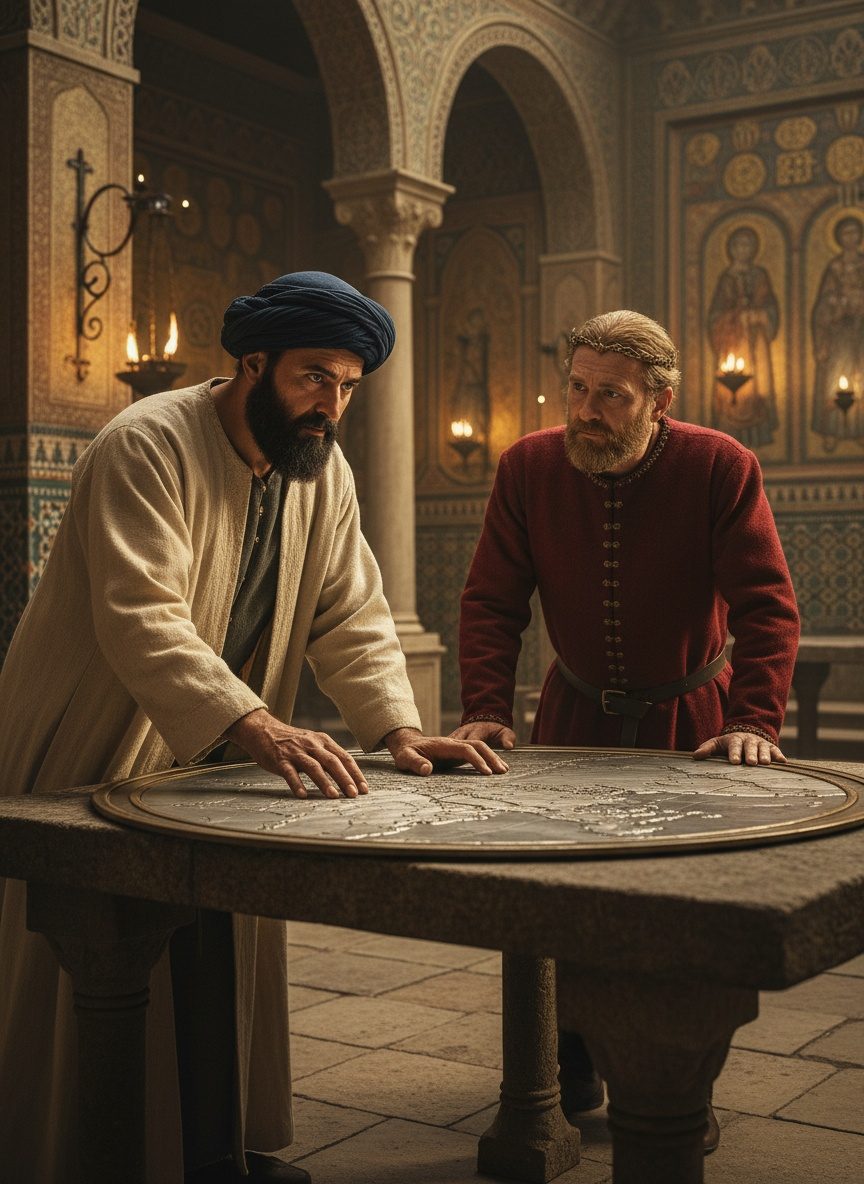
The hall was no stranger to diplomats or astronomers, but al-Idrisi’s presence was of a different nature. He walked with a quiet confidence, his robes rustling softly on the polished stone floor. Under one arm, he carried a map unlike any other—carefully etched onto a massive silver disc. This was no mere chart of lines and points, but a narrative of human exploration and the world’s interconnectedness.
When al-Idrisi presented his creation, there was a palpable hush. The disc, two meters in diameter, scintillated under the grand chandeliers, each reflection subtly emphasizing the artistry and precision that had gone into every inscribed feature. This marvel of medieval cartography detailed not only Europe, Africa, and Asia but also every sea and river, every mountain range, and expansive deserts. It was a vision of the world so comprehensive that even the most seasoned travelers found in it places and routes they had never dared to conceive.
King Roger II, a man blessed with both the shrewdness of a ruler and the curiosity of a scholar, was quick to recognize the importance of al-Idrisi's work. It transcended geography; it was a testament to humanity’s desire to understand and to connect. In a medieval age when civilizations often clashed, this map was a bridge—a shared understanding realized in precious metal.
The map, known as the Tabula Rogeriana, would serve as the definitive depiction of the world for centuries, referenced by explorers, traders, and scholars alike. To create it, al-Idrisi had employed a novel methodology, compiling data from firsthand accounts of travelers and sailors. He also utilized ancient sources, cross-referencing them with contemporary observations to enhance accuracy. This synergistic approach was unprecedented, and it placed al-Idrisi at the pinnacle of cartographic science.
Palermo, at this time, was a dazzling center of learning and culture, with libraries rivaling those of Baghdad and Cairo. It was within this vibrant metropolis that al-Idrisi polished his understanding, encouraged by a ruler who prized intellect and innovation. Roger II’s court was an anomaly, a uniquely tolerant institution that welcomed intellectuals of diverse faiths and backgrounds. It was a place where ideas could flourish, and where the mapmaker and the monarch could collaborate in mutual respect.
As al-Idrisi narrated the map’s intricacies to the assembled courtiers, he revealed an array of less known lands—the beginnings of myths that would propel future journeys. The court listened, spellbound, as he described the mythical gold-producing island of Waqwāq, rumored to exist beyond the confines of the known world. His depiction of distant lands, their climates, people, and resources, were as much lore as they were empirical. This testament to imagination blended seamlessly with reality, illustrating the medieval art of balance between what was known and what could be dreamed.
But it was more than fanciful tales that supported his geographic masterpiece. The map arc significantly influenced the maritime paths, offering navigational insights vital for traders plying the Mediterranean routes. Key port cities were envisioned not merely as destinations but as connective nodes within an expansive network. This understanding transformed the ways in which goods moved from East to West, laying pathways that would resonate for generations.
Yet, despite the grand revelation and the powerful silence that followed, there was more at stake than the acceptance of a new world view. The creation of the Tabula Rogeriana was emblematic of a fleeting moment of unity in a region often fractured by religious and cultural discord. In the chiseled coastlines and the etched mountain ranges of this map were the echoes of a world where knowledge and cooperation transcended borders, where a Muslim scholar could find patronage under a Christian king’s roof for a task that was universal in its aspiration.
As the court gradually dispersed, leaving the grand hall steeped in the glow of twilight, one could reflect on the profound simplicity of a map as an idea. It positioned humans within the vastness of the unknown, challenging them to explore and understand, yet grounding them with the comforting knowledge that, no matter how far they ventured, the world was but a collection of shared spaces.
In retrospect, al-Idrisi’s endeavor was more than a feat of cartography. It was an early starring chapter in the global human narrative—a reminder that curiosity and intellect could chart the course to understanding, even amid the challenges of the medieval world. As fragmented as the historical landscape could often appear, the legacy of this map serves as a timeless reminder of the potential harmony between disparate cultures collaborating on common ground. In our world, where maps have become digital abstractions, the tangible, etched silver of the Tabula Rogeriana remains a symbol of the enduring power and beauty of knowledge shared across divides.