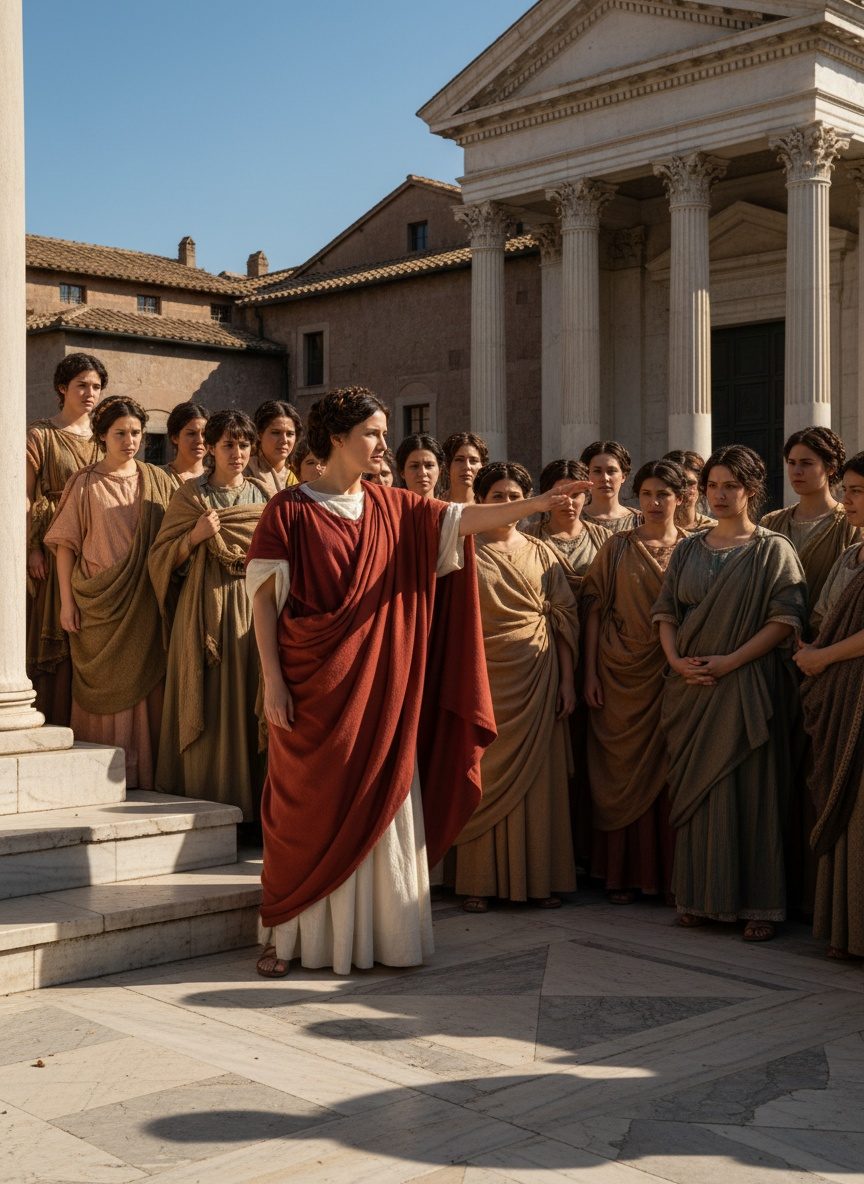
The clamor of thousands echoed through the narrow streets of Rome, a chorus of disdain that the Senate could not ignore. Cato shook his head in disbelief, watching as a tide of determined women poured into the Forum. They were dressed in simple, unadorned tunics, a silent reminder of the law they sought to upend. Amidst the tumult, one woman broke away from the throng and walked with resolute steps toward the Curia. She was an embodiment of the rebellion, a singular figure in a time when her voice should have been silent, her presence unobtrusive.
The year was 195 BCE, and the Roman Republic found itself in the throes of an unprecedented societal upheaval. The bone of contention was the Oppian Law, enacted during the darkest days of the Second Punic War. Passed in 215 BCE, it was a wartime decree wielded to conserve resources and display austerity, forbidding women from owning more than half an ounce of gold, wearing multicolored garments, or using carriages within a mile of the city unless for religious festivals. But now the war was over, and Rome had emerged victorious, her coffers swollen with the spoils of conquest. To many, the law had served its purpose; its continued enforcement now felt like an unnecessary yoke.
The woman who had captured the Senate's ire was no ordinary Roman. Her name was cloaked in the anonymity of history, yet her actions rippled through time. She embodied the growing unrest among Rome's female populace, whose contributions during the war years had been substantial, albeit unrecognized by the male-dominated political sphere. These women took comfort in the rumor that even the legendary Fabius Maximus had purportedly expressed dismay at the disrespect shown toward Roman matrons.
Inside the Senate House, the legendary orator and statesman, Cato the Elder, let his voice boom. To him, this movement was nothing short of an insurrection, a threat that would unravel the very fabric of Roman society. *"If the law is to be repealed only because it stands in the way of women's vanity,"* Cato proclaimed, *"then what will they not claim next?"* His words were calculated, sharp, but outside, among the swelling ranks of women, his rhetoric fell upon indifferent ears. To them, the Oppian Law was a symbol of lingering wartime oppression, an archaic relic infringing upon their dignity and autonomy.
In the streets, the scene was vibrant with color and commotion. Carriages stood unused, but the women marched with a renewed vigor, their cheeks flushed with the cool winter air and anticipation. A bevy of interests converged here—daughters of Rome's ancient patrician class rubbed shoulders with the wives of plebeians. Never before had such a diverse coalition gathered beneath a singular cause, their collective voices demanding the freedom to reclaim what was rightfully theirs.
Historians of later centuries would debate the extent of the influence these women wielded, but on that day, their presence was undeniable. Their march was orchestrated chaos, a ballet of defiance, underpinned by the thrum of a society in the throes of change. The air was tinged with the scent of fresh bread baking and the earthy undertones of livestock, mingling with the faint tang of metal and leather as shopkeepers shuttered their stalls to join the throng.
Inside the Curia, debate raged on. Though Cato's opposition was fervent, not all senators shared his perspective. Many were swayed by the logic presented by Lucius Valerius, a consul who stood in support of repeal. Valerius reminded his peers of their mothers, sisters, and wives—women who had sacrificed alongside them, who tended to farms and businesses in the absence of men during war. The Oppian Law, he argued, served no purpose in this new era of peace and prosperity.
Outside, the rhythmic chant of the women reverberated, a persistent pressure on the marble halls of power. The determination evident in their faces underscored a simple truth: they would not be turned away or silenced. For hours the Senate deliberated, the tension palpable even to passersby unaware of the specifics unfolding within those walls. The Roman midday sun shifted, shadows lengthening in the Forum, casting an extended pause over the city.
Finally, the doors of the Senate House swung open. The decree, a resounding victory for the women of Rome, resonated through the Forum: the Oppian Law would be repealed. The women's cries of triumph were unrestrained, a cathartic outpouring of emotions stored through years of patient endurance. Rome had woken to a new reality—the day marked not just a legal victory, but a societal shift. For the first time, women had stood before the Senate and been heard.
This moment in history illuminates a lesser-seen facet of the ancient world, a reminder that change often comes not from the stroke of a pen or the whim of a solitary ruler, but rather from the determined action of those traditionally sidelined by history. The repeal of the Oppian Law stands as an early testament to collective civic action, foreshadowing the rise of women's movements in times to come. It is a story of resilience and unity, of a society that, when pressured, glimpsed the necessity of evolving beyond mere tradition. In their victory, these women reshaped the contours of Roman society, setting a precedent for future generations. As we delve into this singular event where female voices roared with such might in the heart of Rome, we pause to reflect: enduring power lies not just in rulers or laws, but in the resolve of the populace to define their own narrative. The echoes of their march still linger, reminding us that defiance in the name of equality is timeless.