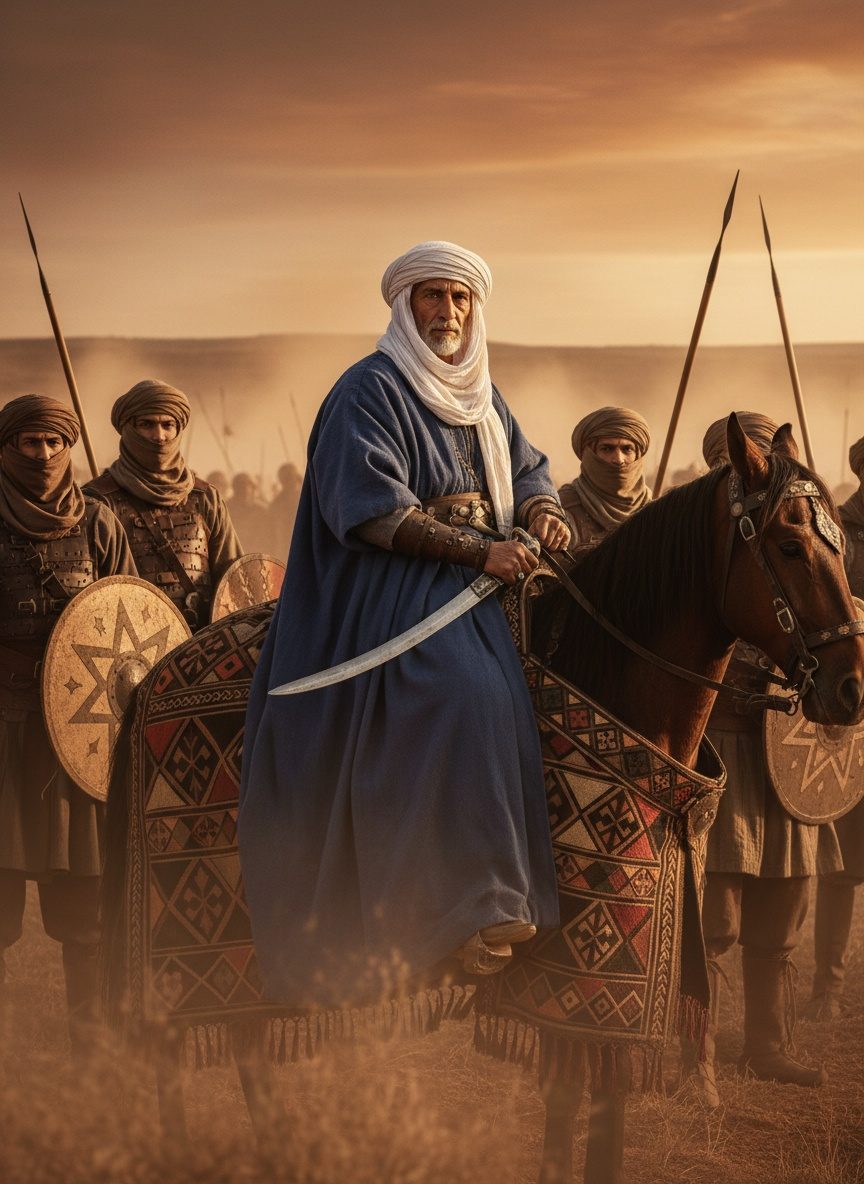
He was over eighty years old. His heart, however, burned with the fire of youth. Yusuf ibn Tashfin, a name that might not resonate with many today, was a beacon of resistance in an era when the fate of Al-Andalus hung precariously on the edge. His story is woven with determination, age-defying valor, and a resolve that altered the narrative of Christian-Muslim conquests in medieval Spain.
In the latter half of the 11th century, the heart of Al-Andalus was throbbing with uncertainty as the Christian kingdoms pressed southward. Mighty cities that once echoed with the intellectual and cultural marvels of Muslim Spain now trembled under the siege of advancing Christian forces. The guardians of these lands, the Muslim rulers of Iberia, faced one defeat after another, and the glittering cities that spread like jewels across the landscape began to dim beneath the shadow of relentless warfare.
It was during these moments of despair that a plea for aid surged across the blue waters of the Mediterranean. The message was simple and laced with desperation: Al-Andalus was crumbling, and its leaders needed help. The call found its way to the bustling city of Marrakesh, the heart of the burgeoning Almoravid Empire, where an aged leader sat amidst his advisors. This was Yusuf ibn Tashfin, a man whose mind was a tapestry of strategic brilliance and who possessed the rare ability to unite tribes under a single banner.
Born into humble origins, Yusuf rose through the ranks not by legacy but through sheer ability, rallying the Almoravids—Berber tribes unified by faith and the sword. His reputation in North Africa was that of a sage and a warrior blessed by time-tested experience and a vision that transcended immediate borders. Yet, the sands of Marrakesh were familiar, comfortable, and the challenges awaiting him across the sea were unknown and daunting, especially for a man of his age. But Yusuf was not tethered by caution that age might impose on lesser men.
The passage of years had gifted Yusuf with the wisdom that youth often lacks. He understood the implications of failure not just for Al-Andalus but for the Islamic world as a whole. It was a pivotal moment that required not just courage but the piercing clarity of a general who recognizes the winds of change. Despite the risks, he mobilized his forces and crossed the treacherous Mediterranean, setting a course for a fate yet unwritten.
The journey itself must have been grueling, a test of endurance for both the elderly Yusuf and his weary soldiers. Yet, the confidence that radiated from him was infectious, propelling his men forward even as waves crashed ominously against their vessels. The port of Algeciras marked their entry into the Iberian Peninsula—tension lingered in the air, thickening with every step they took toward the inevitable confrontation. These warriors from Africa were met with a landscape both foreign and familiar, where loomed the fortified presence of their adversaries.
Yusuf's objective was clear as he aligned his forces against those of Alfonso VI, king of Castle-Leon, near the plains of Sagrajas. Alfonso, seasoned and flushed with prior victories, had little reason to suspect the reversal his forces would soon face. The clash that unfolded in October of 1086 would be swift and decisive. The battlefield, alive with the thunder of hooves and the cacophony of clashing steel, became a stage upon which Yusuf showcased not only his tactical brilliance but also the depth of his resolve.
The Almoravid strategy, honed by years of desert warfare, proved superior as Yusuf coordinated a devastating pincer movement. With the disciplined precision of a master craftsman, he cut through Alfonso's ranks, disrupting cohesion and plunging the Christian forces into disarray. The air was thick with dust and cries as the sun bore witness to the unraveling of what had seemed an unstoppable force. Within a single afternoon, in the fierce glare of battle, Yusuf shattered their might with a strategy both elegant and mercilessly effective.
Rumors of his age seemed to dissipate like vapor amidst the aftermath, and the Christian kings now faced a new reality. The tides had turned, and the men who crossed the sea with Yusuf had proven to be more than worthy adversaries. Not merely invaders, but defenders, rooted not just in ancestral lands but in shared destinies that transcended borders, they had altered the course of Iberian history.
A reputed octogenarian, Yusuf ibn Tashfin receded into the annals of history having completed his mission. While he eventually returned to Marrakesh, his legacy lingered in the lands he fought to protect, like the echoes of ancient mountains standing against the winds. His arrival had stemmed the Christian tide, postponing the eventual reconquest by centuries and preserving the majestic remnants of Muslim Spain for generations to admire.
But beyond the victory at Sagrajas, Yusuf's exploits imparted a greater narrative—one that speaks to the timeless role of determination and wisdom over youthful exuberance. At a time when longevity was rare and revered, Yusuf's crossing of the Mediterranean remains a testament to the resilience of the human spirit and the influence of strategic genius at any age. It serves as an enduring reminder that the fabric of history is often shaped by those bold enough to answer the call of destiny when it matters most.