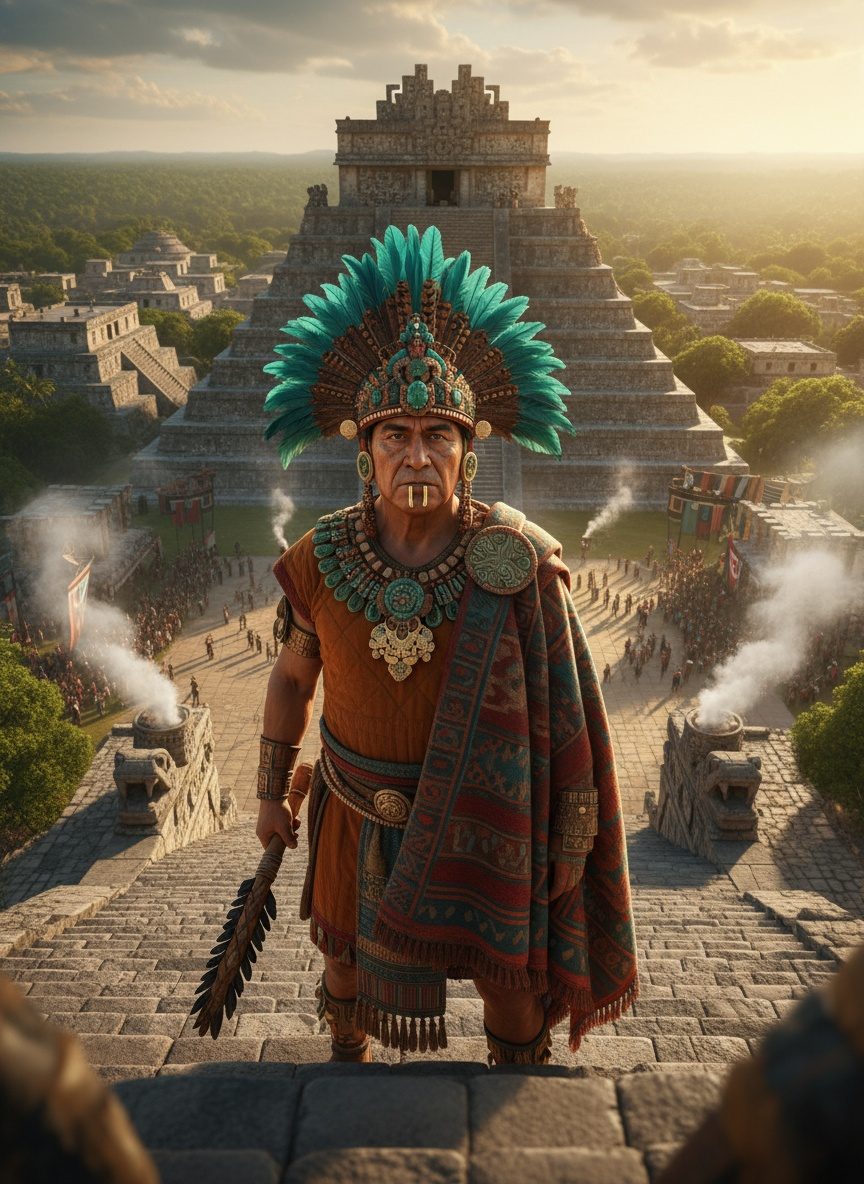
The air was electric with tension as Itzcoatl took a deep breath and gazed across the circle of skeptical faces. The flickering torchlight danced shadows on the walls as he raised his voice above the murmurs. "What if," Itzcoatl declared, his voice a blend of defiance and hope, "we forge our own destiny?" His question sliced through the heavy air, cutting straight to the heart of the matter. For decades, the Mexica had labored under the yoke of Tepanec domination, their once proud spirits worn thin by the shackles of tribute and poverty. Yet here stood a leader proposing rebellion — not with fiery speeches or rash promises, but with the simple query that ignited a revolution.
Chains of Tribute and the Call for Rebellion
The Tepanec Empire had not always cast a shadow over the Mexica. Once wanderers in search of a homeland, the Mexica had carved out a place for themselves in the Valley of Mexico. However, as their power grew, so did the oppressive demands of their Tepanec overlords. Each harvest was greeted with the knowledge that the fruits of their labor would be whisked away to fill Tepanec coffers. Warriors longed to prove their might not as Tepanec pawns, but as champions of their own fate. The weight was palpable, resting on both shoulders and spirits.
It was Itzcoatl, the fourth ruler of the Mexica, who dared to dream beyond submission. Against a backdrop of indifference and fear, his proposition was viewed as nothing short of madness. To challenge the Tepanec seemed a suicide mission, armed with nothing but desperation and a fledgling alliance. Yet Itzcoatl's determination was rooted not in insanity, but in an intrinsic understanding of the potential locked within his people. His vision saw beyond immediate survival to a horizon where the Mexica would rise as architects of their own empire.
Forging the Triple Alliance
Itzcoatl's audacity was met with foresight as he secured powerful allies. He envisioned more than just escape from Tepanec domination — he reached out to the rulers of Texcoco and Tlacopan, kindred nations with their own grievances against the Tepanec. The art of persuasion became Itzcoatl's tool, crafting a coalition bound not by tradition but by a shared vision of autonomy.
It was a coalition that transcended the mere military might of each individual city-state. The architecture of the alliance was one of mutual respect and shared spoils, envisioning an empire whose strength would lie in its unity. This Triple Alliance laid a foundation that would challenge the Tepanec stronghold and plant the seed of the Aztec Empire. While the Tepanec scoffed at the notion of rebellion, assuming their grip unbreakable, Itzcoatl's alliance quietly amassed strength, fueled by strategic prowess and a burning desire for freedom.
The Battle and Beyond
The night sky bore witness to battle cries and clashing arms as the Mexica, alongside their newfound allies, stormed the Tepanec stronghold in 1428. The battle was a crucible, where the mettle of Itzcoatl's vision was tested against the metal of Tepanec swords. Victory did not come easy; it was etched in blood and sweat, won by warriors who believed in the promise of a new dawn. Itzcoatl stood amidst the ashes of their enemies, not merely as a conqueror but as a liberator who had answered his own question with resounding triumph.
The fall of the Tepanec marked more than just the collapse of a regime; it heralded the rise of a new age. Under Itzcoatl's stewardship, the Mexica began rebranding their narrative — shaping an empire that would become synonymous with Aztec might. The chains that had once shackled them were melted down and reforged into the very weapons that expanded their reach across the region.
Legacy of Unity and Ambition
Itzcoatl's victory was not one of mere conquest; it was the manifestation of an idea — the envisioning of an empire that, at its heart, was a testament to the power of unity forged in shared adversity. By questioning the status quo, Itzcoatl unlocked possibilities that the Mexica had only dared to whisper. His leadership set in motion a cultural and political renaissance that would sculpt the very history of the Americas.
The question Itzcoatl posed to his council reverberates through history, serving as an enduring reminder that the course of civilizations can pivot on the willingness to defy convention. What empowered the Mexica was not simply the dissolution of Tepanec rule, but the audacious belief that they could — and would — determine their own fate. Itzcoatl's legacy lies not only in the cities and monuments of the Aztec Empire but in his gift of vision, the boldness to ask one's own people to dream beyond the visible chains of their situation. In doing so, he illuminated a path for all those who find themselves standing at the crossroads of oppression and opportunity.