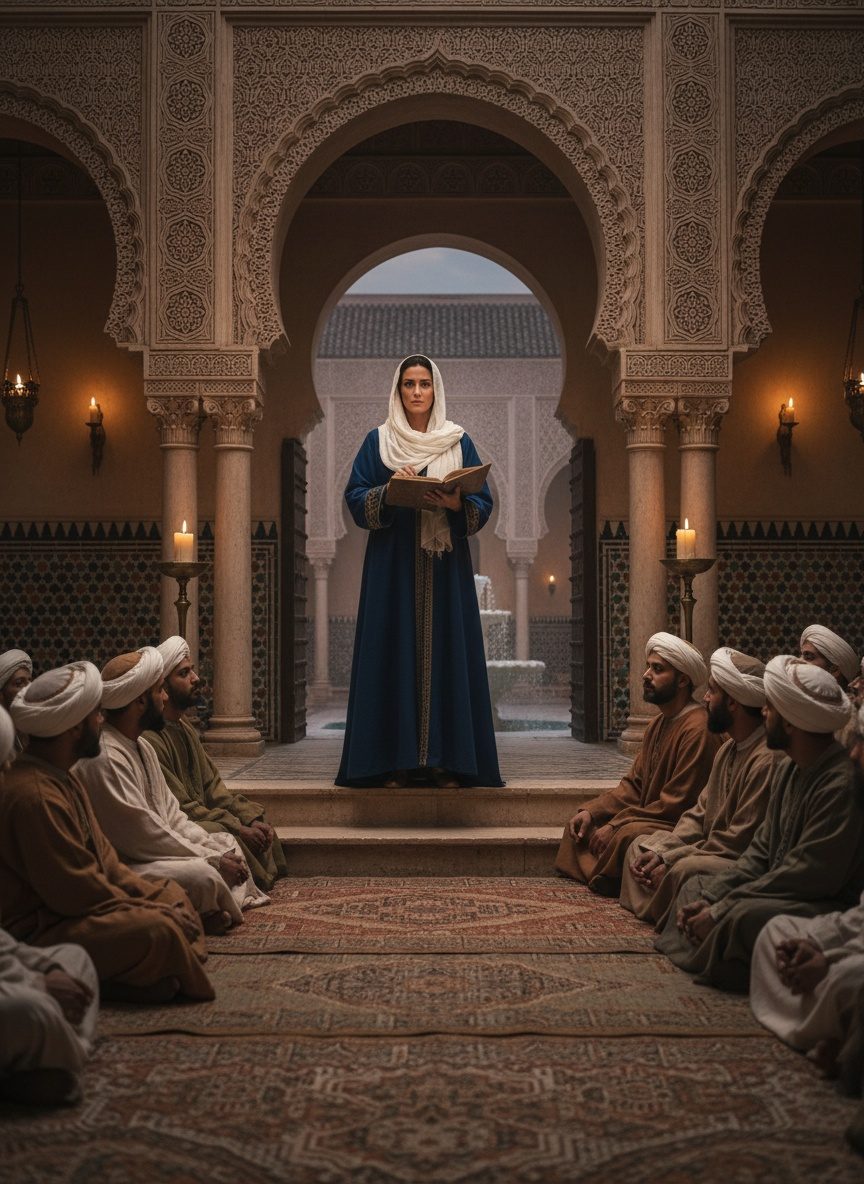
She was no ordinary scholar. Her voice commanded the reverence that not even seasoned clerics could muster.
The First Steps Into an Unwelcoming World
Baghdad, 1051. A city bustling with trade, scholarly pursuits, and the intricate weavings of a diverse culture. In the medieval Islamic world, knowledge was power. The madrasa was a hallowed sanctuary of intellectual discourse and religious guidance, dominated exclusively by men. No woman had ever set foot inside to teach — until that fateful day.
Fatima al-Fihri, a pioneering figure in her own right, had already shown the world what a woman could achieve. The university she established in Fez not only stood as an architectural marvel but as a testament to her commitment to learning and education. Her very existence served as an inspiration. But it was another woman whose actions would echo within the walls of the medieval academic sanctum, challenging societal norms and leaving an indelible mark on history.
A Woman of Remarkable Resolve
Her name, now lost to history, survives in the whispers of scholars and antiquarians. When she crossed the threshold of the madrasa, a place where no woman had taught before, the air bristled with tension. Her presence was a living challenge to the deeply ingrained traditions of the time.
Yet, it wasn’t just her audacity that set her apart; it was her unparalleled knowledge. Her arguments were methodical, her reasoning unassailable, and her insights profound. Possessing an eloquence that rivaled even her most learned counterparts, she presented her interpretations of Islamic jurisprudence with clarity and depth. As she spoke, seasoned scholars listened, their pens resting on their parchment as her words filled the room.
The Ripple Effect of the Unseen
The significance of her actions did not end within the confines of the madrasa. Her courage had far-reaching implications, challenging societal expectations and subtly shifting the sands of gender roles in the Islamic world. Though the patriarchal structures remained formidable, her bold move demonstrated that women could partake in scholarly discourse on equal footing with men.
Her presence at the madrasa may have been ephemeral, but it sent ripples through the community. It was a testament to the power of knowledge—a force so compelling that it made age, gender, and social constraints irrelevant. She carved a path for other women, who would later teach, debate, and even issue fatwas, all building upon the legacy of Fatima al-Fihri.
The Scholars Who Followed
The story doesn't end there. Inspired by their predecessors, women in subsequent decades began to play increasingly significant roles in Islamic scholarship. Silent no more, they engaged in theological debates, translated pivotal texts, and influenced the development of Islamic jurisprudence. Names like Aisha bint Abu Bakr, remembered for her profound understanding of hadiths, and Lubna of Cordoba, renowned for her fluency in multiple languages, became symbols of this growing intellectual force.
These women undertook roles as educators and translators, contributing to the rich tapestry of knowledge that defined the medieval Islamic world. Their contributions extended beyond the walls of academic institutions, influencing broader cultural and scientific landscapes, and proving that the legacy Fatima al-Fihri initiated was flourishing and expanding.
A Legacy Left Unwavering
The woman who entered the madrasa in 1051 did more than teach; she left a profound legacy that continued to unfold long after she had spoken her last words. Her actions offered a glimpse into a future where gender would not hinder one's intellectual pursuits. This tale from the 11th century reminds us that the quest for knowledge knows no barriers, and that courage, in any era, has the power to transcend entrenched norms.
In times when the role of women in society was rigidly confined, this woman's bold entry into the heart of academic discourse challenged the foundations of those limitations. Her story is a testament to the enduring pursuit of knowledge and the unyielding spirit required to claim one's place within it. And today, as we revisit her legacy, we are reminded that every voice — irrespective of gender — has the potential to spark change in ways we may never fully anticipate.