He was deemed too dangerous to fight for his country. Yet, as bullets soared past him on an Italian ridge, Daniel Inouye's bravery steeled him to push forward against insurmountable odds. Born in 1924 in Honolulu, Hawaii, Inouye found himself in a liminal space within his homeland during a time when his loyalty was questioned simply because of his Japanese ancestry. The attack on Pearl Harbor had only deepened existing prejudices, transforming people of Japanese descent on American soil into perceived threats rather than fellow citizens. Even so, the resilient spirit of young Inouye remained untarnished. When the U.S. military finally altered its policy, he ran two miles to enlist, eager to prove his allegiance and capability. Little did he know that his unwavering courage would put him at the center of one of World War II's most gripping and valorous stories.
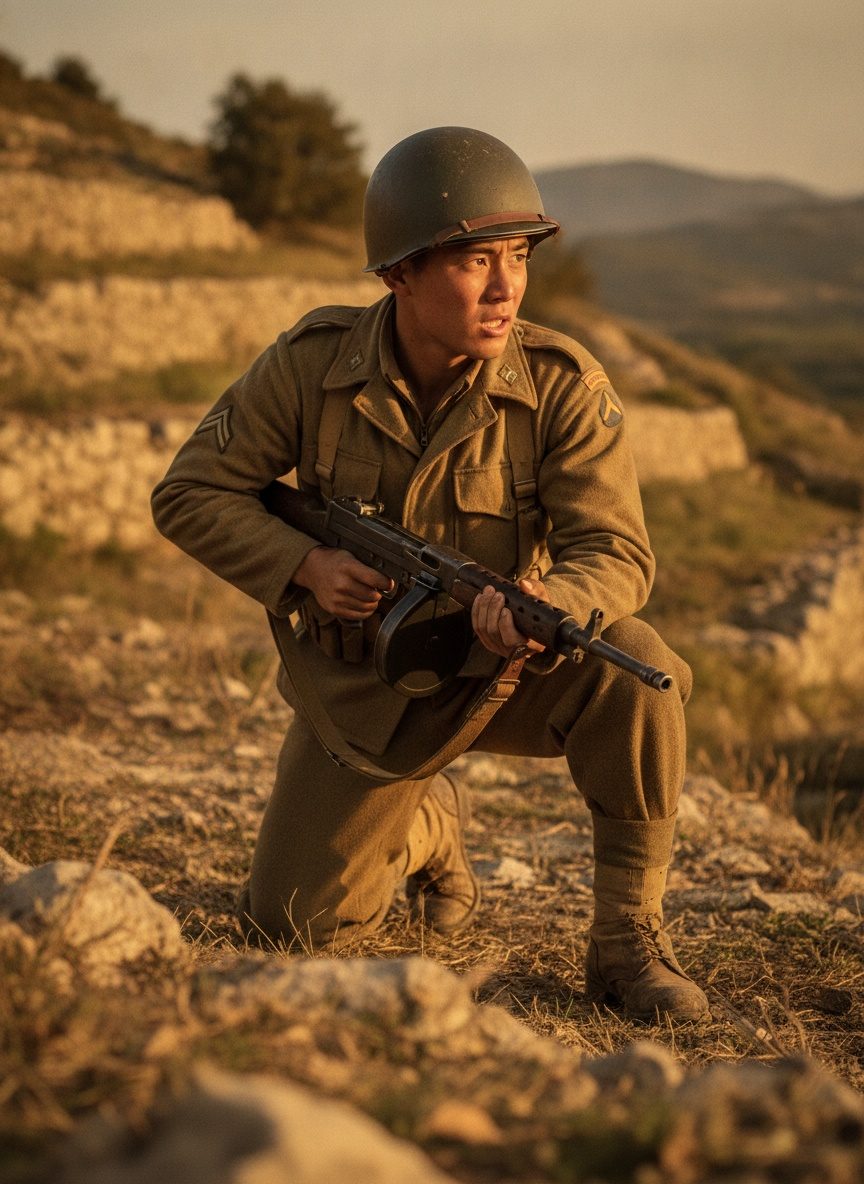
Serving as a part of the 442nd Regimental Combat Team, a unit primarily composed of Japanese American soldiers, Inouye was plunged into the thick of World War II. This battalion quickly earned a storied reputation for its relentless determination and unmatched bravery in the face of adversity. The climatic events that would place Inouye in the pantheon of military heroes unfolded in April 1945 during the final throes of the war. Positioned in the treacherous terrain of the Italian Apennines, his platoon faced formidable German defenses. This was no ordinary ridge; it was a crucible of combat, where three enemy machine-gun nests formed a lethal triangle within forty yards of the American forces. The assault demanded not just strategy but sheer audacity.
Inouye, a lieutenant by then, led the charge and, with steely resolve, orchestrated an attack that required impeccable courage. Engulfed in the cacophony of war, with the staccato of enemy machine-gun fire rattling around him, Inouye exhibited the kind of leadership few could muster. He approached the first of the machine-gun nests, crawling on hands and knees amidst the hail of bullets that razed the ground around him. Emerging dangerously close, he hurled a grenade that neutralized the threat. The first obstacle was eliminated, but the heart of the battle still thumped with fury.
Despite being injured, Inouye pressed on, like a force of nature unwilling to be restrained by pain or doubt. As he advanced on the second machine-gun nest, a rifle grenade struck his torso, leaving him wounded but undeterred. One can only imagine the physical agony and yet, Inouye's mind was singularly focused on his objective. His unwavering determination saw him destroy the second nest with sheer grit, dealing another blow to the entrenched defense.
Victory, however, was still a distant glimmer. As Inouye honed in on the third nest, the moment that would define him for generations to come arrived. A German soldier, intent on obliterating this unyielding adversary, launched a grenade that would catastrophically alter Inouye's life. The explosion tore through his right arm, rendering it useless—a devastating turn in the desperate heat of battle. But what followed was the extraordinary act that would etch his name into history. With blood pouring from his wound and an unrelenting spirit coursing through his veins, he commandeered the weapon from his injured arm and continued the fight with his left.
This level of perseverance is not merely the stuff of legend; it's a testament to the human spirit when faced with its darkest challenges. With his functioning left arm, Inouye threw his remaining grenades, clearing the third nest, and silencing the source of his platoon's torment. His men, inspired beyond belief, drove forward, galvanizing the charge and ensuring the enemy was vanquished from the ridge.
By the day's end, it wasn't just the strategic victory of securing the ridge that stood as a testament to their efforts, but the moral victory for those deemed 'enemy aliens' vindicating themselves and their allegiance. Inouye's actions didn't just reflect his own extraordinary courage but were emblematic of the 442nd RCT's valor and resolve. For his selfless bravery and supreme sacrifice, Inouye was awarded the Distinguished Service Cross, later upgraded to the Medal of Honor.
The story of Daniel Inouye doesn’t conclude with this violent episode. Returning home as a celebrated hero, he chose not to rest. He emerged as an influential figure in the political arena, serving Hawaii as a U.S. Senator for nearly five decades. His contributions never waned, whether on the battlefield or in the chambers of Congress, where he fought passionately for civil rights and veterans' affairs. Through every chapter, Inouye carried the scars of that day in Italy—not merely as reminders of loss, but as emblems of the endurance that marked his character and the ideals he stood for.
Inouye's narrative is more than just one of extraordinary valor on a distant battlefield; it's a seminal part of the American story often overshadowed by the broader tapestry of the war. It reminds us of those who stand resolute in the face of prejudice and doubt to affirm their place in the world. The legacy of Daniel Inouye—an American by choice and by action—serves as a powerful reminder of what it means to truly embody the principles of courage, loyalty, and conviction. In a time when the definitions of patriotism and loyalty were often muddled by fear and bigotry, he personified them with clarity and grace, one grenade at a time. The ridge in Italy wasn't just a tactical high ground; it was a battleground of ideals where Inouye's spirit soared above, unbroken and unapologetic.