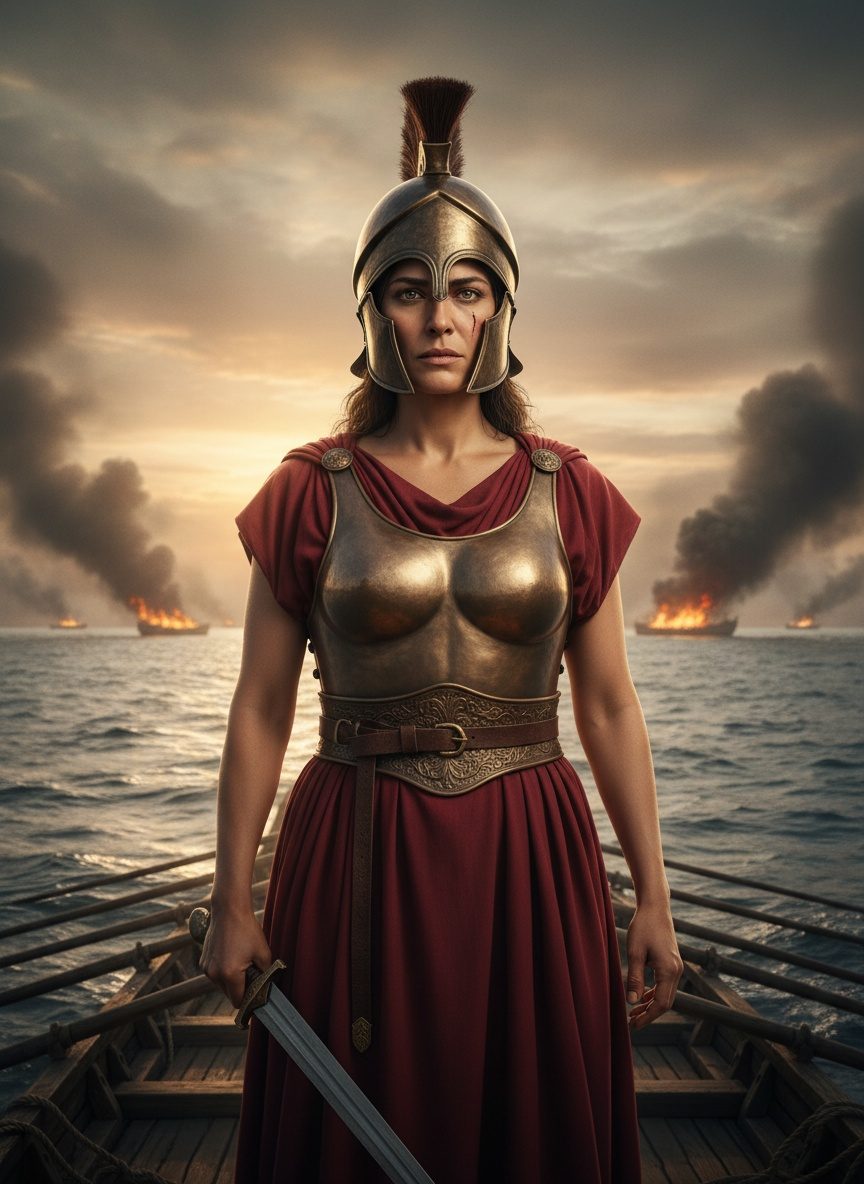
Thrown forward, the prow of her ship crashed through the wooden hull of an allied vessel, splintered wreckage scattering in the boiling blue waters off Salamis. Queen Artemisia stood steady, unfazed by the violent collision, her eyes fixed forward, unfaltering amidst the chaos that churned the narrow strait. Relentless and calculating, the queen of Halicarnassus commanded respect on a battlefield typically dominated by men, where most sought only to tell the mighty Persian king what they thought he wanted to hear. But Artemisia had dared to speak truth to power, a truth that now unfolded in brutal clarity.
Between Empires: The Persian Campaign
In 480 BCE, the clash between the Greeks and Persians reached its bloody crescendo in the waters near Salamis. The air hummed with tension as two powerful cultures vied for supremacy. For the Greeks, this battle represented the attempt to push back against Xerxes' vast empire, while Xerxes sought to stamp his authority across the seas as he had across lands. Amidst this turmoil, Queen Artemisia emerged, a rare female commander, leading her fleet on behalf of Persia—a testament to her prowess and political acumen.
Artemisia was no stranger to warfare or intrigue. As the daughter of Lygdamis I and the ruler of the small yet strategically significant city-state of Halicarnassus, her life was forged in corridors of power and aboard the decks of warships. Her involvement in the Persian campaign was not merely an act of loyalty to Xerxes; it was also a calculated move to preserve her city's status. Yet even as she aligned with Persia, her insight set her apart from other commanders. In the war council ahead of Salamis, with Persian anxiety and arrogance both swirling like the looming winds of battle, she spoke words none dared.
"Withdraw your fleet," she urged Xerxes, knowing that his ships were vulnerable within the enclosed waters where Greek triremes excelled. For her, the writing was on the wall: the Greeks had lured them here deliberately, a trap tightly sprung. Yet, blinded by the mirage of unbeatable numbers, Xerxes chose not to listen, leading his mighty fleet into a catastrophic whirlpool of defeat.
The Clash at Salamis
As dawn broke over Salamis, the slow, rhythmic beat of war drums stirred the sea-air, a harbinger of the imminent clash. Artemisia’s ships, swift and sharp, cut through the water. Her crew, drilled to perfection, carried out maneuvers under her exacting eye. Her ship bore down upon friend and foe alike, sailing through the chaos that engulfed the Persian fleet. Greek triremes darted between the cumbersome Persian vessels, their slimmer builds cutting through the water with lethal efficiency.
But amid the confusion, it was Artemisia’s move that turned eyes. Finding herself pursued by an Athenian vessel, she made the snap decision to ram one of her own allies, sinking it swiftly to fool her Greek pursuers into believing she fought on their side. The tactic worked; her cunning spared her from capture or death, and the Athenian captain switched targets, leaving her to escape.
In the midst of a devastating defeat for Persia, this act of deception became legend. Xerxes himself, watching the disaster unfold from the safety of the shore, is said to have commented, "My men have become women and my women men," upon hearing how Artemisia outwitted her attackers. For even in that place of ruin, she emerged with her reputation not tarnished but enhanced, demonstrating the tactical foresight and audacity that placed her name beside the greatest commanders of the age.
The Navigator of Truth
Herodotus, the famed historian of the age and a native of Halicarnassus himself, wrote of Artemisia with admiration, calling her the most remarkable commander in the battle. Through his writings, she is preserved in history as a leader whose brilliance cut through the biases of men who dismissed her due to her gender. Yet it was more than her savvy at sea or in councils that marked her legacy; it was her unsparing honesty.
Generations have passed since Herodotus first recorded the events of Salamis, yet Artemisia’s story compels reflection on the nature of leadership. In an epoch when courage was often measured by the sword, hers was a courage of intellect and insight—a warning of the impending disaster that went unheeded and yet showcased her understanding of strategy far exceeding her peers. She remains a reminder that truth in leadership, no matter how inconvenient, is often the first casualty in the fog of ambition.
Today, Artemisia's story serves as a rare spotlight on a woman who defied convention, wielded power on pragmatic terms, and penned her own chapter amidst the epics of ancient history. In an era that echoed to the clatter of clashing empires, she held her own, her voice and actions leaving a ripple that persists across millennia. Salamis was a defeat for Persia, but in the annals of history, it cemented the tale of a queen who dared to steer a path few expected, and fewer still could follow.