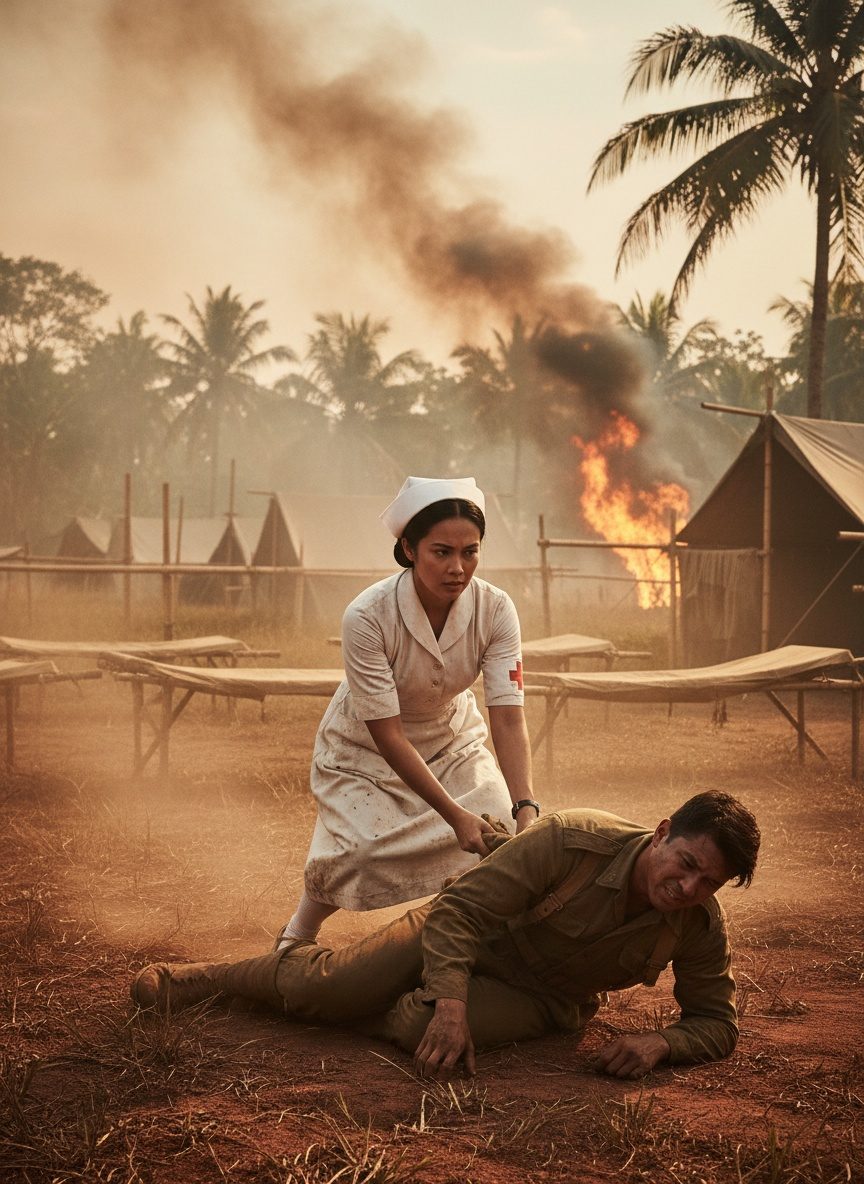
She carried no gun, nor wore a soldier's uniform. Instead, Valentina Tolentino wore the white dress of a nurse, stained and worn from days without rest. She was unarmed, yet she faced a volley of bullets with nothing but her unwavering determination.
In 1944, deep in the heart of Manila, the capital of the Philippines was caught in the throes of World War II's violence. Japanese forces had intensified their assault across the archipelago, and medical staff were trapped in a makeshift field hospital as tensions crested to a boiling point. Amidst the chaos and the relentless barrage, most would find a retreat the only option—a chance to survive. But for Valentina Tolentino, the calamity was a call to arms in a different form of battle.
Imagine the scene: shell casings clattering to the ground, the air thick with the acrid scent of gunpowder, and cries for help cutting through the relentless gunfire. Despite these harrowing conditions, Tolentino saw something others might have missed—her duty. Sixty Japanese soldiers had overrun the field hospital, and in this frenzy, Tolentino faced a haunting decision. Her patients, who depended on her for life-saving care, were stranded on exposed ground, easy targets in a cruel game of survival.
Tolentino's training as a nurse had not prepared her for warfare, yet in those urgent moments, it guided her hand. She knew every second mattered; hesitation could mean another life lost. While others might only see futility in trying to rescue the wounded amidst such chaos, Tolentino saw hope. She resolved to evacuate her patients, not once pausing for her own safety. It was a plan brinked on bravery or perhaps, as some might argue, sheer audacity.
On her hands and knees, Tolentino crawled through rubble and debris, each movement deliberate and cautious. Her heart pounded not from fear, but from the urgency of her mission. She reached her first patient under suppressive fire, somehow invisible threads protectively weaving between her and the bullets that whizzed by. With a gentle firmness, she assured the wounded soul before beginning the arduous task of dragging him to a place of shelter.
Time blurred as she made the journey over and over, risking her life with each fraught crossing. By her resolute hands alone, four patients were pulled from the jaws of death back to moments of grace and care. The air roiled with the sounds of conflict, yet Tolentino maintained a singular focus. Each trip bore the weight of not just bodies, but the profound hope that they would survive to see a day beyond war.
In the drawn out sequences of these rescues, Tolentino became something greater than a nurse; she was a force of nature, one refusing to be subdued by fear. The miracle was not just in the act she performed, but in the result—none of her patients perished during that harrowing ordeal. It was a testament to her swift, instinctive decisions, each deeply rooted in her commitment to preserving life.
Though Valentina Tolentino's bravery occurred in a moment of chaotic wartime anonymity, her story resonates powerfully today, revealing facets of courage not confined to battle-honed warriors but residing within those driven by compassion and responsibility. Her actions illustrate a different kind of heroism, one that shines brightest not in conquest but in unwavering perseverance. In an era riddled with narratives of destruction, Tolentino's actions remind us of the humanity threading through even the darkest chapters of history.
This narrative, brimming with courage under fire, teaches a lesson often neglected: valiance does not always bear arms; it sometimes moves silently through smoke and shadows, saves lives, and fulfills promises of hope when all seems lost. Valentina Tolentino's tale may not have been one taught in traditional courses of history, but it stands as a testament to the strength found in the quiet corridors of a nurse's resolve, bravely carved into the annals of the past.