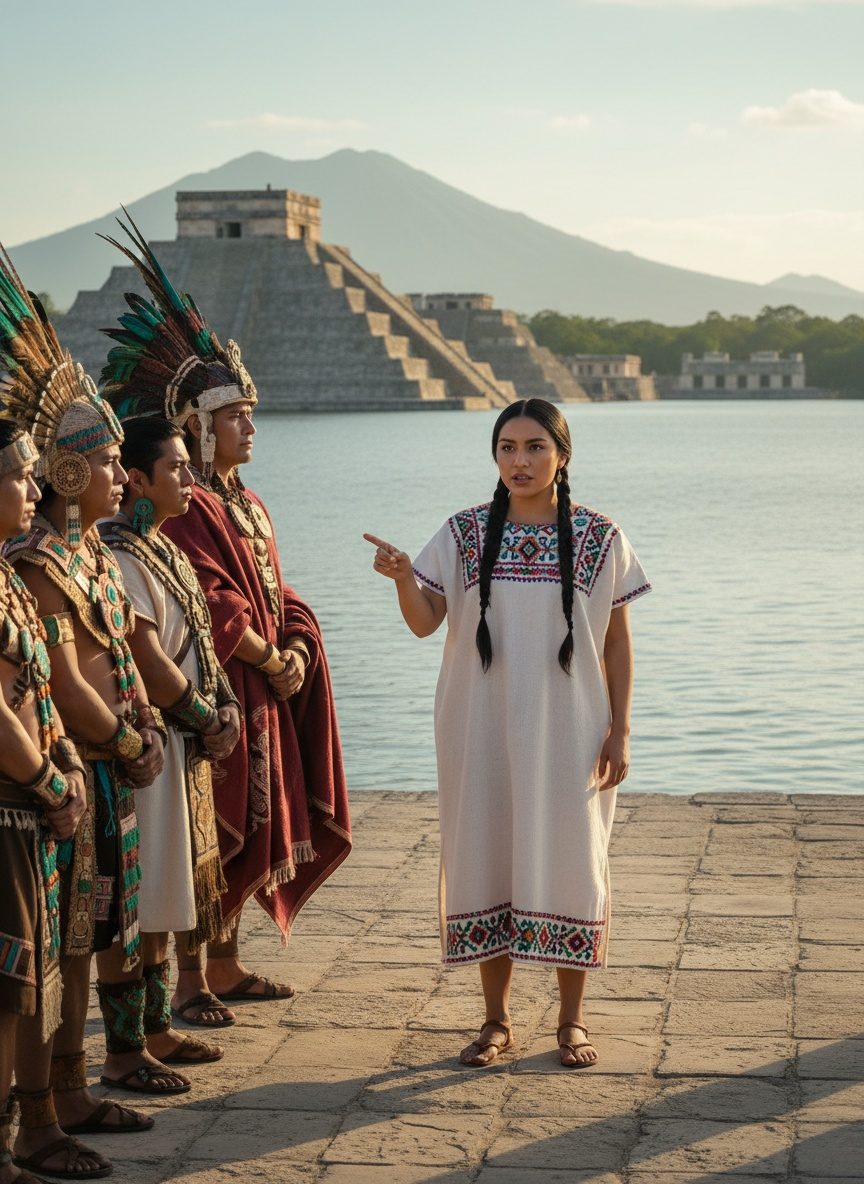
1519. The coastal air hung dense with humidity, carrying the mingled scents of salt and earth to the shores of a nascent world brimming with tension and possibility. As the distant horizon blurred with the morning mist, the Aztec Empire lay sprawled across the Mexican landscape, alive with vibrant cities and ancient traditions.
The Child of Three Worlds
In this sprawling empire lived a young girl whose life, much like the empire itself, was a tapestry woven from disparate threads. Born around the cusp of the 16th century in what is now known as the Mexican Gulf Coast, she was a child of three worlds. The daughter of a noble family, her early years were marked by privilege. Yet, circumstances shifted dramatically when she was sold into slavery as a child after her father died, and her mother remarried, a fate not uncommon in the shifting allegiances and power struggles of indigenous societies.
This young girl, known in her time as Malinalli, was exchanged as a peace offering between indigenous groups, a pawn in the complex game of tribal diplomacy that characterized the region. Though captivity was not what her family envisioned for her, these years spent with the Maya shaped her profoundly. She absorbed their language and customs, adding to her already extensive knowledge of the Nahuatl language spoken by the Aztecs.
Her linguistic dexterity and keen intelligence positioned her uniquely in a world on the brink of monumental change. Little did those around her realize, Malinalli’s ability to navigate seamlessly between cultures would carve out an extraordinary role in the history yet to unfold. It was her voice that would rise above the clamor of confusion, forging understanding between two worlds destined to collide.
The Meeting of Two Worlds
In the spring of 1519, the Spanish Conquistador Hernán Cortés landed on the Mexican coast near present-day Veracruz. The sight of the strangers, their skin pale as moonlight armor gleaming under the sun, set the stage for encounters that would alter the course of history. The Aztec Emperor, Moctezuma II, watched these developments with cautious intrigue, aware of omens that foretold the coming of new, god-like beings. Yet, uncertainty reigned. He needed someone who could weave back and forth between his world and theirs, a task that fell to Malinalli, who the Spanish would come to know as La Malinche.
Given as a slave to the Spaniards by the indigenous people her captors encountered, Malinalli quickly stood out to Cortés. Her trilingual abilities placed her as an essential intermediary. With the assistance of a Spanish friar, she communicated the nuances of Nahuatl through her intermediary language, Maya, to Cortés. It was she who relayed the Emperor’s words to the foreigners and conveyed their responses back, a living bridge between empires and their leaders.
This position brought both reverence and resentment. To the Aztecs, she became a symbol of both understanding and betrayal. Each translation was more than just words; it was a negotiation of power, life, and death. One can imagine the weight she must have felt as empires trembled and destinies were altered based on the fidelity and intent of her translations, carrying the unseen potential to soothe conflicts or ignite wars.
The Legacy Beyond Words
The years pressed on, and with them came the fall of the mighty Aztec Empire. The whole world seemed to shift beneath Malinalli’s feet as the last traces of the old ways were erased by the storm of conquest. Yet, perhaps unerringly, she stood as a testament to resilience and the complexity of human alliances. Malinalli—La Malinche—came to embody different meanings to those who followed: a traitor to some, a heroine to others, and a complex symbol of cultural exchange that resonates today.
Her tale sheds light not only on her personal struggle but also on the broader narratives of colonization and indigenous resistance. While some remember her as an opportunistic figure who aided conquerors, others view her as a pragmatic woman who skillfully navigated the volatile landscape to ensure her survival and significance. In the shadows of a dying empire, her words carried more than just the weight of shifting powers; they bore the stories of loss, transformation, and the unrelenting spirit of those who lived through perhaps the greatest upheaval their world had ever seen.
As we reflect on the intertwined histories of nations, La Malinche’s legacy continues to provoke thought and dialogue about the complexities of identity, collaboration, and power. Her story urges us to consider the multifaceted roles individuals play in the ebb and flow of history, and to acknowledge the human dimensions within the larger machinery of empires and their demise.