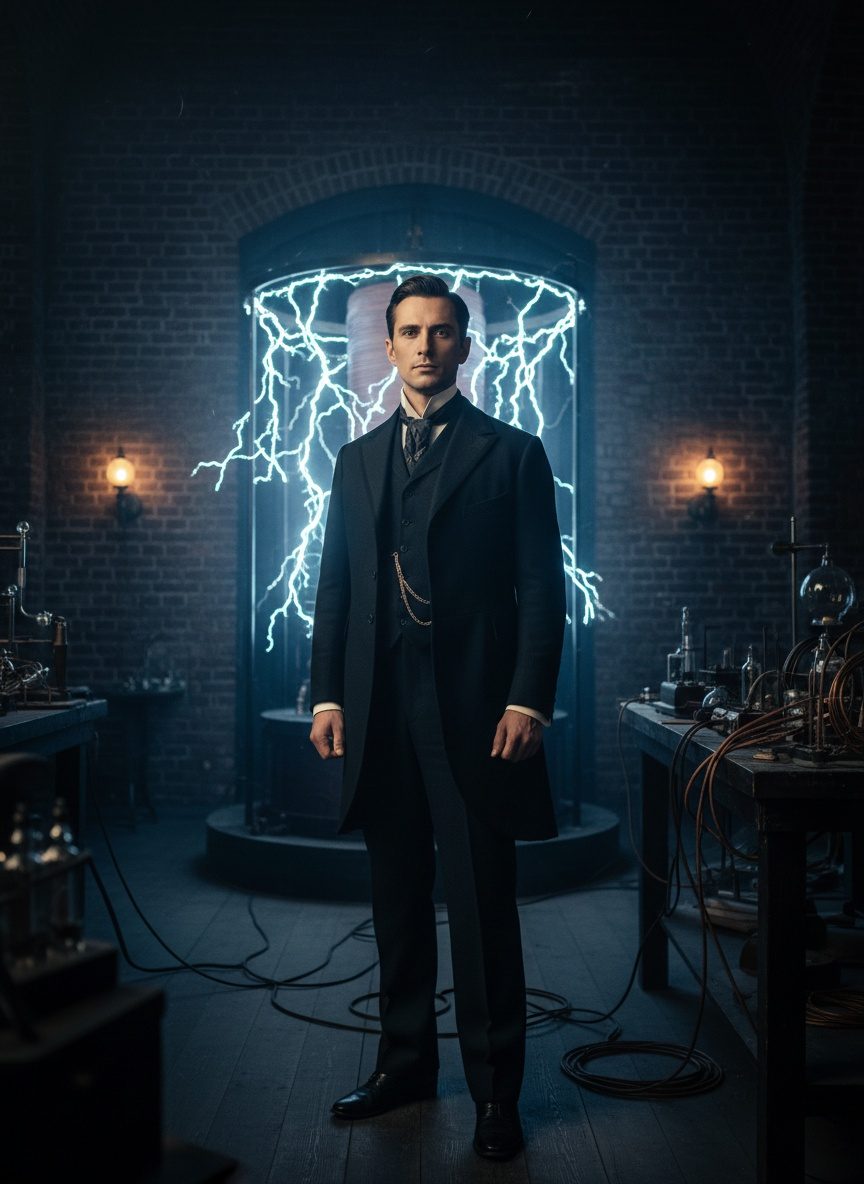
It was a humid afternoon in July 1884, and the New York Harbor buzzed like a beehive, filled with swarming travelers, each grappling for a foothold in the land of opportunity. The city itself was a cacophony of sound and light, the steam engines hissing and gas lamps flickering to fend off the growing shadows of the tenements. Among the throng of immigrants stepping onto the bustling docks, a gaunt figure emerged, eyes brimming with ambition and a mind bubbling with radical ideas. This was Nikola Tesla, a young man from the Austro-Hungarian Empire, holding nothing in his possession but a threadbare suit, four cents, a few poems, and a spark of knowledge that would soon electrify the world.
The Visionary and The Magnate
By the time Tesla arrived in America, Thomas Edison was a household name. The very air of New York City seemed charged with Edison's achievements; his direct current (DC) power systems lit up parts of Manhattan, casting long shadows and longer aspirations for the burgeoning metropolis. Yet, for the wide-eyed Tesla, Edison's reign had just begun when opportunity knocked. Clutching a letter of introduction, Tesla sought the renowned inventor, eager to share his revolutionary ideas. But while the streets gleamed with Edison's filaments, it was Tesla's invention that promised to illuminate not just cities, but the very future.
Edison, enthralled by his own successes, rebuffed Tesla's vision. The Direct Current systems worked well enough, Edison's hubris claimed, why tinker with perfection? Tesla's bold proposal—a new form of electricity known as Alternating Current (AC)—was a technical symphony in a world content with monophonic tunes. Lacking support yet undeterred, Tesla found a new ally in the titan of finance, J.P. Morgan. Morgan, ever a businessman with an acumen for innovation, was captivated by the potential of harnessing an endless tapestry of electricity, woven seamlessly through his financial empire. Yet, when Tesla's ideologies grew too outlandish, suggesting free power for all, Morgan, the pragmatic capitalist, recoiled. His funding, like a gust of wind, vanished as swiftly as it had arrived.
Edison's Shadow and Tesla's Light
As the 19th century waned and the dawn of a new era beckoned, the backdrop of America's industrial landscape was painted in swathes of rivalry—the War of Currents, it was later termed. Edison and Tesla found themselves at the helm of opposing camps. Proponents of DC sought to tarnish Tesla's reputation, sparking fears of the dangers posed by AC currents. But Tesla, unflinchingly resilient, pressed forward. In the rise of mighty power stations and sprawling electric grids, the possibilities Tesla imagined found daylight, softly illuminating the edges of an electricity-hungry world.
While America grasped for its industrial second wind, Tesla enlisted the support of George Westinghouse, an industrial tycoon who embraced the future Tesla envisioned. With Westinghouse's trust and resources, Tesla's innovative AC technology matured into a formidable force. The culmination of his work came when the World's Columbian Exposition in 1893 beamed with incandescent lightbulbs powered exclusively by Tesla's AC system—a radiant testament to his relentless brilliance.
The Night Illuminated, the Dream Dimmed
Despite such triumphs, the fractures in Tesla's fortune spread like cracks in a dam. Inventive dreams gave way to chilling solitude as invention after invention struggled to find commercial success. His endeavors into futuristic technologies—telescopic communication, X-rays, and wireless electricity—attracted awe and skepticism in equal parts. J.P. Morgan's withdrawal mirrored a wave of reservations from once-enthusiastic supporters. Like a tide retreating from the shore, financial backing ebbed unmistakably.
In the twilight of his life, Tesla found refuge in a lonely hotel room in New York City, merely a whisper of presence in the city's roaring heart. His room, lit by the glow of his own genius—an electric bulb—was a paradoxical sanctuary, a room of shadows and light. It was here, isolated but not forgotten, Tesla's expansive mind drifted into the soft embrace of obscurity.
Tesla's story is etched into the very fabric of modern existence. The hum of an electric world owes its genesis to the spark he ignited. But his journey—a blend of brilliance and burdens—is a somber reminder of the fine line between visionary genius and the often mercurial nature of fortune and recognition. As we flip a light switch or charge a device, Tesla's legacy, though flickering at times, continues to illuminate the essence of innovation: forging pathways untraveled, even when shrouded in darkness.