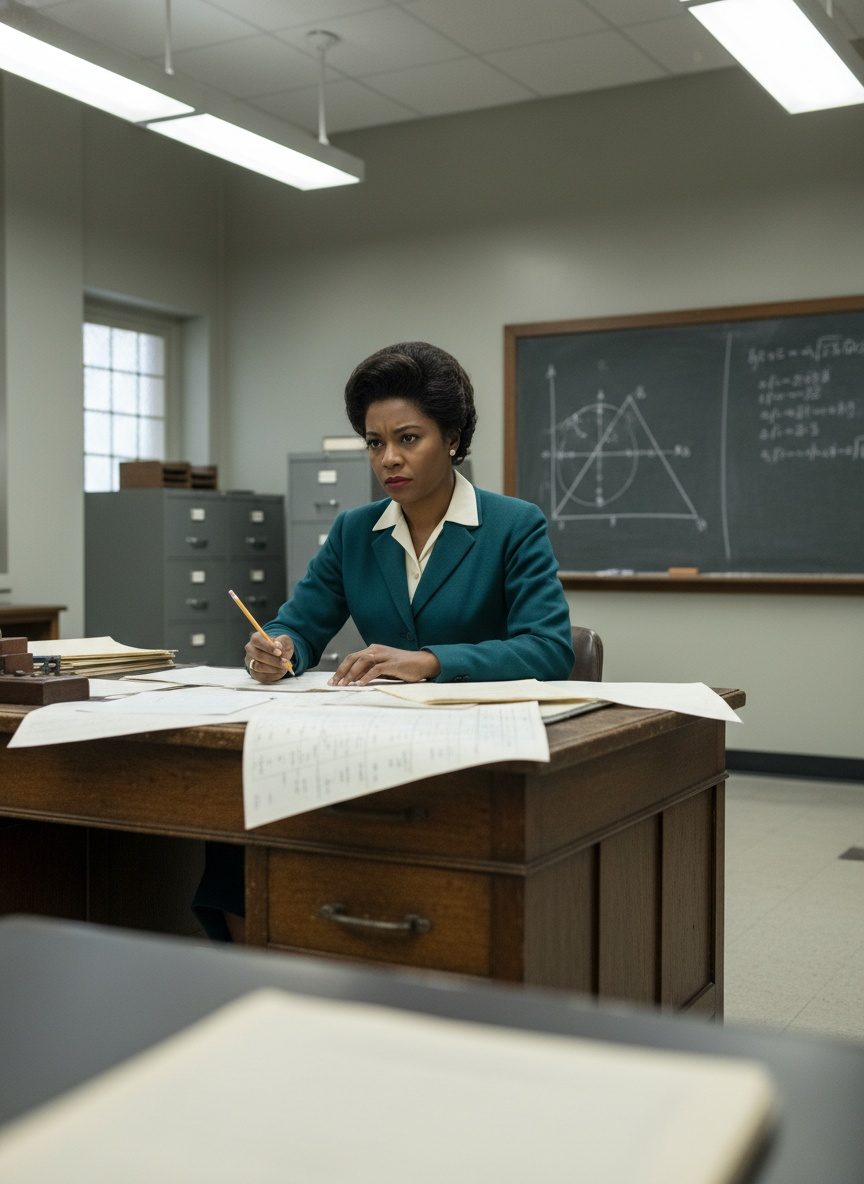
The room buzzed with tension as Katherine Johnson's fingers danced deftly over the paper, her pencil executing precise calculations with the precision of a surgeon's scalpel. She sat in a corner of NASA's bustling office, surrounded by the hum of machinery and the low chatter of engineers. Eyes flickered in her direction with a mix of respect and curiosity; the stakes couldn't have been higher. John Glenn, the astronaut who was set to make American history, wouldn’t step into the spacecraft without her go-ahead. While others trusted the gleaming new computer, Glenn placed his faith in Katherine's relentless accuracy. "Get the girl to check the numbers" had been his directive, his life depending on the mathematics that filled Katherine's days—and often her nights.
The Woman Behind the Curtains
In 1962, America was a nation striving to cement its position in the Space Race. Yet, beneath the facade of progress, social divisions festered. The NASA halls where Katherine worked reflected these divides. She operated in an environment that segregated her not only by her gender but by her race. Officially a "computer" in the all-Black West Area Computing section, her role came with its own boundaries: separate bathrooms, different dining facilities, and a constant undertone of skepticism about her capabilities.
Undeterred, Katherine's mathematical genius refused to be bounded by labels or prejudice. Her calculations were not just numbers—each figure encapsulated the hope, ambition, and ingenuity of a nation in orbit. With every equation she worked through, she was not only calculating trajectories but also rewriting her place in history. Her work facilitated Freedom 7, the American mission that would, quite literally, reach for the sky. Yet she was a hidden figure, her contributions concealed beneath the opaque veil of institutional biases.
As she meticulously ran the computations for John Glenn's historic flight—a mission that would cement America’s reputation in the cosmos—Katherine proved to be more than just a mathematician. She became an essential piece in the NASA machine, her input critical to the success of missions that were televised and celebrated worldwide. Despite this, her name was whispered in corridors but was conspicuously absent from the official accolades and public acknowledgment that her white, male colleagues readily received.
Navigating the Impossible
The pinnacle of Katherine Johnson's career came during the Apollo 13 mission, a high-stakes operation that unfolded under the watchful eyes of the world. The mission, initially destined for lunar success, had gone awry, a service module explosion putting three astronauts in peril. As the news broke, what should have been a meticulously planned lunar landing devolved into a desperate race against time to safely bring the crew home.
Back on Earth, amidst the organized chaos of NASA's mission control, Katherine—a pencil and paper in hand—set about calculating a life-saving return trajectory. While others relied on electronic computers, her mind served as the ultimate codebreaker of cosmic puzzles. The room was silent, intense focus masking the collective anxiety that hung in the air. Each stroke of her pencil was a lifeline, her impeccable mental gymnastics directing the crippled spacecraft back to Earth.
Despite the weight of that world-renowned operation pressing upon her shoulders, Katherine never faltered. Her calculations were a testament to human resilience and ingenuity—the unsung symphony in a saga of near disaster. Yet, her role remained shrouded in obscurity, her narrative woven into the background of a male-dominated tapestry.
Beyond Numbers and Nautical Miles
Katherine Johnson's story is much more than that of a mathematician. Through the decades, her narrative serves as a poignant reminder of both the trials and triumphs of women and minorities in fields dominated by privileged majorities. Despite her critical contributions to one of humanity's greatest achievements, her name was curiously absent from textbooks, brilliantly concealed for half a century.
Finally, decades later, as the echoes of space exploration advanced and society's tides began to turn, the world acknowledged Katherine Johnson. In 2015, the Presidential Medal of Freedom was a belated yet fitting tribute to a woman whose extraordinary work had lofted humanity into the stars. She stood, aged 97, as an emblem of perseverance, her legacy whispered not through corridors but shouted through history's resume.
Her story provokes introspection into the contributions hidden in the shadows, urging a rewrite of the narratives we celebrate. She calculated mankind's ambitions, embodied a quiet revolution, and her pencil-forged pathways remain etched in the annals of history. Katherine Johnson's journey from a segregated section in NASA to a timeless symbol of excellence emphasizes the enduring power of truth emerging from the shadows, a beacon igniting a path forward for dreamers yet to come.