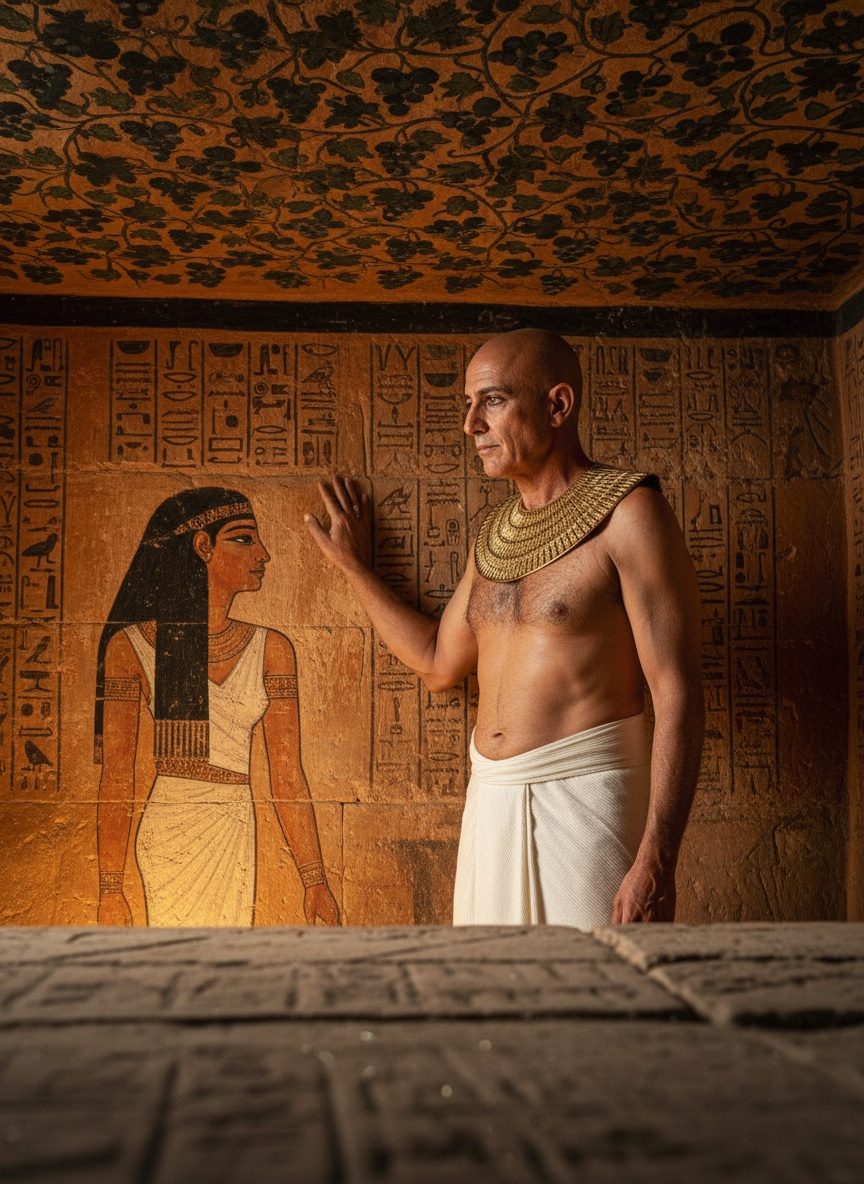
In the often relentless heat of Thebes, a place where the air seemed heavy with the scent of the Nile’s fertile offerings and the ancient sun cast long shadows by midday, stood the magnificent tomb of Sennefer. Carved deep into the limestone cliffs of the Valley of the Nobles, its splendor might have been mistaken for a small palace rather than a simple resting place. This tomb held a secret, however, that set it apart from others in the vast Theban landscape: instead of gods or kings, it was one woman's face that graced the walls, a face that spoke of love rather than power, devotion rather than duty.
Sennefer, the esteemed Mayor of the Southern City, as Thebes was known, lived during the reign of Pharaoh Amenhotep II, around 1400 BC. His position granted him access to wealth and influence unfathomable to many at the time. He was a man of status, his every move watched by those seeking favor or fearing his wrath. However, beneath his official duties and the political machinations of court life lay a personal decision that would echo through history. In constructing his tomb—a testament to his earthly successes and preparation for the afterlife—Sennefer made an eternal vow. Not to his sovereign, but to Meryt, his beloved wife.
Walking through the passageways of his tomb, one is greeted not by the grandiose homage to the pharaoh, which was customary among the elite, but by an intimate celebration of Meryt. Her visage is there at every turn, her presence omnipresent, as though she herself were guiding Sennefer on his journey through eternity. Every fresco, every delicately carved relief, captures the essence of Meryt. Her face is a serene constant amidst the vibrant depictions of life's bounty—harvests of grapes, preparations for banquets, and moments of domestic harmony.
Why would a man of such significant standing choose to dedicate so much of his tomb to his wife? While the specifics of Sennefer’s motivations are lost to the sands of time, we might infer much about his enduring admiration and respect for Meryt. In ancient Egypt, the concept of Ma’at—truth, balance, order, harmony—was foundational to all aspects of life and death. Meryt, in her steadfast presence, may have embodied this very principle for Sennefer, grounding his world in a way politics and power could never achieve.
The detail and artistry in her depictions suggest not only a personal affection but perhaps also a social statement. By elevating Meryt to such prominence, Sennefer may have been paying tribute to the powerful role that women held within Egyptian society, a role often overlooked by the broader tapestry of history. Contrary to many ancient societies, Egyptian women could own property, inherit wealth, and hold significant positions of responsibility. Meryt, through her husband’s veneration, emerges not just as a romantic partner but as a woman worthy of eternal celebration.
As you delve deeper into the depths of the tomb, the air cools, and the light from the outer world fades, leaving only the flicker of a torch to illuminate the surroundings. Here, the images grow more intimate. One scene might depict Meryt holding a lotus flower, symbolizing rebirth, its fragrance forever captured among the irreplaceable sands of time. In another, she might be shown engaged in an offering to the gods, a partnership reflecting her own readiness for the afterlife’s journey.
For Sennefer, immortality was not measured by the breadth of his political achievements but through the lens of personal fulfillment and fidelity. Unlike the pharaohs who etched their names into eternity with sonorous titles and divine claims, Sennefer’s legacy was imbued with a quieter yet profound strength. His homage to Meryt echoed a love story that transformed sepulchral corridors into a testament of human connection. Her likeness was there to protect him, guide him, and, perhaps most importantly, join him in the journey through the afterlife.
What might we learn from this dedication that resonates even today? In a world preoccupied with grand gestures and public esteem, Sennefer’s tomb serves as a reminder of the power of personal legacy. His decision to honor Meryt reflects a prioritization of intimate ties over the transient applause of power—a recognition that the bonds we forge with those closest to us outlast the fleeting triumphs of authority.
Thus, as scholars and visitors stand beneath the ancient stone, they are transported beyond the political intrigues of the 18th Dynasty to a place where eternal love is enshrined in every chisel mark. Sennefer’s devotion transcends time, making us pause to consider how, despite millennia of change, the human heart's desires remain remarkably constant. In our quest for eternity, perhaps what truly endures is not the memory of what we built for ourselves, but whom we chose to treasure and celebrate along the way.