He was a commoner with no royal blood. Yet Senenmut held the ear of a pharaoh.
A Commoner's Rise in the Land of Pharaohs
In the thriving atmosphere of ancient Egypt's 18th Dynasty, the nobility ruled with an iron fist, each lineage following in the esteemed footsteps of their forebears. It was an era when the idea of a commoner ascending to the highest circles of power alongside the Pharaoh was not just improbable—it was unthinkable. Yet, against this backdrop of social rigidity, Senenmut emerged from obscurity to become one of the most significant figures in the powerful court of Pharaoh Hatshepsut.
Senenmut was an anomaly to the societal norms of his time. Born without title or inherited wealth, he defied conventions through sheer talent and ambition. His early life remains largely shrouded in mystery, but what we do know paints a compelling picture of his rapid rise. A self-made man, Senenmut was distinguished by his acute intelligence and profound knowledge of architecture—a discipline held in high regard in a civilization that venerated monumental structures.
Designing a Legacy: Hatshepsut's Mortuary Temple
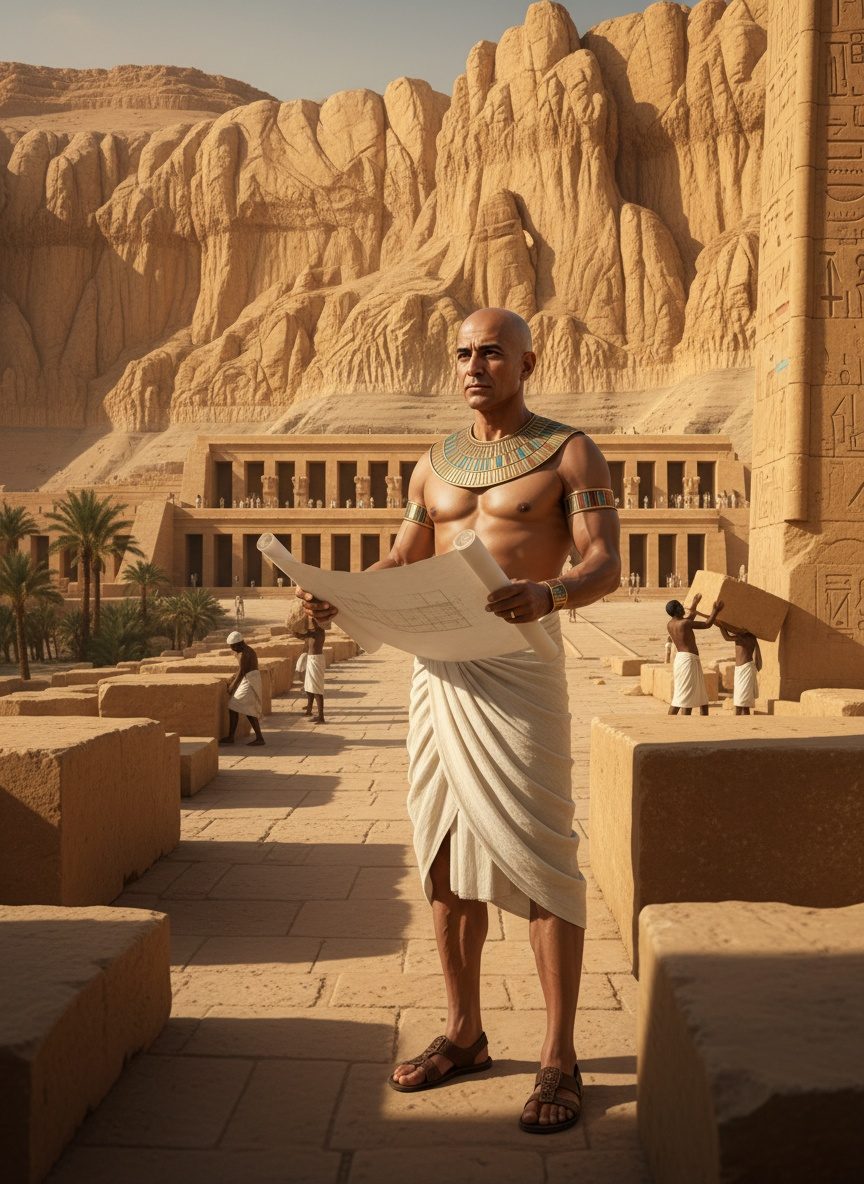
When Pharaoh Hatshepsut sought to immortalize her reign through an architectural marvel, she placed her trust in Senenmut's hands. Her mortuary temple at Deir el-Bahri, unlike anything Egypt had seen before, became Senenmut’s crowning achievement. Nestled against the rugged cliffs in the Theban necropolis, the temple was a symphony in stone—a masterpiece that harmonized with its natural surroundings, seemingly carved from the very mountains themselves.
With vast porticoes, imposing colonnades, and intricate reliefs decorating its massive walls, the temple was a testament to both Senenmut's architectural genius and Hatshepsut’s grand vision. The monument’s designs strategically emphasized Hatshepsut as a divine ruler, ensuring her eternal presence in the afterlife and securing her legacy among Egypt’s pantheon of greats. Senenmut's intimate understanding of both the pharaoh’s ambitions and the complexities of Egyptian architectural forms was undeniable—and it cemented their partnership as one of mutual respect and admiration.
The Trusted Tutor to the Princess
Senenmut's influence extended beyond architecture. He was entrusted with the education of Neferure, Hatshepsut’s daughter, signifying a level of trust and favor unparalleled among commoners. In this role, he was responsible not only for imparting knowledge but also for preparing the princess for a future potentially as influential as her mother’s.
His appointment as tutor was not merely symbolic; it was a signal of his unique standing at court. Senenmut knew that the success of the young princess was intertwined with the stability of Hatshepsut’s reign, and his efforts contributed to the strength and legitimacy of her dynasty. The exceptionally rare privilege to tutor royalty underscored his enviable position and further solidified his lasting imprint on a critical period of Egyptian history.
The Architect of Monuments and Power
Among his many accolades, Senenmut's role as overseer of royal works granted him the reins over some of Egypt’s most revered construction projects. His efforts resulted in not only extraordinary individual structures but a holistic transformation of the Theban landscape—improving the kingdom’s infrastructure and elevating its cultural prominence.
Senenmut had other titles that expanded his influence: steward to the king’s daughter, chief of all the king’s works, orator of divine offerings. Each new designation revealed his close association with Hatshepsut's reign and highlighted the formidable trust placed in him. Yet this level of power, carved from the endless desert sandstone and fertile imagination, made him a target for envy and ire among those who saw his rise as a threat to the old order.
The Relentless Shadow of Erasure
Despite his monumental achievements, attempts were made to erase Senenmut from history, much like Hatshepsut herself after her death. Many of his statues were defaced, and inscriptions bearing his name were systematically chiseled away in an effort to obliterate his contributions. But the plain stone walls of the temple at Deir el-Bahri have preserved his story—a mute witness to the past that refused to be silenced.
In the hands of time, erasures and restorations have accentuated his paradoxical existence. As history attempted to erase Senenmut's name, his constructions stood as his defenders, imbuing his memory within their shadows and sunlight. The story of Senenmut matters because it defies the notion that one's birth determines one's destiny. His life is a testament to the potency of talent over birthright, the timeless struggle for recognition amidst forces that seek systemic invisibility. In the grandeur of Egyptian stone and sand lies a message as enduring as the monuments themselves: even the deepest erasures cannot quell the light of extraordinary vision.