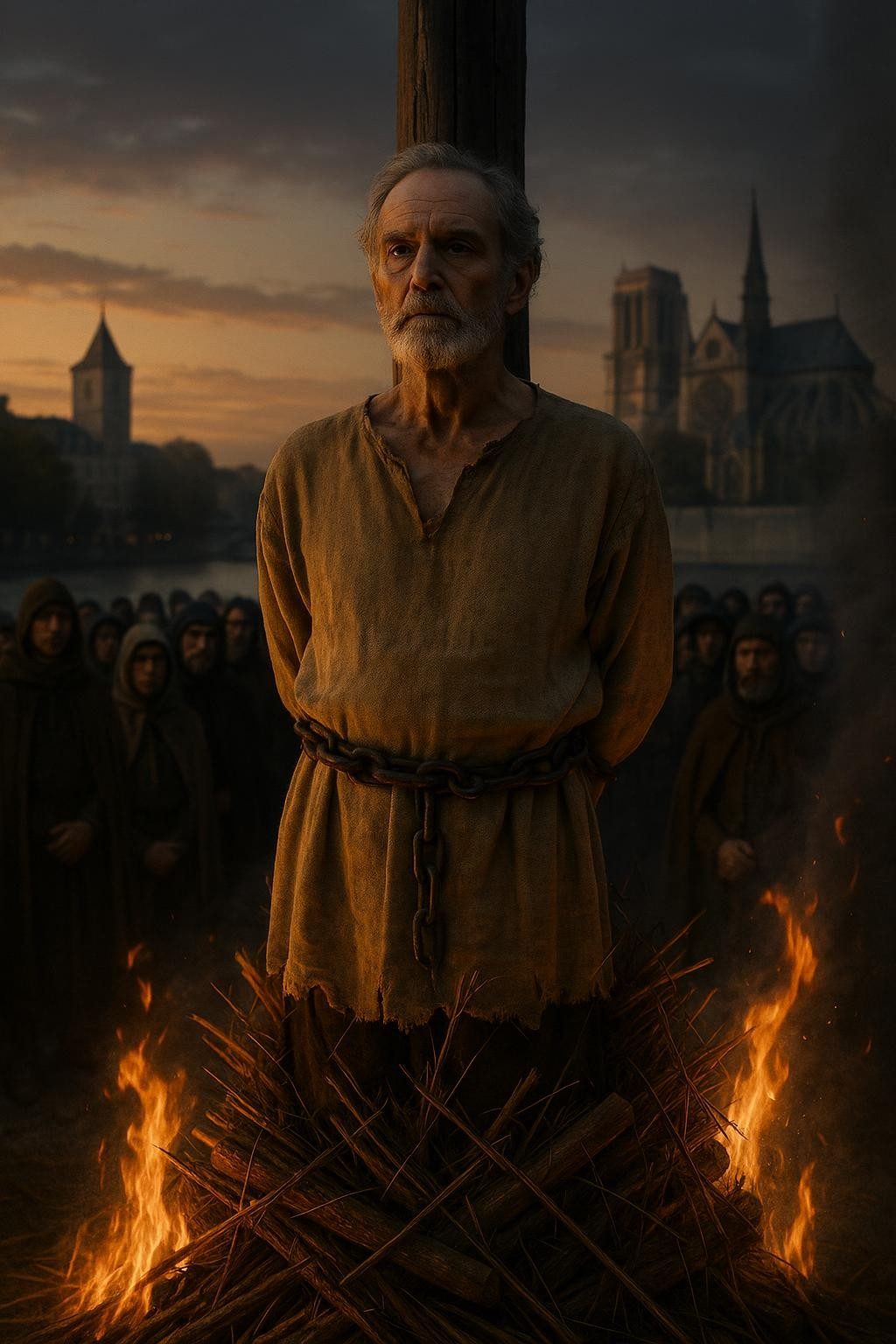
On a crisp March morning in 1314, an icy wind swept through the uneven cobbles of Paris, its ruthless chill cutting through the layers of the gathered crowd's woolen tunics and cloaks. Against the backdrop of the grim, gray sky, the murmurs of anticipation swelled and ebbed like the tides of the nearby Seine. This frigid audience braced themselves not only against the cold but for the spectacle they had been promised — an execution that would silence any remaining echoes of an order all but obliterated. In the midst of this charged atmosphere stood Jacques de Molay, the former Grand Master of the Knights Templar, bound yet unbroken, defiant even as he faced the fire.
The tale of Jacques de Molay, culminating in such a public and fiery death, began with the surreptitious workings of King Philip IV of France. Seven years earlier, whispers of scandal and accusations of heresy had unleashed a calculated storm upon the Templars. Once a fiercely independent order — defenders of pilgrims and holy sites — the Templars had grown wealthy and politically powerful, their coffers and influence rivaling that of any kingdom. For Philip, whose own treasury was depleted by wars and fiscal mismanagement, seizing Templar assets represented more than an opportunity; it was a lifeline. The arrest of Templar knights on Friday, October 13, 1307, would later ignite legends of bad luck, but for de Molay and his brethren, it marked the start of a harrowing ordeal.
How de Molay endured the unspeakable torments of the dungeon remains a testament to his resilience. The King, aided by Pope Clement V, unleashed the formidable Inquisition's apparatus of torture, designed to extract confessions of sacrilege and at the same time, to obliterate the Templar image. For seven grueling years, de Molay and his fellow knights were subjected to physical and psychological torture — hands twisted by the rack, limbs broken, and spirits nearly shattered. Nonetheless, even when words seeped out like blood from a crushing wound, their confessions were mired in the muddy waters of coercion.
Despite having capitulated under duress, de Molay found himself before the public that fateful morning, poised to recant. It was meant to be a spectacle of shame, the Templar's final submission, a penitent sinner heading to the pyre. But what unfolded was nothing short of defiance. Jacques de Molay stood not as a broken man, but as one rebuilt by inner conviction. His voice, though weathered, rose above the din of the crowd, retracting his confession and denouncing his tormentors. This bold volte-face struck a chill deeper than any winter gust, as the crowd witnessed not just an execution, but an act of righteous courage.
The immediate response from King Philip IV was one of panic and determination to quash this unexpected display of defiance. By sunset, de Molay and another high-ranking Templar were led to the Ile de la Cité, to the execution grounds prescribed by the king's decree. The crowd, now larger and more hushed, encircled the site, their breaths held tight, absorbing every whispered word escaping de Molay's lips. Tradition holds he called upon divine justice, foretelling the impending doom of his persecutors, a prophecy that echoed ominously in the hearts of those gathered.
As the kindling was lit and the flames climbed hungrily skyward, licking at the wooden pyre and consuming its human offerings, the image of Jacques de Molay stood firm in the minds of those who watched. Unlike the scattered embers that drifted into the twilight, his resolve was absolute, a stark contrast to the brittle flames. There was no cry of agony that marred his final moments; he accepted his fate with a dignity that only deepened the enigma surrounding the Templar order.
In the years that followed, tales of his martyrdom spread, becoming entwined with the myths and mysteries of the Templars themselves. The hushed prophecy would indeed see a swift fulfillment: Pope Clement V perished a month later, and by the year's end, King Philip IV too had met his own mortal end. Whether divine retribution or mere coincidence, it added a spectral footnote to an already legendary narrative.
The story of Jacques de Molay stands not merely as an episode of medieval intrigue and power plays but as an enduring anecdote on the resilience of human spirit and conviction. It calls to mind the timeless struggle between state and individual, where the price of truth, even against insurmountable odds, is paid dearly. In preserving his honor and that of his fellow knights, de Molay ensured that the torch of the Templar legacy would never fully gutter out in the winds of time. In the annals of history, as in the minds of generations that followed, he remains a vivid symbol of integrity against the juggernaut of systemic injustice.