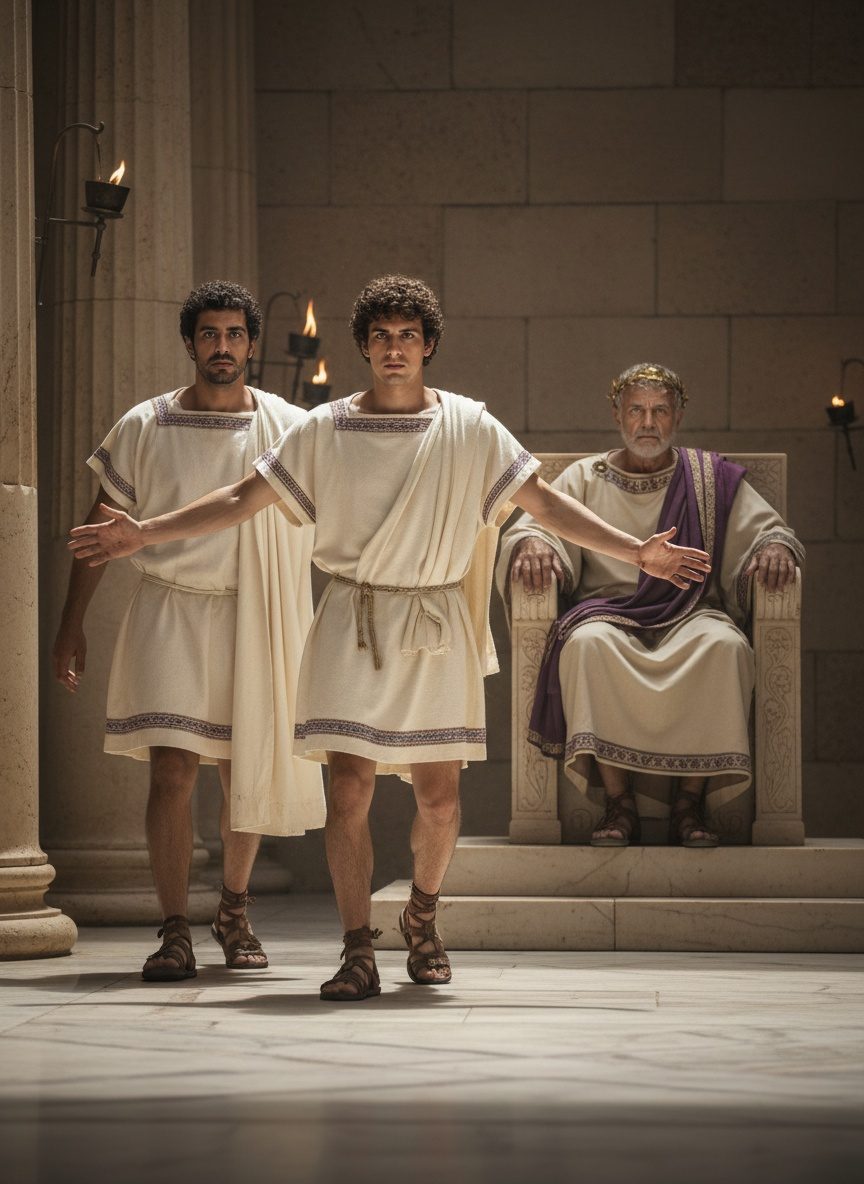
Dionysius of Syracuse was a tyrant feared by many. Yet, one fateful act of loyalty stopped him in his tracks.
The Tyrant’s Judgement
In Syracuse, around 400 BC, the name Dionysius resonated with power and dread. Known for his iron grip on the city, Dionysius ruled with a mixture of strategy and severity that left little room for dissent. Those who dared to oppose him faced severe consequences, often at the cost of their lives. Among his edicts was a particular sentence: death for Damon, accused of plotting against the throne.
For most, the ruling would have been the end of the story—a swift, inevitable descent into oblivion. However, fate took an unexpected turn with the intercession of Damon’s closest friend, Pythias. As a fellow student of the Pythagorean school of thought and a man of principle and unswerving loyalty, Pythias presented himself at the court of Dionysius with an extraordinary request: to take Damon's place on the executioner's block while Damon completed matters of personal importance before his end.
Dionysius, intrigued by such a bold proposition, was faced with a new kind of intrigue. Contemptuous of human decency yet curious to see how deep this loyalty ran, he granted Pythias’s request. He gave Damon a short reprieve on the condition that should Damon fail to return, Pythias would suffer the consequence in his stead. This was a gamble Dionysius clearly thought he could not lose. Friendship, the tyrant probably assumed, would wither at the prospect of imminent death.
A Friend’s Devotion
Pythias, now a hostage to fate, awaited at the palace, unwavering in his resolve as the days went by. The citizens of Syracuse watched with a morbid mixture of respect and pity, assuming that Pythias would soon be a martyr to a futile cause. Whispered conversations filled the streets, painting Pythias as either the epitome of loyalty or a naive fool.
Yet, within the heart of the prison cell, Pythias exhibited no fear. He had faith in his friend, a trust not shaken by Dionysius's machinations. Observers began to notice, albeit grudgingly, the powerful bond between the two friends—a depth of connection rarely seen and deeply revered by the philosophies they lived by. This bond was emblematic of the ideals of the Pythagorean Brotherhood, where loyalty, honesty, and common virtue were held above all else.
The return of Damon seemed increasingly unlikely as the days dragged on. The execution date stood looming like an unmovable wall as Dionysius prepared to enact his sentence. Yet, on the day set for Pythias's execution, as anxiety spread through the city, a stir occurred at the gates of Syracuse. Damon had returned, breathless and weary from his journey, but fervent in his mission. As he strode back into the clutches of death, the gathered crowd gasped in collective disbelief.
An Unforeseen Mercy
Before the gathered assembly, amid gasps and murmurs of awe, Damon embraced his fate, ready to stand in Pythias's place as promised. Dionysius himself, witnessing this display of unwavering devotion, was moved in a way he hadn’t anticipated. The spectacle of friendship—true and unyielding—had struck a chord in the tyrant's heart.
Such loyalty was something his reign had yet to portray. The patience of Pythias and the perseverance of Damon were virtues that transcended political maneuvers or courtly games. For the first time, Dionysius encountered a force stronger than fear. It was as if the very foundations of his stringent rule had cracked under the weight of genuine virtuousness.
In a decision borne of sudden clarity or perhaps admiration, Dionysius pardoned both friends. He marveled openly at their bond, confessing that he had not believed in such allegiance among men. The once inevitable demise of Damon had transformed into a celebration of life reborn and a friendship validated beyond any measure.
The story of Damon and Pythias soon spread beyond the city walls, becoming a narrative that whispered through time—a testament to the profound impact of loyalty and trust. Unlike the ethereal myths of gods and titans, theirs was a story grounded in the trials of mortality—a lesson of intimacy and valor in the face of tyranny. Through these virtues, they momentarily reshaped the world around them, reflecting what humanity could strive to be, even under the shadow of death.