In an age when many Greeks believed that the world ended at the Pillars of Hercules, one young geographer dared to sail beyond. Navigating treacherous waters and defying contemporary conventional wisdom, Pytheas of Massalia embarked on a journey that would lead him to the distant, mist-shrouded lands of Britain around 325 BC. But what he discovered and documented would prompt disbelief and skepticism from his peers — tales of lands where the sun never set, peculiar phenomena like the midnight sun, and the mystical moniker of Prettanike. This is the story of how Pytheas charted new territories and challenged the known boundaries of his world, only to find himself a prophet without honor in his own time.
The Boy from Massalia: A Passion for Exploration
Imagine Massalia, the bustling Greek colony that sat where modern-day Marseille stands, in the fourth century BC. It was a vibrant hub of trade and learning, where cultures from across the Mediterranean met and mingled. It was here that Pytheas of Massalia grew up, enraptured by the whispered stories of lands beyond the horizon. Unlike most of his contemporaries who focused their intellectual pursuits inward on mathematics or philosophy, Pytheas set his sights outward, onto the unknown world that lay beyond the familiar.
Pytheas was no ordinary scholar. He was a geographer and an astronomer, combining meticulous scientific inquiry with a relentless spirit of adventure. At a time when few Greeks had ventured far beyond their bordering seas, driven by commerce rather than discovery, Pytheas craved knowledge for its own sake. Armed with curiosity and courage, he embarked on a sea voyage that would cement his place in history, even if it took centuries for it to be truly recognized.
Crossing the Edge of the Known World
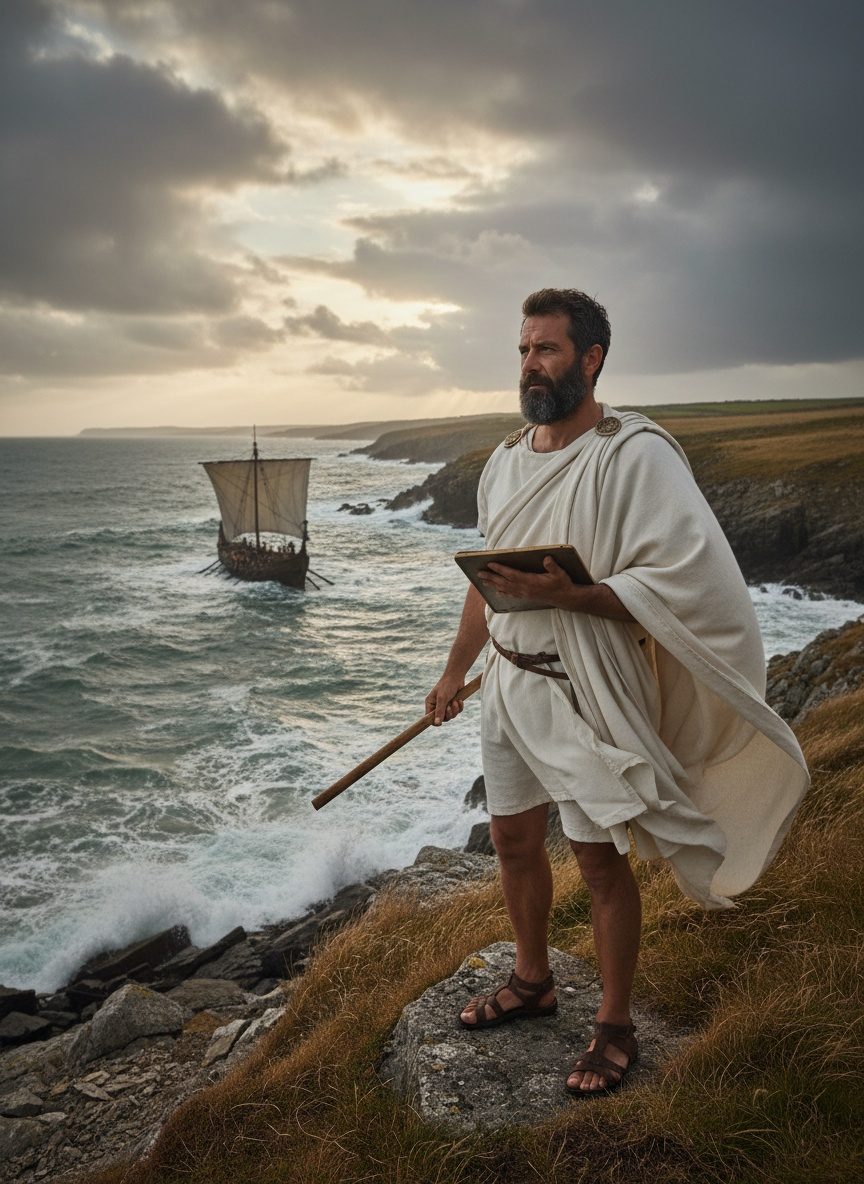
Setting sail from Massalia, Pytheas headed north, navigating the unfriendly waters of the Atlantic. As the bow of his vessel sliced through the waves, he crossed boundaries that had been considered indomitable. The voyage itself was a monumental undertaking, requiring profound seamanship and a bold heart. Yet Pytheas was nothing if not determined. His ships braved hostile weather patterns, daunting tides, and the whims of the ocean gods.
No ancient records precisely dictate how long this pioneering journey took, although some estimate it could have been months, possibly even a couple of years. Nevertheless, when Pytheas and his crew finally reached the shores of what we now know as Britain, they were stepping onto land that no Greek feet — as far as records show — had ever walked before.
Prettanike and the Phenomena of the North
If there was one aspect of Pytheas's journey that captivated his audience back home, it was his descriptions of Britain, or as he called it, Prettanike. The name itself hints at the island's enigmatic allure, evoking a place untouched by Greek civilization. As he explored its rugged coastlines, Pytheas documented the unforeseen: enormous tides that ebbed and flowed like nothing he had seen in the Mediterranean, and the land of rising and setting suns that defied conventional Greek cosmology.
Even more astonishing to the Greek mind was Pytheas's account of the midnight sun — a phenomenon of enduring daylight during the summer months. As Pytheas journeyed further north, he encountered regions where the sun hung low on the horizon, never fully setting, a tale that seemed inconceivable to his sun-baked countrymen back home. Yet, with his keen observations and systematic recording, Pytheas laid down the earliest known scientific estimations of latitude and longitude, calculations that were astonishingly ahead of his time.
The Harsh Return: Branded a Liar
Upon returning to the comforts of Massalia, Pytheas was eagerly awaited by the scholars and thinkers of the era, ready to listen to the stories from beyond the edge of their mapped world. But their anticipation quickly turned to skepticism — and outright disbelief. They turned a blind eye to his claims of bizarre tides, the midnight sun, and lands lush and strange. In their minds, the account was more fiction than fact. Even the esteemed philosopher Strabo later called Pytheas a liar, dismissing his accounts as imaginative drivel.
Why such doubt? Perhaps it stemmed from jealousy, or the intimidation of scientific ideas so vast they breached the comfort of established norms. It could also have been the unfathomable difference in what Pytheas described compared to the known Mediterranean world. Whatever the reasons, Pytheas's credibility was harshly questioned, and his astounding discoveries were put away as myths of an overly ambitious adventurer.
Why Pytheas's Journey Matters Today
Today, the name Pytheas might not conjure images of greatness like Alexander or Homer, but in the realms of exploration and science, it should. Pytheas's journey to Britain offers us more than just the story of an adventurous cartographer; it presents an age-old dilemma in human inquiry — the challenge of pushing beyond consensus, of questioning the world as we are told it is and bravely exploring what lies beyond. Those who challenge norms and venture into the unknown often find themselves alone, echoing Pytheas's unfortunate destiny, for ahead of one's time is often a lonely place to reside.
In the attempts Pytheas made to map and understand our world, we glimpse the unyielding human spirit striving to stretch the limits of knowledge. And in pondering his journey, we engage with a timeless meditation, for today’s “edge of the world” may lie in science, in technology, in understanding the nuances of our increasingly interconnected global society. Recognizing Pytheas reminds us to uphold the inquisitive soul and to see doubt not as a failure but as an invitation to continue searching, learning, and exploring. History may not have taught us about Pytheas in school, but understanding his audacious journey reminds us all that some paths to enlightened comprehension begin where the maps of current understanding end.