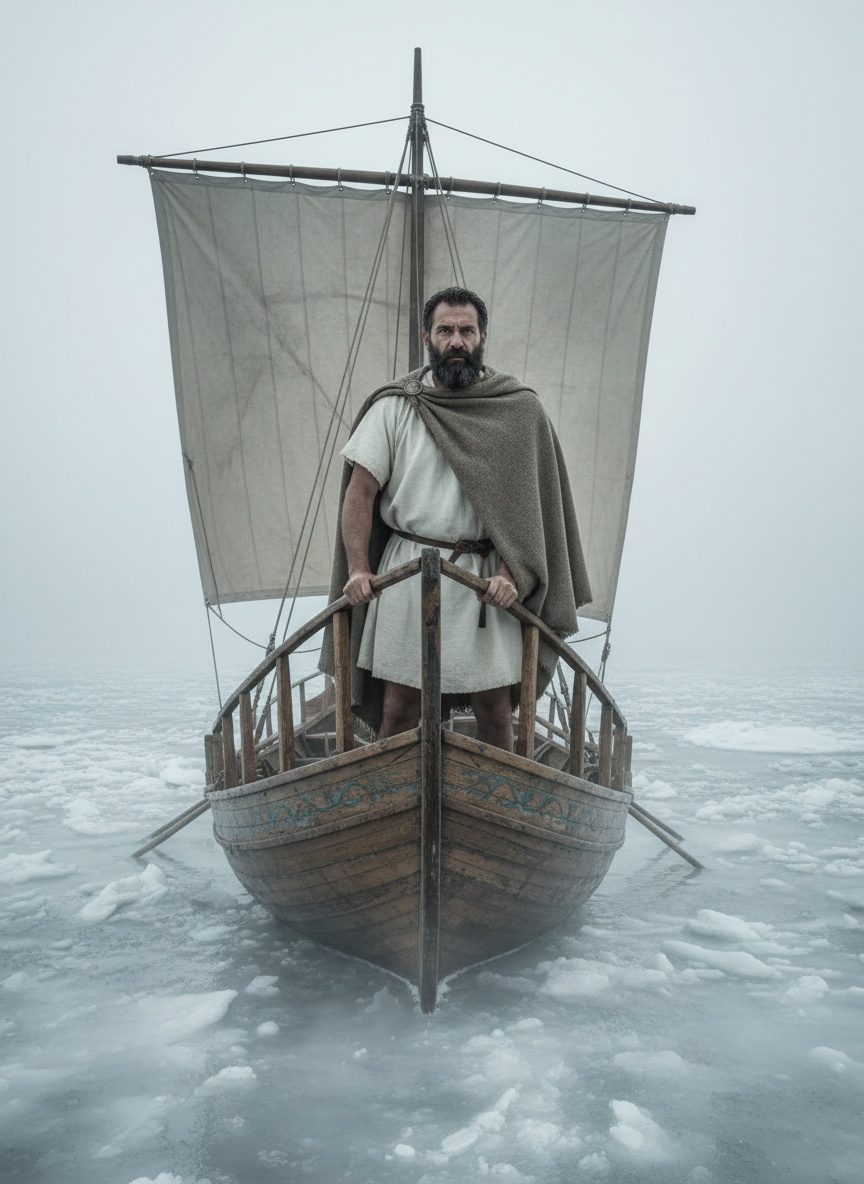
325 BC. A Greek sailor stared out into an ocean tipped with ice and mystery.
Pytheas of Massalia — an ancient city known today as Marseille — was not a warrior or a conqueror. He was a merchant, an astronomer, but above all, an explorer. A man driven by a single question and an insatiable curiosity about the world beyond the Mediterranean Sea. His expedition was one of the earliest in recorded history to push the boundaries of the known world, fueled less by political or military ambition, and more by a quest for scientific knowledge and discovery.
The tale begins in Massalia, a bustling Greek colony on the southern coast of what is now France. It was a city rich in trade and ideas, a frontier town where merchants swapped stories of other lands, feeding Pytheas' imagination. In 325 BC, armed with nothing but a small ship, Pytheas set sail northwest toward the great unknown of the Atlantic. His navigation relied on the stars, the wind, and instinct sharpened by years of seafaring. To the learned Greeks, this venture seemed audacious, bordering on foolishness, yet Pytheas was undeterred.
As he sailed past the pillars of Hercules, known today as the Strait of Gibraltar, Pytheas left behind the familiar winds and currents of the Mediterranean and entered the vast expanse of the Atlantic Ocean. He traveled up the Iberian Peninsula, where he likely marveled at the lands and people foreign to Greek eyes. But it was his journey further north, beyond the comfort of Mediterranean climates, that defined his adventure.
Pytheas reached the island known today as Britain, an achievement in itself, as this was a land known only through vague reports and myths. He circumnavigated the island, making detailed observations of the local tribes and noting the rich tin deposits — the foundation of Bronze Age wealth. Pytheas' descriptions of the Celtics, the feasts, and the fields of Britain were among the first written accounts of these remote people.
Despite these achievements, it was Pytheas' venture beyond Britain that would become legendary, wrapped in mystery and skepticism. He sailed north until he reached a realm of ice and perpetual day, a place he called Thule. Today, many scholars believe this could have been Iceland or the coast of Norway. Pytheas described a sun that never set, an observation that aligns with the phenomena of the Arctic Circle's endless summer days. He spoke of a sea that congealed into slush, an early recording of the polar ice, unimaginable to his contemporaries.
Pytheas' measurements astounded later scholars. He accurately predicted the midnight sun, and though his readings were dismissed for centuries, they would not be matched until a thousand years later. His calculations of latitude and distances were remarkably precise, even by modern standards. Yet, upon his return to Massalia, Pytheas was met with disbelief. The accounts he brought back were so extraordinary, so against the prevailing wisdom of his time, that few could swallow their plausibility.
The classical world had a hard time reconciling Pytheas' discoveries with their understanding of geography, limited as it was by the boundaries of the known empire. To many, his descriptions appeared as fantasy, his tales an affront to the accumulated knowledge of revered Greek scholars. They dubbed him a liar, a teller of tales, and dismissed many of his observations simply because they were beyond their own experiences. Even the great Greek geographer Strabo derided Pytheas with scorn, unable to accept that such places and phenomena could exist.
What Pytheas brought back was a vision of a world far more intricate and vast than his contemporaries could grasp. In describing lands of endless sunlight, seas of ice, and the shimmering aurora borealis, he unwittingly charted not just geography but a realm of human potential and curiosity. Pytheas highlighted the divide between acceptance and skepticism, a theme resonant throughout the ages.
Why does Pytheas' journey matter today? Because it reminds us that the frontier of knowledge is always a daunting place, fraught with doubt and resistance. His courage and refusal to accept limits exemplify the eternal spirit of inquiry, the relentless human urge to peer beyond the horizon. Pytheas' tale encourages us to question the bounds of the known, to challenge the sceptics, and to wonder at the possibilities of the unknown. His was a journey not just of discovery but of imagination, daring others in his wake to believe in new worlds, even if unseen and unconquered, existing just beyond the edge of comprehension.