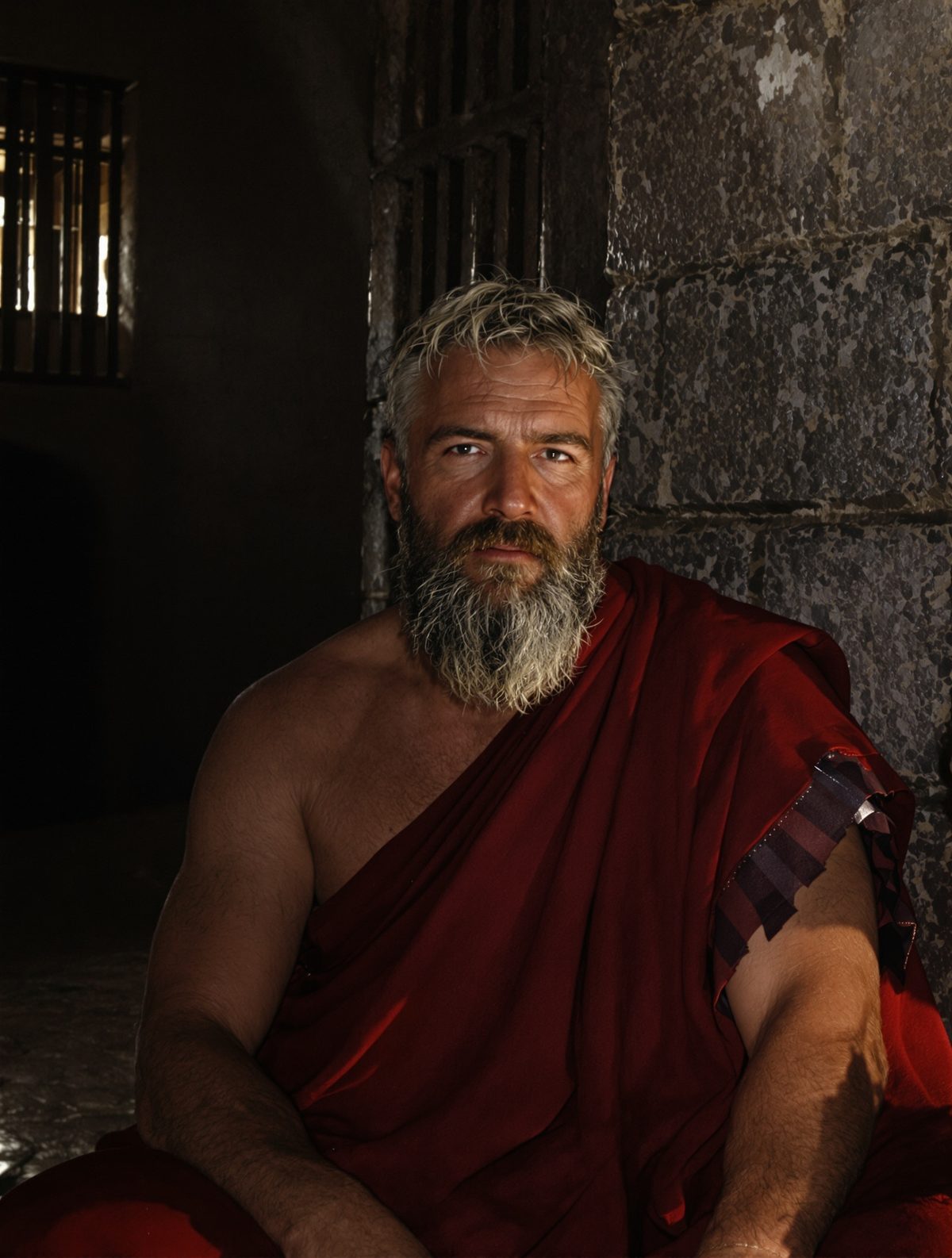
Picture this: one of history's greatest mathematical minds, gasping for breath as he flees through the dusty streets of ancient Italy. His pursuers are gaining ground, their sandaled feet pounding closer with each passing second. Ahead lies salvation—a simple field of green bean plants stretching toward freedom. Any rational person would leap the low fence and disappear into the crops. But Pythagoras, the man who unlocked the mathematical secrets of triangles, stops dead in his tracks. He would rather face certain death than set foot among those innocent-looking legumes.
This isn't the stuff of legend or myth. This is how one of antiquity's most brilliant philosophers met his end in 495 BC—killed not by the sword of logic or the arrow of mathematics, but by his own inexplicable terror of beans.
The Man Behind the Math
Before we dive into this bizarre tale, let's appreciate just who Pythagoras really was. Born around 570 BC on the Greek island of Samos, he wasn't just the guy who gave high school students nightmares about right triangles. Pythagoras was a rock star of ancient philosophy, a mystic who attracted followers like a spiritual guru and founded one of history's most influential schools of thought.
His mathematical achievements were genuinely revolutionary. While the Pythagorean theorem (a² + b² = c²) bears his name, he and his followers made breakthrough discoveries in geometry, astronomy, and music theory. They figured out that musical harmony came from mathematical ratios—play a string, then play half its length, and you get the same note an octave higher. This was the birth of mathematical music theory, showing that numbers governed not just space, but sound itself.
But here's what they don't teach you in geometry class: Pythagoras believed that numbers were divine. To him and his followers, called Pythagoreans, mathematics wasn't just a tool—it was the sacred language of the universe itself. Everything could be understood through numerical relationships, from the movement of planets to the nature of human souls.
This obsession with numerical perfection, however, came with some very strange baggage.
The Sacred Brotherhood and Their Peculiar Rules
Around 530 BC, Pythagoras established his philosophical community in Croton, a Greek colony in what's now southern Italy. This wasn't just a school—it was more like a religious cult with mathematical homework. The Pythagorean Brotherhood, as it became known, lived by an incredibly strict set of rules that would make a monastery seem relaxed by comparison.
Members took vows of secrecy so serious that breaking them meant death. They couldn't eat meat, couldn't touch white roosters, and were forbidden from picking up anything that had fallen to the ground. They couldn't look in mirrors beside a light, couldn't stir fire with iron, and absolutely could not—under any circumstances—step over a crossbar.
And then there were the beans.
The Pythagorean prohibition against beans was absolute and non-negotiable. Members couldn't eat them, touch them, or even walk through fields where they grew. To modern minds, this seems like nothing more than an ancient dietary restriction, perhaps an early recognition of favism—a genetic condition that makes fava beans potentially dangerous to some Mediterranean populations.
But Pythagoras's fear went far deeper than concerns about digestive health.
Beans, Souls, and Sacred Geometry
To understand why beans terrified one of history's greatest thinkers, you have to dive into the mystical worldview that shaped Pythagorean philosophy. Pythagoras believed in the transmigration of souls—the idea that after death, human souls moved into new bodies, including those of animals and, yes, plants.
But beans held special horror in this cosmic recycling system. According to Pythagorean doctrine, beans were literally containers for human souls. Their shape resembled human genitalia and their hollow stems provided a direct pathway between the underworld and the realm of the living. Ancient sources claim that if you chewed a bean and left it in the sun, it would soon smell like human semen or blood.
Even more disturbing to Pythagorean sensibilities: beans were the only plants that didn't have joints in their stems, making them fundamentally different from the segmented, mathematically ordered plants that reflected divine geometry. This smoothness was unnatural, wrong, and dangerous.
Eating a bean, therefore, wasn't just consuming a vegetable—it was committing cannibalism and disrupting the sacred order of the universe. For a man who saw mathematical harmony in everything from planetary orbits to musical scales, beans represented chaos incarnate.
The Revolution That Sealed His Fate
Pythagoras's philosophical community thrived for decades, but their success bred resentment. The Pythagoreans had become politically powerful in Croton, influencing local government and social policy. Their secretive nature, elite membership, and growing influence made them targets for a democratic backlash.
Around 508 BC, a wealthy local named Cylon applied for membership in the Brotherhood but was rejected—possibly for failing to meet their intellectual standards, or perhaps because his character didn't align with their philosophical ideals. Hell hath no fury like a rich man scorned, and Cylon began organizing opposition to Pythagorean influence in the city.
The situation escalated rapidly. Cylon's faction accused the Pythagoreans of being anti-democratic elitists who looked down on common citizens. They whipped up popular resentment against the Brotherhood's secrecy and political meddling. Public sentiment turned ugly, and by 495 BC, open violence erupted.
A mob attacked the Pythagorean meeting house, setting it ablaze with many members trapped inside. Ancient historians record that dozens of philosophers perished in the flames. Those who escaped, including Pythagoras himself, became hunted fugitives in their own city.
The Final Chase
The details of what happened next come to us from multiple ancient sources, including the writings of Diogenes Laertius and Iamblichus, though they differ on some specifics. What's clear is that Pythagoras, now in his seventies, found himself running for his life through the streets of Croton.
His pursuers—whether Cylon's supporters, angry citizens, or hired assassins depends on which account you follow—had murder in mind. They chased the aged philosopher through the city and into the countryside beyond. For a man of his advanced years, Pythagoras showed remarkable stamina, staying ahead of his hunters as they pursued him toward the city limits.
Then he reached the bean field.
The crop stretched across his path like a green barrier to freedom. Beyond lay safety—hills and caves where he could hide, perhaps even loyal followers who might shelter him. All he had to do was run through a field of vegetables. Instead, this brilliant mathematician, this man who had unlocked secrets of the cosmos, stopped running.
Ancient sources tell us he stood at the edge of that field, paralyzed by his own philosophical convictions. He couldn't bring himself to trample on what he believed were the earthly vessels of human souls. His pursuers caught up, and there at the boundary between salvation and superstition, they killed him.
The Numbers Don't Lie: Why This Still Matters
Pythagoras's death might seem like nothing more than ancient absurdity—a brilliant mind felled by irrational fear. But his final moments reveal something profound about the relationship between knowledge and wisdom, between intellectual achievement and practical judgment.
Here was a man whose mathematical insights still shape how we understand the world 2,500 years later. Every architect, engineer, and physicist relies on principles that Pythagoras helped establish. Yet the same mind that could perceive mathematical harmony in the universe was enslaved by superstitions that cost him his life.
This paradox isn't just ancient history. Today's world is filled with brilliant specialists who excel in narrow fields while remaining surprisingly naive about everything else. We've seen Nobel Prize winners fall for obvious scams, tech geniuses who can't maintain personal relationships, and medical experts who ignore their own health advice.
Pythagoras's bean field reminds us that intelligence isn't uniform, that expertise in one area doesn't automatically translate to wisdom in others. It's a warning about the dangers of rigid thinking and the importance of questioning our own assumptions—even the ones that seem most fundamental to who we are.
In the end, the man who showed us that the square of the hypotenuse equals the sum of squares of the other sides couldn't solve the most basic equation of all: survival equals adaptation. His mathematical legacy will endure forever, but his final lesson might be the most valuable of all—sometimes the greatest obstacle to escaping our problems isn't the world around us, but the beliefs we carry in our heads.