155 CE. A gentle breeze swept through the packed arena, rustling the anticipation of thousands.
The Heart of Smyrna's Power
The ancient city of Smyrna, now part of modern-day Turkey, held an air of sophistication and power in the 2nd century CE. Renowned for its intricate system of trade routes that connected the eastern reaches of the Roman Empire with its western expanses, Smyrna was a bustling hub of commerce and culture. Invoking the favor of the Roman Empire afforded the city not only prosperity but also a formidable sense of security. Yet, this security demanded steadfast loyalty to the emperor and all he represented.
Amidst the marble edifices and crowded marketplaces, the Colosseum stood as the focal point where justice was both celebrated and executed. It was here, under the watchful gaze of Roman officials and a boisterous crowd, that a life-altering moment unfolded. In curating the spectacle of punishment, the Romans reminded their subjects of the supreme authority of the Empire and the deified emperor himself.
It was within this context of devotion to imperial traditions that a different sort of fidelity faced its ultimate test. The clash between burgeoning Christian beliefs and long-held Roman customs was epitomized in the figure of a man whose resolve would echo through history.
The Unyielding Resolve of Polycarp
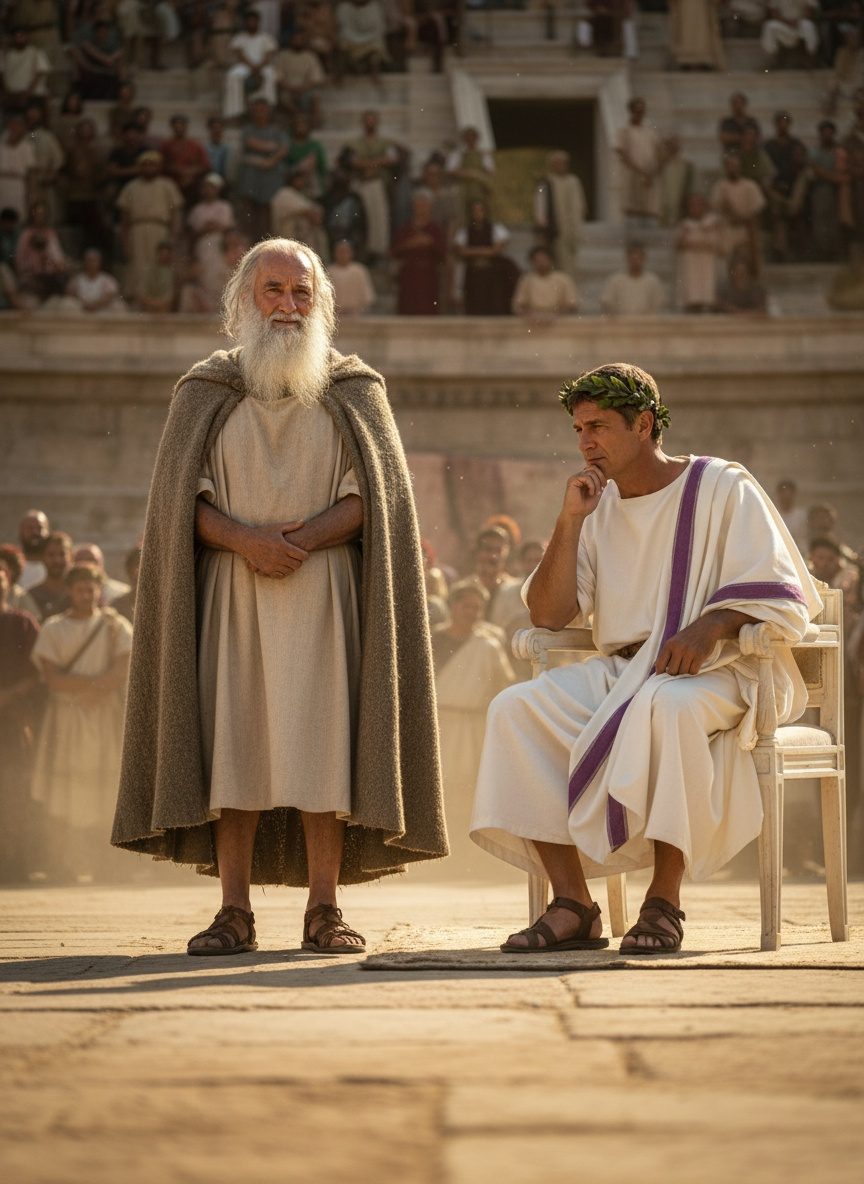
Polycarp, the venerable bishop of Smyrna, stood frail yet unshaken at the heart of this confrontation. At the age of eighty-six, his stooped form and snow-capped beard spoke of a life steeped in the teachings of Christ. He had guided his flock for decades, his lineage traced as far back as the apostle John himself—a testament to the purity of his faith. Now, facing the authority of Rome, he was offered a choice often too daunting for any mortal soul: renounce Christ and live, or defy Rome and meet death.
The Roman proconsul, perhaps driven by reluctance to spill the blood of an old man, implored Polycarp to reconsider. The old bishop’s decision was met with a simple refusal, recounted with reverential awe in the ancient world: "Eighty-six years have I served him, and he has done me no wrong. How then can I blaspheme my King and Saviour?" His words, imbued with a serene audacity, cut through the chilling silence that had gripped the audience.
This act of defiance was not merely a personal testament of faith. Within the context of Christian persecution under Rome, it became a profound assertion of belief against an empire that demanded its subjects' absolute loyalty. Polycarp’s stance revealed the burgeoning conflict between two worlds—the temporal dominion of Rome and the spiritual kingdom of Christianity.
The Fire of Martyrdom
The crowd’s hushed anticipation turned to roars as the executioners approached Polycarp, ropes and wood in hand. Ordinarily, Roman executions were brutal affairs designed to instill fear, their brutal spectacle serving as a deterrent against insurgence. Yet, here was a scene that transcended its gruesome objective. As the flames were set to the pyre, witnesses recounted a peculiar and miraculous occurrence: the fire, they said, refused to consume him, enveloping but not burning him like a ship's sail in the wind. Awestruck, the observers deemed it a divine intervention.
Eventually, it is said, an executioner was forced to use a dagger to ensure the old bishop’s death. As his spirit left his body, his final act immortalized him as a courageous martyr, inspiring generations of Christians to persist in their faith, even unto death. Polycarp's martyrdom underscored the inherent power of belief, a power potent enough to withstand even the greatest earthly force of its time—the Roman Empire itself.
The impact of this event resonated far beyond the confines of Smyrna's arena. News traveled swiftly, seeding the burgeoning Christian communities with the tale of Polycarp’s unshakable conviction. For the Christians of the Roman world, it came to symbolize unwavering bravery in the face of persecution, a powerful narrative of faith overcoming fear.
The Echoes Across Time
In the years that followed, Polycarp's dramatic stand became central to the Christian understanding of martyrdom, illustrating a faith grounded not in mere teachings but in profound personal sacrifice. His story was immortalized through the pen of the early Church Fathers, becoming a cornerstone narrative in the collective identity of Christians enduring the harsh realities of Roman rule.
More than a relic of ancient history, Polycarp's choice serves as a reflection on the nature of conviction and its place in an often oppressive world. The echoes of his last stand invite contemplation on the definition of loyalty—whether to empire, creed, or conscience. In a world awash with competing demands for allegiance, Polycarp’s defiance insists on the daring courage required to stand resolute.
As we traverse the corridors of historical memory, Polycarp's tale asks us continually to examine the depth of our own beliefs, and how far we are willing to go in their defense. In the stillness of that ancient arena, the embers of his sacrifice continue to burn fiercely, lighting the way for successors of every creed who dare to confront power with nothing but faith.