Polycarp faced a fire that would test his faith. But his resolve burned brighter.
The Defiant Bishop of Smyrna
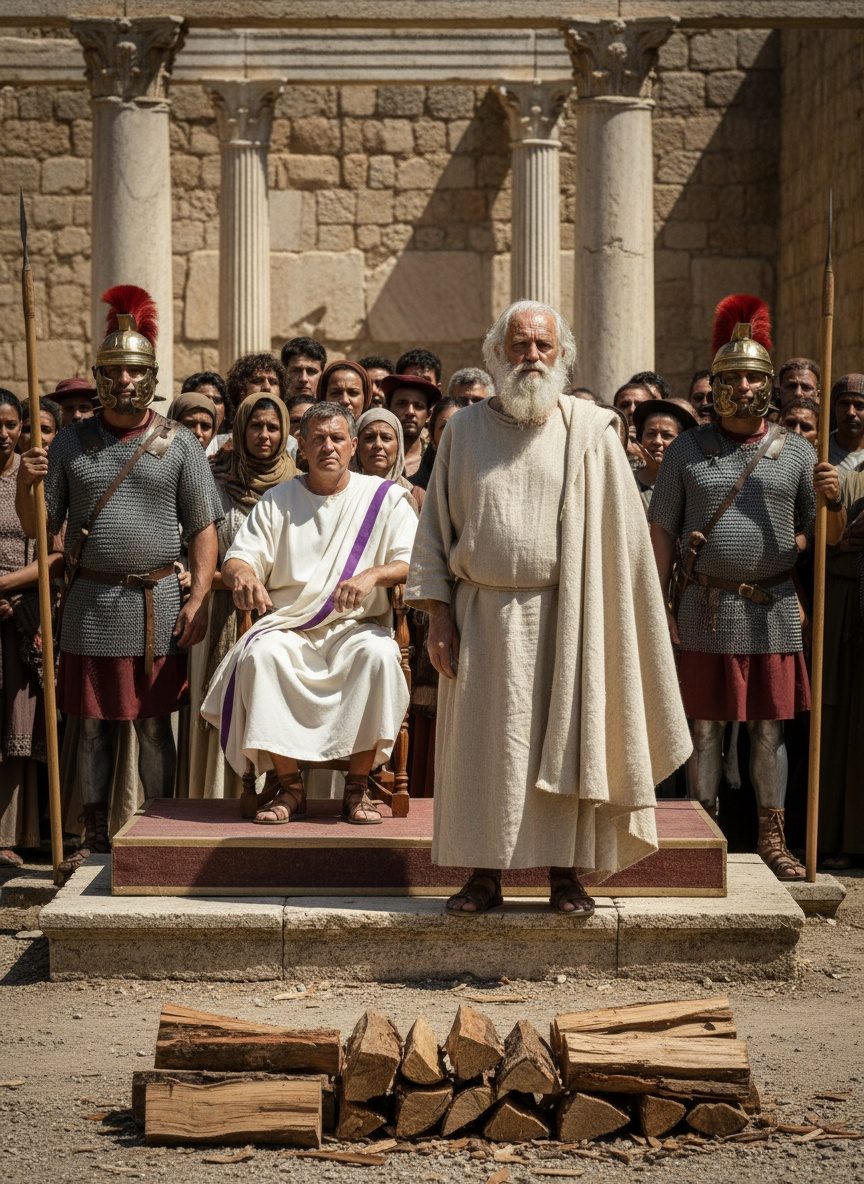
The city of Smyrna, in 155 CE, bustled with life as merchants hawked their wares and citizens flocked to the marketplace. Yet on one particular day, the city's usual energy was replaced with a charged tension. Crowds gathered, whispering in anticipation of the execution of an 86-year-old man, a figure who had become the embodiment of resistance against the Roman authority: Polycarp, the Bishop of Smyrna.
Polycarp was no mere figurehead but a revered leader in the burgeoning Christian community. His journey with the faith had begun in the days of the apostles, and over decades, he had nurtured a congregation that looked to him as a spiritual father. The authorities saw his influence as a threat to the Roman order — where the emperor was supreme, the divine was inseparable from governance, and the Christian rebuke of idolatry could be seen as subversion.
Trial by Faith and Fire
In a time when allegiance to the emperor was often proven by offering sacrifices to the Roman gods, Polycarp was presented with a dire ultimatum. The prefect met him sternly, offering escape from death for a simple act of denouncing his faith and cursing Christ. "Swear the oath, and I will release you," the prefect demanded. But what might have come easily for others, was, for Polycarp, an insurmountable betrayal of his lifelong beliefs.
Tension reached a peak as the pious bishop stood resolute. Refusing to even feign deference to the Roman deities, Polycarp's famous reply resonated through the ages: "For eighty and six years have I been His servant, and He has done me no wrong. How can I blaspheme my King who saved me?" Such was the compelling strength of his conviction that even his executioners hesitated, their conscience pricked by the unwavering courage of the bishop.
A Portrait of Courage
With his refusal, the path was set, and the fire readied. As the crowd of onlookers gathered, expecting a spectacle of another Christian martyr's fall, what they witnessed was a display of rare valor. It is said that Polycarp requested not to be fastened to the stake — he would stand in the flames without restraint, a testament to his unyielding belief.
The flames were lit and as they curled around the elderly leader, stories recount a miraculous scene, claiming that the fire shaped around Polycarp's figure, refusing to touch him. It was only when a soldier, moved perhaps by either desperation or respect, ended his life with the thrust of a sword, that the bishop's resistance ceased.
Lessons from a Forgotten Stand
The spectators who came for entertainment left in reflective silence. This wasn't just the execution of a Christian leader but a profound demonstration of conviction that spoke to the heart of what it meant to truly believe. Polycarp's story is not just a testimonial of blind faith but of deep-seated values that prioritised spiritual integrity over temporal life.
The account of Polycarp's martyrdom spread far beyond Smyrna, becoming a cornerstone narrative for early Christians who faced persecution. He stood not just as a man of faith but as a symbol of resistance against the oppression of dominant powers, inviting reflection on the cost of true conviction.
A Legacy Beyond Flames
As centuries have passed, Polycarp's defiance remains an extraordinary story of fortitude. It underscores the weight of conscience in deciding the course of one's life. In modern times, where compromise often paves a smoother path, Polycarp's steadfastness challenges us to measure the integrity of our own convictions.
Polycarp’s legacy is less about suffering and more about the power of belief to transcend persecution, shaping a community long after the flames faded. In that respect, he imparted a lesson on courage that is timeless — one that goes beyond the annals of Christian history, reminding us that some truths are worth any cost.