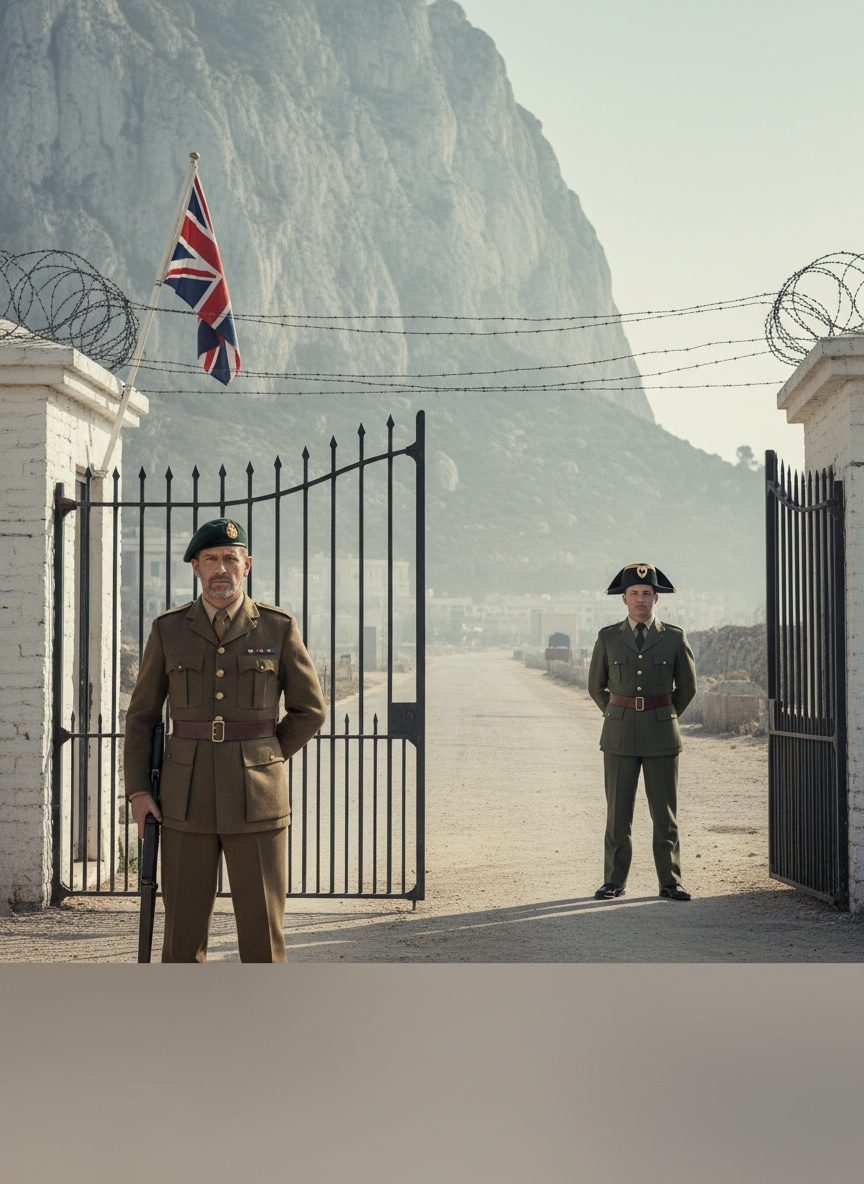
June 1969. The gate that had been a bustling thoroughfare was now a bleak, silent barrier.
The Sudden Seal of Silence
In the summer of 1969, the fortress of Gibraltar, that ancient sentinel atop the Rock, found itself unexpectedly isolated. Francisco Franco, Spain’s formidable dictator, ordered the closure of the border with Gibraltar. A ribbon of concrete and wire turned the liveliness of La Linea, the Spanish town bordering Gibraltar, into a spectral quiet, separating one small community from another. The physical distance was mere meters, yet the divide was immense, severing Gibraltarians from colleagues, friends, and families who resided just across the way.
For 15,000 Spanish workers, the closure was not merely a disruption; it was a calamity. Overnight, livelihoods vanished, leaving economic desolation just beyond Gibraltar’s gates. Families split apart riveted by uncertainties. Communities that had thrived on cross-border trade and camaraderie found themselves pawns in a political standoff; their spontaneity exchanged for the rigidity of checkpoints and the watchful eyes of steely guards.
The Political Chessboard
The border wasn’t just a line on a map; it was a symbol of colonial discord between Spain and Britain. Gibraltar, a pivotal naval base, had been a bone of contention since it was ceded to Britain in the early 18th century. With Franco's closing of the border, Spain hoped to assert its claim over the territory, aiming to suffocate Gibraltar into submission by cutting off its vital lifeline to continental Europe.
The British response was notably passive, choosing diplomacy over aggression. The rationale, perhaps, was rooted in the geopolitical quagmire of the time. The Cold War's shadow loomed large, and Britain, reluctant to exacerbate tensions with another staunchly anti-communist regime, opted for restraint. While the realm beyond the Rock remained untouched by military might, Britain’s lack of overt action puzzled many. To protest would have meant escalation; to do nothing felt like abandonment. Thus, the gate remained unyielding.
Life on the Enclave: A Struggle for Normalcy
For Gibraltarians, day-to-day life became an ordeal of adaptation. The economy pivoted towards resilience, leveraging tourism and offshore banking to buffer against the absence of their former labor force. Industries reshaped their operations, and ingenuity flourished amid adversity. Civilians became adept at negotiating the enforced solitude, threading through the ties of community even as family gatherings and friendships were reimagined across the water’s edge.
Yet, it was the mundane things that truly highlighted the chasm. Schoolchildren wrote letters instead of strolling a mile into Spain to visit relatives. A Gibraltarian cafe that had been a regular haunt for Spanish patrons stood eerily quiet. The market once bustling with Spanish wares now improvised with imports by sea—symbols of Gibraltar’s defiance and enduring spirit.
The separation weighed heavily on the psyche, particularly on those whose roots were split by the border. Marriage across the frontier became a tumultuous affair; love strained but not extinguished, crossed political fault lines. Under the cloud of isolation, Gibraltar’s community knitted tighter, gallantly maintaining their unique blend of British, Spanish, and North African influences.
The Gate Reopens
In a world progressing toward cooperation, barriers can seem inexplicit, ghostly reminders of division. It took thirteen years and the passing of Franco to finally inhale the possibilities of reconciliation. In the early 1980s, a new era of political dialogue began to thaw the frozen frontier. By 1985, Spain, under different leadership and aspirations, made the landmark decision to reopen the gate, ending a closure that had extended a decade beyond the Franco regime itself.
The reopening wasn’t just the turning of a latch; it was the reawakening of connections and aspirations long suppressed. Workers returned to jobs left so suddenly, and streets once desolate bustled with chatter and commerce. Living rooms overflowed with reunions, restoring ties long maintained through letters and distant waves across the Straits.
The thirteen-year closure remains an enigmatic chapter of stubborn endurance and quiet tenacity within the annals of Gibraltar’s history. It serves as a potent reminder of the complexities that lie within the tapestry of national pride and international relations—a story hidden in plain sight, obscure yet significant. It echoes the sentiment that in a world punctuated by walls, there’s an unyielding human spirit always aiming to breach them with peace.