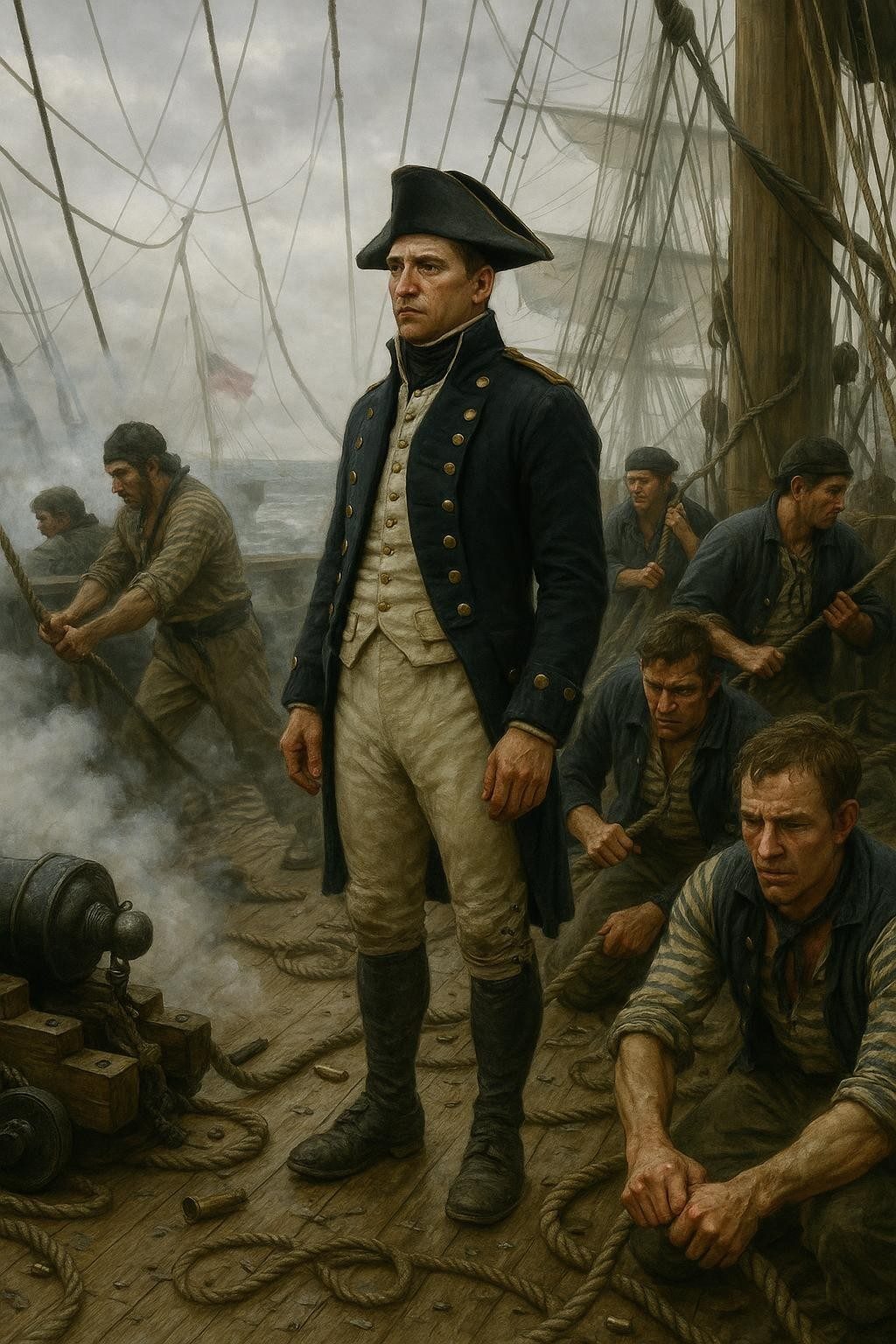
The air outside Boston harbor was thick with suspense, the salty tang of the sea intermingling with the quiet preparation on board the ships. On the deck of HMS Shannon, Captain Philip Broke's eyes were locked on the horizon. He could see the USS Chesapeake drawing closer, its sails striking an ominous silhouette against the gray sky. The Chesapeake had taken up Broke's audacious challenge for single combat, a bold maneuver that was unheard of in this age of naval warfare. As the two ships closed the distance, the air vibrated with the rising anticipation of battle, the distant murmur of the crew's movements a prelude to the violent clash that would soon unfold.
The Challenge Accepted
Captain Philip Broke was not your average naval commander. A man of meticulous detail and immense pride, he had drilled his crew into one of the finest fighting forces on the Atlantic. For weeks, HMS Shannon had been patrolling the waters off Boston, its captain eager for a chance to prove the supremacy of his ship and crew. The War of 1812 had been raging for over a year now, and American ships, emboldened by several victories against British vessels, were a thorn in Britain's side.
The Chesapeake, under the command of Captain James Lawrence, was seen as a prime target. Broke, with the confidence of a man who knew his ship's capabilities, penned a formal letter of challenge to Lawrence. This was no ordinary correspondence—it was a throwback to the chivalric notions of combat, more in line with medieval knights than naval officers. In an era when naval engagements were often dictated by circumstance rather than choice, for Broke to extend such an invitation was seen both bold and unconventional.
The challenge was set: ship to ship, man to man, cannon to cannon. The Chesapeake, docked in Boston, did not shy away from the challenge. Despite being blessed with a good crew and a sturdy ship, Lawrence was perhaps cajoled by recent American naval victories and eager to make his mark. Furthermore, tensions were high and growing at this time; the capture of a British vessel would be a prestigious further blow to England. As the Chesapeake slipped its moorings on that fateful June day, both its crew and the city of Boston were filled with hopeful anticipation.
Thirteen Minutes of Thunder
As the Chesapeake emerged into the open sea, she was met by the steadfast gaze of HMS Shannon. The distance between the two ships closed rapidly, each crew bracing for the impending clash. When within range, it was the Shannon that struck first, the loud retort of its cannons shattering the serene ocean air—a sound that echoed across the waters like a roll of thunder. The initial broadside was devastating, showcasing the accuracy and training that Broke had tirelessly instilled in his men.
For thirteen minutes, the two ships exchanged volleys, a cacophony of gunfire mixed with the cries of fallen sailors and the splintering of wood. Smoke enveloped the decks, making it almost impossible for either crew to see beyond their immediate surroundings. Broke's gunners had honed their skills through relentless drills, and it showed. The Shannon's maneuvers were precise, its crew executing orders like clockwork. The Chesapeake struggled to maintain composure under the relentless assault.
Amidst this chaos, Broke seized the opportunity for a bold maneuver. Spotting an opening, he ordered a boarding action. Leading the charge himself, he stormed onto the Chesapeake's deck with his men—a move as swift as it was fierce. Hand-to-hand combat ensued, with cutlasses flashing in the early evening light and the desperate resistance of the American seamen slowly giving way. The thunderous roar of cannon fire was replaced by the brutal clamor of close-quarters battle.
Beyond Victory and Defeat
The battle, though brief, was decisive. As the smoke cleared, the Shannon stood triumphant, its flag flying high while the Chesapeake's colors were struck. Captain James Lawrence, mortally wounded during the melee, gave his last famous command: "Don't give up the ship." It became a rallying cry for the U.S. Navy, even amidst the loss. For Broke, the victory was total but costly, as he was severely injured during the boarding.
When the Shannon towed its prize into Halifax a few days later, it marked a significant yet controversial chapter in the War of 1812. While the British celebrated a tactical victory, the Americans found a hero in Lawrence, whose valor in the face of overwhelming odds inspired a nation. Yet, the battle itself was noteworthy for its uncommon nature. Few engagements of the period were fought on such agreed-upon terms, with both captains fully aware and willing participants.
What made this duel significant was not just its brevity or ferocity, but what it represented—a collision of ideals and the indomitable human spirit. Broke's audacious challenge and Lawrence's gallant response were reminders of an era when personal honor often steered the course of history. The battle between HMS Shannon and USS Chesapeake encapsulates the unpredictable nature of war and the timeless dance between victory and defeat. In the grand tapestry of naval history, their clash stands not just as a testament to tactical prowess, but as a reflection on the motivations of men; it whispers of the driving forces behind seemingly mad acts of valor, and how they echo through the ages in the lessons left for us to ponder. The Chesapeake, now under a foreign flag, was a sobering sight for the Americans, a stark reminder of war's relentless cost and the ever-fluctuating tides of fortune.