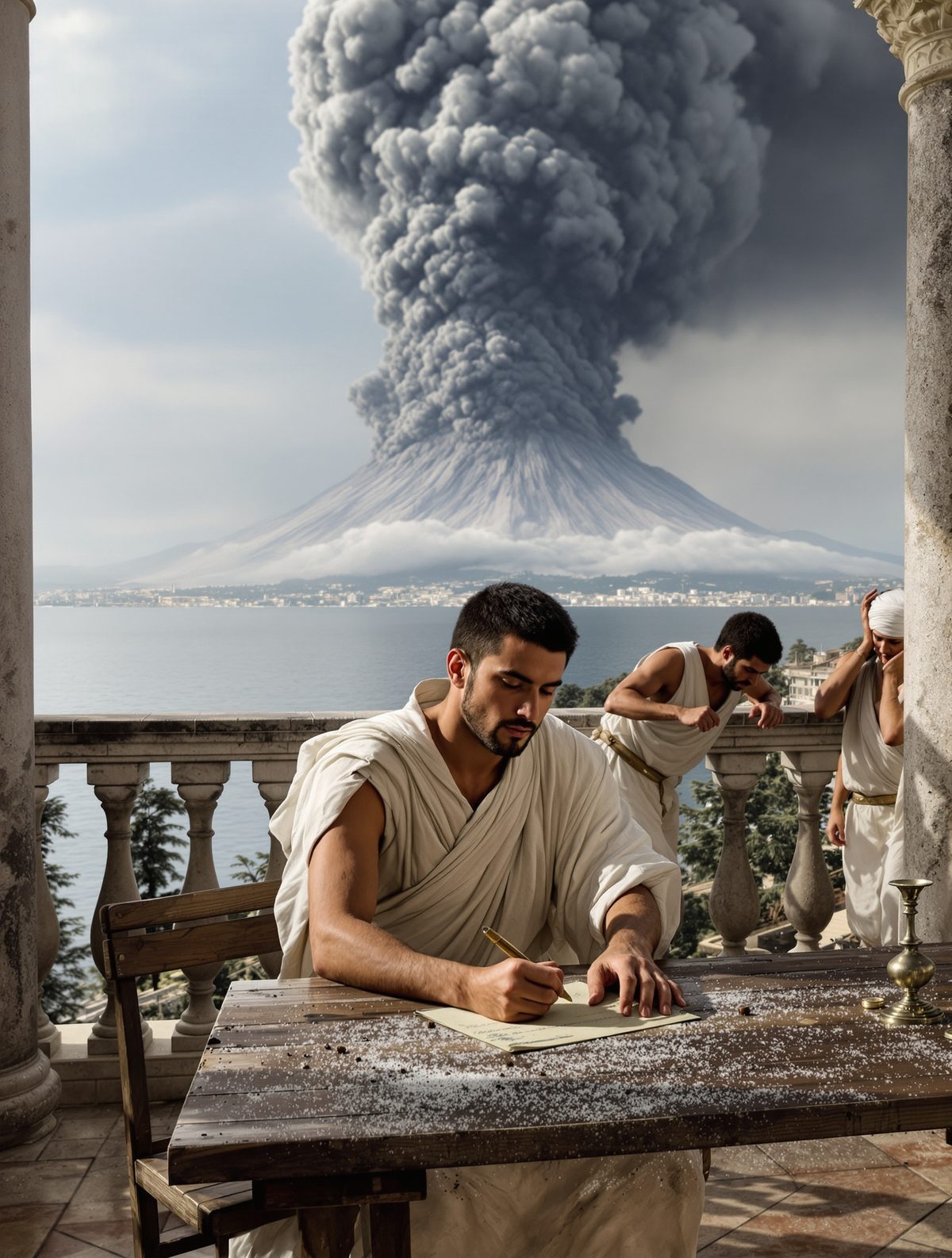
The blast echoed across the Bay of Naples, causing fisherfolk to clutch their nets tighter and sailors to look nervously towards the mountain. Smoke and fiery debris spewed forth in a gruesome dance of nature's fury. As the earth quaked and the sky turned ashen, a young Roman named Pliny sat on the shores a safe distance away, quill in hand, striking notes into his parchment. He took it all in — the cries, the chaos, the darkness. It was August 24, 79 AD, and this teenager was capturing history as Mount Vesuvius claimed Pompeii.
The Sleeping Giant Awakens
Mount Vesuvius had once stood quietly overlooking the bustling Roman towns of Pompeii and Herculaneum, its slopes dotted with vineyards and villas. The volcanic beast had lain dormant for centuries, its lethal potential hidden beneath a veneer of tranquility. But at noon on that seemingly ordinary day, everything changed.
Seventeen-year-old Pliny the Younger was at his family’s villa in Misenum, across the bay. It was his fateful decision to observe rather than flee, to document rather than despair, that handed posterity one of the rarest gifts: a detailed eyewitness account. For centuries, what Pliny took down — and later transformed into letters to his friend Tacitus — would become the foundational text for understanding volcanic eruptions.
Amidst Ash and Darkness
Pliny's account begins with an ominous description of an "uncommon cloud" rising high in the sky, shaped like a vast pine tree, the trunk rising high and branches spreading wide. For the Romans, volcanic eruptions were not understood scientifically, but rather seen as omens of the gods. Yet Pliny, in his sharp observations, approached it with the curiosity of a proto-scientist.
What he saw defied imagination. First, the earth trembled, sending shapes skittering off shelves and animals into frantic retreat. Then, the falling ash transformed daylight into a thick, suffocating darkness. "It was as if the day had died," he would later write, the sun hidden behind the malicious cloud.
People fled their homes in terror, some holding rags over their mouths to filter the choking air. The ash coated everything, caking visibility and sound alike, until all that was left of Pompeii was a silent shroud.
The Last Voyage of Pliny the Elder
In those panicked early hours, Pliny the Younger’s uncle, Pliny the Elder, took a more daring path. Commanding the Roman fleet stationed at Misenum, the elder Pliny was both a seasoned admiral and a naturalist at heart. Upon seeing the eruption, Pliny the Elder set sail — not away from danger, but into it, partly to observe, partly to aid those stranded on the shore.
His was a mission of curiosity and rescue. Pliny the Elder had devised some of ancient Rome’s most extensive natural histories and, perhaps sensing history unfold, could not resist wading into the heart of it. Sadly, the toxic fumes would prove too much for the venerable admiral, claiming his life as a sacrifice to science. His spirit of inquiry lived on through his nephew's writings.
Eyewitness to the End
Pliny the Younger’s narrative captures the personal and communal chaos amidst a societal apocalypse. He noted how every attempt at escape was met with more destruction; bridges collapsed under their own weight, the ground cracked open, and every step forward was shrouded in uncertainty.
From Misenum, Pliny described not just the physical destruction, but the psychological turmoil of those days: the pitched cries of the people praying in terror, clinging to creeds and creeds unwritten. It was profound despair witnessed by a sharp eye, with each word chosen meticulously to preserve the memory of not just destruction but human spirit.
Why Pliny’s Letters Still Matter
In the aftermath of Vesuvius's wrath, about 2000 people are estimated to have perished in Pompeii alone, the town buried under layers of ash and pumice. Pompeii disappeared from history until its rediscovery in 1748, remarkably preserved and providing tremendous insights into Roman life. Yet, before archaeologists would unearth its streets, Pliny's penscribings were the sole testament to the catastrophe.
Modern volcanologists look at Pliny the Younger's account to classify eruptions, rendering terms such as “Plinian” to describe eruptions driven by massive gas clouds. But beyond aiding scientific classification, Pliny's letters speak to humanity itself — its fear, awe, and resilience.
What Pliny left us is more than a vivid retelling of disaster; it's a reminder of nature's capricious power and humanity's enduring quest to understand its world. In every earthquake or eruption today, we engage with that same essence, where knowledge becomes a form of defiance against forces beyond our control.
As long as Vesuvius looms, still active, still potentially destructive, Pliny the Younger's words urge us to remember: history is not just in what is preserved or unearthed, but in the stories told, the notes taken, and the insights shared. In the dance of destruction and documentation, we find the pulse of time itself.