The July sun beat relentlessly down on the rocky slopes of Little Round Top at Gettysburg, Pennsylvania. Amidst the chaos and carnage, a battered regiment of Union soldiers braced themselves for an assault they could scarcely withstand. At their helm was Colonel Joshua Chamberlain — a former college professor turned unlikely hero. As the Confederate forces surged forward, Chamberlain made a decision that defied military convention: he ordered a bayonet charge. Out of ammunition and hope, his men charged downhill into history.
The Making of a Soldier-Scholar
Joshua Lawrence Chamberlain was not your typical military officer. Born in Brewer, Maine, in 1828, Chamberlain was a scholar with a passion for rhetoric and theology, fluent in numerous languages. Before the Civil War, he taught at Bowdoin College, covering subjects ranging from logic to natural science. Yet, compelled by a sense of duty to his country, Chamberlain ventured into a vastly different field — warfare.
In 1862, Chamberlain enlisted in the 20th Maine Volunteer Infantry Regiment, declining a prestigious sabbatical in Europe. Though he began with little military training, his acute intellect and charismatic leadership quickly marked him as an officer of rare potential. By the time his regiment reached Gettysburg in July 1863, Chamberlain had risen to the rank of colonel, entrusted with the defense of the extreme left of the Union line.
The Strategic Anchor: Little Round Top
The Battle of Gettysburg commenced on July 1, 1863, evolving into a three-day marathon of combat that would ultimately prove decisive in the American Civil War. By the second day, the Union Army found itself in a precarious position. The Confederate forces aimed to break the Union line by attacking its vulnerable flanks, with Little Round Top — a rocky, tree-covered hill — serving as the linchpin of this strategic defensive line.
General Gouverneur K. Warren, recognizing the hill's critical importance, rushed reinforcements to strengthen the Union position just in time. Among those who arrived to hold the line was Chamberlain's 20th Maine. Located at the endpoint of the formation, their role was clear: protect the Union left flank at all costs.
A Crisis of Ammunition and Nerve
On July 2, Colonel Chamberlain's regiment faced repeated attacks from the 15th Alabama Infantry. As wave after wave of Confederate soldiers surged against them, the Union defenders fought desperately to hold their ground. The battle raged from late afternoon until early evening, with Chamberlain's men repelling assaults at tremendous cost.
Amid the relentless Confederate onslaught, Chamberlain's regiment suffered significant casualties and dwindled rapidly to about 200 men. Even more dire, they were running out of ammunition. As they counted their remaining rounds, Chamberlain realized the situation was untenable; they couldn't withstand another attack.
But retreat was not an option. Allowing the Confederates to break through at Little Round Top would jeopardize the entire Union line, potentially changing the course of the war. Surrender was equally unthinkable.
An Audacious Decision: "Fix Bayonets!"
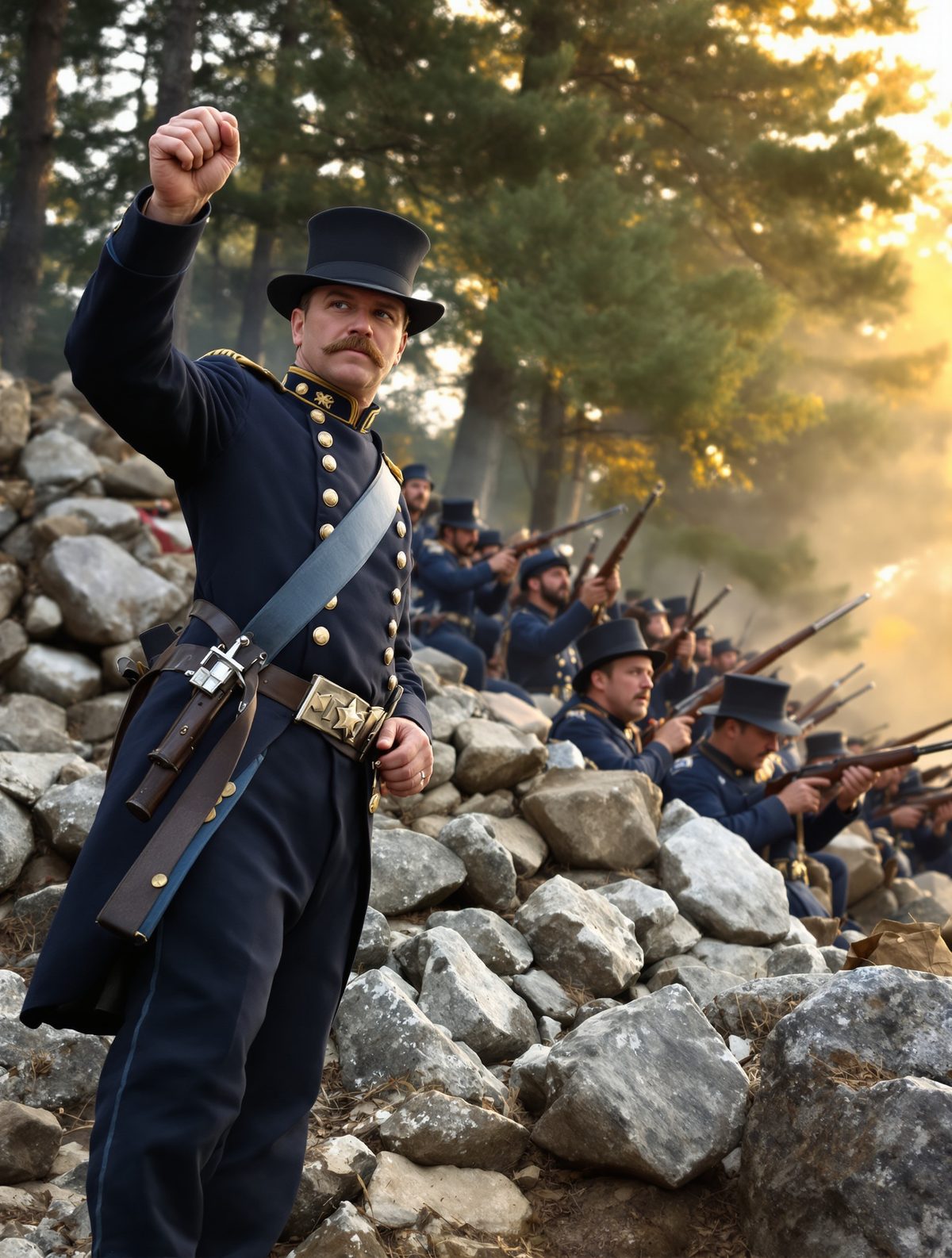
It was in this moment of desperation that Chamberlain conceived a bold plan that history would not soon forget. Gathering his officers around him, he declared, "Fix bayonets!" The order rippled down the ranks like a shockwave, a testament to the dire reality of their situation. His troops, having little left to lose, prepared for a charge that seemed suicidal.
With a dynamic swing movement intended to sweep the advancing Confederates from the field, Chamberlain led the charge himself. The 20th Maine erupted from their crouched position behind the stone wall with a blood-curdling yell, catching their adversaries off-guard. The sudden ferocity and surprise of the bayonet charge stunned the Confederate soldiers, who initially hesitated and then fell back in confusion.
Turning the Tide at Gettysburg
What happened next was an extraordinary turn of events. The audacity of the charge, combined with the element of surprise, drove the Confederate forces downhill, scattering their ranks and capturing hundreds of soldiers. The left flank of the Union line held firm, thanks to Chamberlain's decisive action. The Southern push to take Little Round Top had failed, and with it, the momentum of their attack.
The daring move ensured the integrity of the Union position at Gettysburg, contributing to a victory that would mark a turning point in the Civil War. Chamberlain's leadership and the courage of his men became the stuff of legend, encapsulating the indomitable spirit of those who fought for the Union cause.
The Legacy of Courage and Innovation
Joshua Chamberlain's actions on Little Round Top present a profound lesson on leadership and tenacity. A man of letters turned warrior, his willingness to innovate and act decisively under pressure not only altered the course of one of history's most significant battles but also redefined what it meant to lead.
Today, Chamberlain's charge stands as a testament to the impact individuals can have in shaping events. It reminds us that sometimes in life, when faced with overwhelming odds and limited resources, bold action can tip the scales. Chamberlain's legacy endures not just in military history, but as an enduring lesson in the power of human courage.