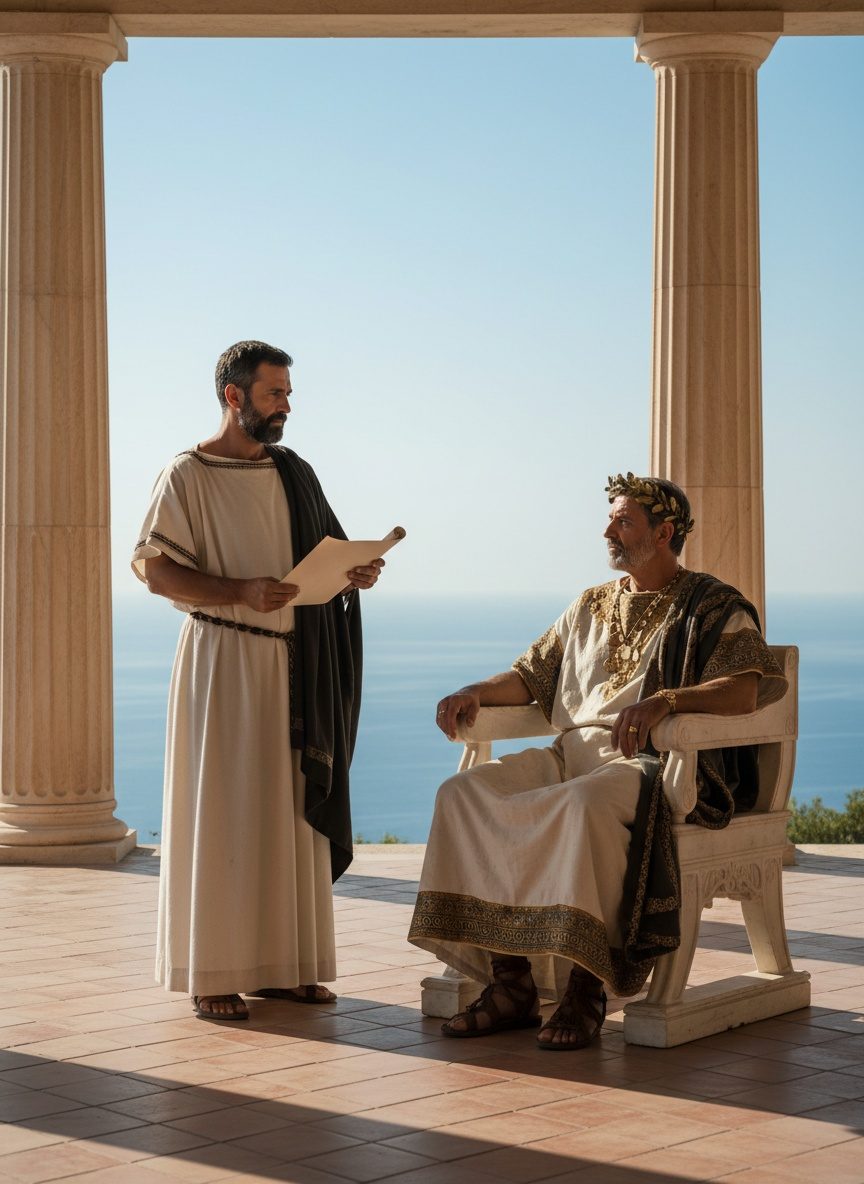
The soft murmur of anticipation rippled through the hall like a quiet breeze through a field of grass. Hiero, the tyrant of Syracuse, sat upon his ornate throne, casting a long, contemplative shadow across the polished floors. All eyes were upon him, yet his gaze fixed intently on the figure at the center of the room. Pindar, Thebes' most esteemed poet, stood poised, his presence emanating an unexpected calmness in the charged air, as if he held a secret that even the mighty Hiero couldn't fathom.
The room was a testament to Hiero's power, opulent and grand, each corner adorned with treasured spoils of his many conquests. Hiero had summoned Pindar to commemorate his victory at the Olympic Games, a triumph he had secured with the gold that flowed from his coffers. Silver-lined goblets clinked softly as guests adjusted in their seats; the air was thick with the smell of incense and expectation. But what Pindar offered that day was not flattery veiled in verse or praise gilded with sycophancy. His ode lifted instead the gods themselves, drawing upon the timeless, the eternal — entities far greater than any mortal king.
The Olympics of 476 BC had seen Hiero's chariot team cross the finish line triumphant, yet the victory was not merely an athletic one. For Hiero, it was a political maneuver, a powerful statement to the Greek world of his dominion and influence. But as Pindar’s words began to weave their spell, the Olympian victor was left humbled. Stories of heroes and divine intervention flowed from the poet's lips with an elegance that seemed to redefine what victory truly was. It wasn't the spoils of war or the wealth amassed, but rather a connection to something mightier, something beyond the comprehension of even the most formidable rulers. There, in the heart of Syracuse, Pindar began rewriting the legacy of a tyrant with his verses.
Born in 518 BC, Pindar hailed from an aristocratic family in Thebes. Steeped in the tradition of choral poetry, he was renowned for his mastery of the epinician ode, the celebratory poems written to honor victors in the Panhellenic games. His voice, at once commanding and ethereal, carried the weight of Greece's storied past with an insight that saw beyond the mere mortal wrangling for power. Pindar's poetry celebrated the glory of human achievement, interwoven tightly with the fates and will of the gods, reminding even the most triumphant of men of their place in the grand tapestry of existence.
In that encounter with Hiero, Pindar's ode did not dwell long on the particulars of Hiero’s achievements—there was no flourish over the gilded victories or meticulous plan that Hiero's tactical mind devised. Instead, Pindar’s focus shifted to themes much grander, much deeper. He spoke of the fragility of human life in contrast to the immortality of the divine. He painted pictures of men struggling under the gaze of gods, succeeding only through grace bestowed from above. His words were not a celebration of Hiero’s power, but a reminder of the transient nature of earthly accomplishments, elevating the discourse to matters beyond mortal control.
Hiero, a man who had seized power through force and cunning, was brought to tears by this revelation in verse. The powerful were often hard-hearted, their souls plated with the metals that symbolized their conquests. Yet here was a poet who could cut through the armor of his heart, revealing the vulnerable human interior. Hiero wept, not with sorrow, but with a profound understanding of the wisdom in Pindar's words. It was said that Hiero, in recognition and gratitude, paid Pindar in silver — a compensation that spoke to the value he placed on the poet's immortalizing words. It was as if the tyrant had purchased a piece of eternity for himself.
This event left an indelible mark upon Greek history. More than a mere transaction between a patron and an artist, it represented a confluence of might and creativity that transcended the temporal struggles of power. Pindar’s ode to Hiero became a testament to the enduring power of art to shape, challenge, and redefine legacies beyond the dictates of mortal aspirations. Hiero, once known for his iron-fisted rule, was now immersed in a narrative that highlighted divine favor and the true nature of victory — a narrative which outlived him and became a vital part of the Hellenic cultural landscape.
The intersection of Hiero and Pindar’s paths serves as a crucial reminder of the timeless dialogue between power and art, of how the brush of a poet can paint a tyrant’s reign in immortal hues. Here was a lesson of humility, yet also of transformation — the pen mightier than the sword, reshaping the world not through conquest, but through the gentle persuasion of finely crafted verse. It was a moment immortalized not just in silver, but in the echoes of Pindar’s songs that continue to be sung across millennia. In this interplay of power and artistry lies a lesson for all ages: that even the humblest of words can render the mightiest of legacies eternal.