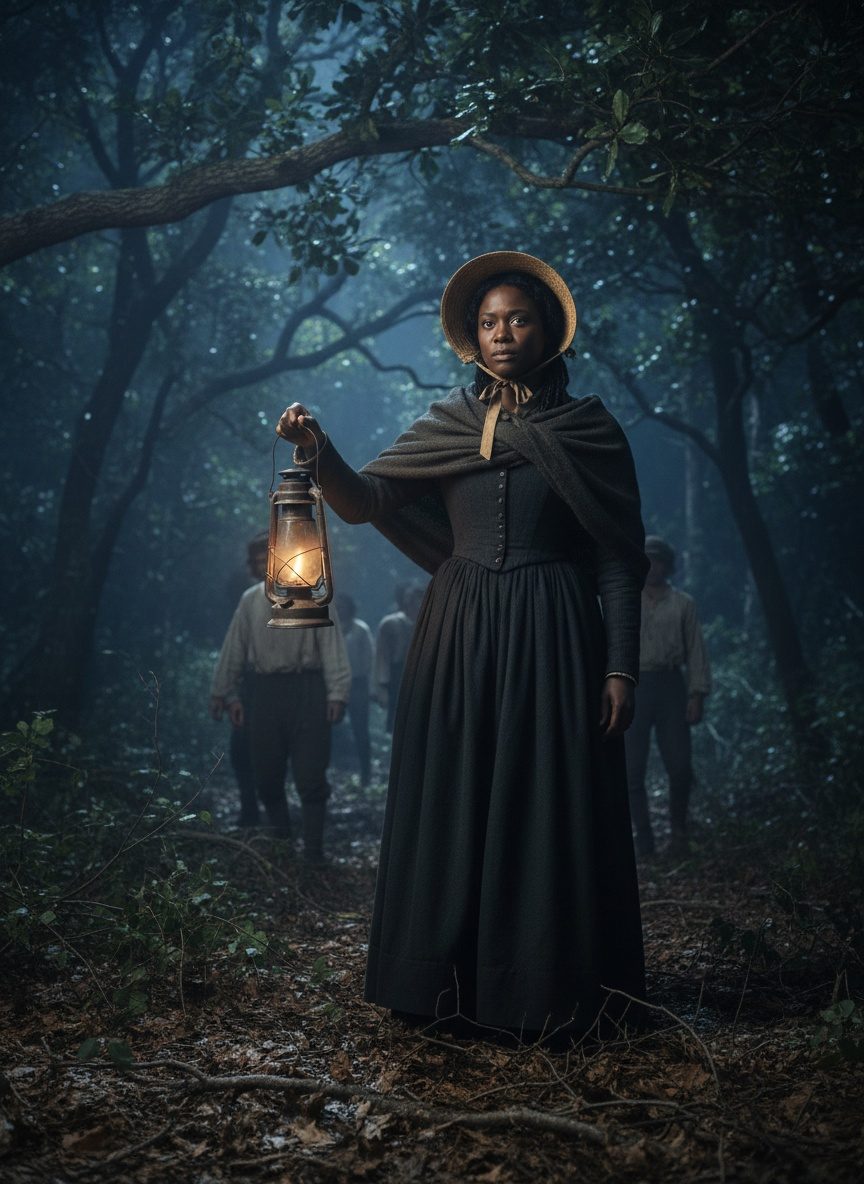
The underbrush crackled beneath her feet as Harriet Tubman paused, ears straining for the sounds of pursuing footsteps. Her eyes, accustomed to the darkness, scanned the moonlit forest, seeking any movement that betrayed an unwelcome presence. Behind her lay the Sleeping families of freedom seekers, their trust vested entirely in her ability to coax them, unseen, through the hostile Maryland night toward liberty. Raising her pistol, which she called her persuader, she let the cool steel comfort her determination, knowing it often did more than coax. It compelled.
A Journey North — And Back Again
Harriet Tubman's journey into the swampy woods of Maryland began with a singular, pivotal decision. In 1849, after enduring the brutality of slavery since her birth, she took the harrowing first step of her journey to freedom. For Harriet, it began as a solo escape from the place she called home, the plantations where she labored and the people she loved but needed to leave behind if she was ever to see them free. She trekked alone for over 90 miles, following the North Star, her guiding light, to reach the free soil of Pennsylvania.
The early life of Harriet Tubman was defined by persistence against unrelenting oppression. As Araminta "Minty" Ross, she learned early the hard realities of slavery. A life-altering head injury at the hands of an overseer resulted in seizures and vivid visions she fervently embraced as divine signs. These convictions would fuel her courage and drive to aid others, transforming from an escapee into a beacon of liberation.
But crossing the line to freedom once was not enough for Harriet. Driven by a deep fidelity to those still entrapped, she resolved to return. Her first return trip was a lone venture deep into the South, the initial of many daring treks. Each time she ventured into the slaveholding states, she risked capture and a reward of $40,000 on her head—an enormous sum for a woman who could not claim her liberty as a birthright.
The Undaunted Conductor
Harriet Tubman was a master of strategy and guile. She planned her journeys meticulously, leveraging safe houses and coded signals on what would later be immortalized as the Underground Railroad—a vast, covert network of allies and sanctuaries aiding escaped slaves in their flight north. In the dark of night, with whispers of danger in every breeze, she coaxed frightened groups to press forward, her intuition and quick-wit invaluable as she navigated unfriendly terrains.
Tubman bore many titles: Moses, Conductor, General. But it was the unyielding coterie of escapees she led—more than 70 souls—that attested profoundly to her wily arsenal and unshakable resolve. She cleverly took advantage of ever-changing Federal laws to outwit those who hunted the promises of bounties, leading her passengers to Canada and the northern United States, where enforcement reach waned.
Each expedition had its unique trials. Tubman once diverted an ill-fated group when they were a hair’s breadth from capture, veering off-road to a safe, uncharted path. Her reputation for safe passage became legend; the stories of her abolitionist prowess grew with such fervor that she carried an aura of the mythological—a woman who walked among danger with impunity.
No One Left Behind
Harriet Tubman’s legacy rests profoundly not only within the daring counts of these missions but also in the certainty that not one person she shepherded was ever recaptured. She was a captain tending to her flock, with her unwavering policy: anyone who decided to turn back on an expedition risked the group’s safety and would be met with her persuader's forceful reminder to persevere forward.
In her later years, during the tumult of the American Civil War, Tubman’s relentless spirit proved indispensable. Beyond her work on the Underground Railroad, she served as a nurse, cook, and even spy for the Union Army, a tireless advocate in the pursuit of freedom and justice. She consistently pressed for change, advocating for enslaved people's rights and the liberties of women until the day she took her last breath.
Harriet Tubman’s story transcends the narrative of a fearless woman in a time of overwhelming injustice. It speaks to a story of human tenacity and moral uncompromise. Her life's journey defied the shackles imposed on her from birth, becoming a pivotal force in shaping the pursuit of liberty. Tubman’s legacy does not rest solely on her daring deeds but in the quiet resurgence she inspired—the belief in a greater, freer tomorrow. The forests of Maryland bear witness not only to the footsteps she once walked but to the indomitable spirit of a woman who refused to accept the chains of forgetfulness.