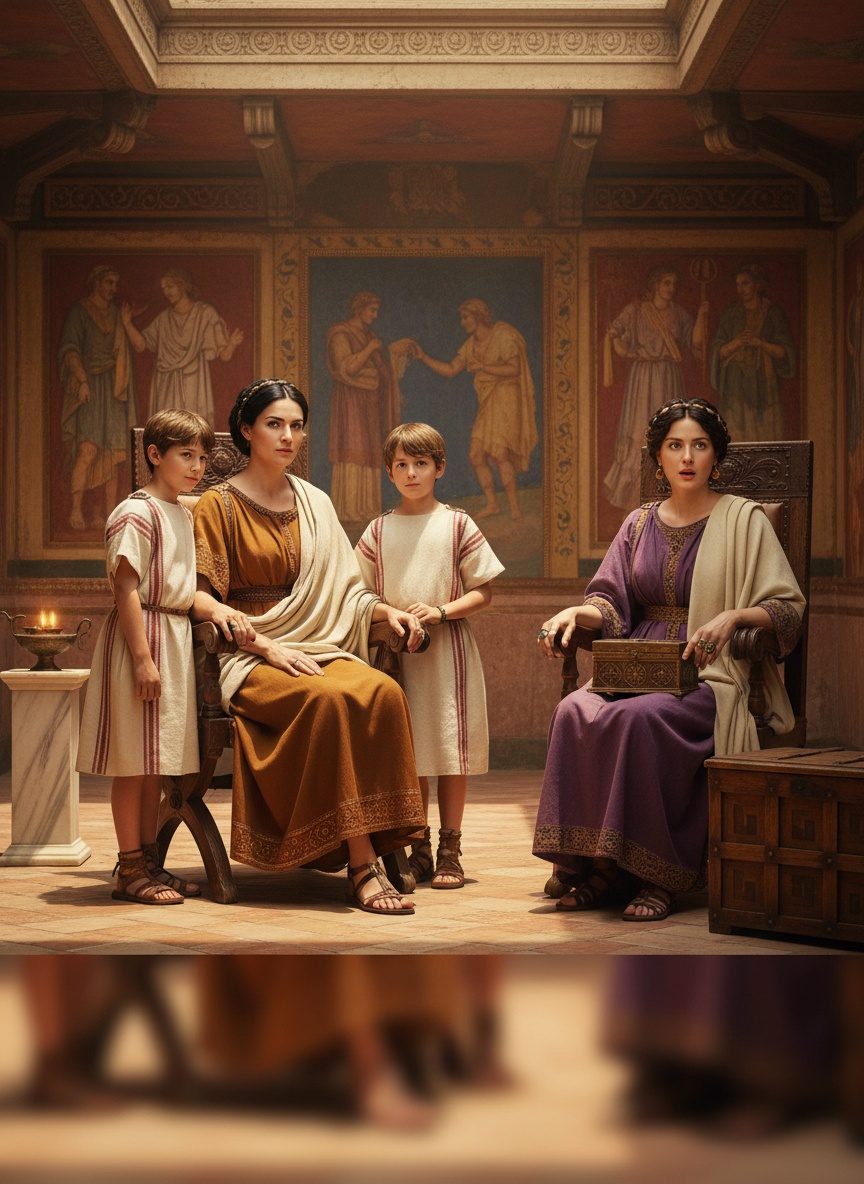
Most people associate jewels with wealth and material possession. Cornelia Africana's version of jewels gleamed with the brilliance of character and future greatness.
A Legacy Beyond Rubies
Cornelia Africana was the daughter of Scipio Africanus, Rome's greatest general, who famously defeated Hannibal in the Second Punic War. Her life was steeped in the legacy of Rome's martial and political empire. But it wasn't pearls or rubies that Cornelia cherished most. Her wealth was rooted in the lives of her two sons, Tiberius and Gaius Gracchus, who would come to be known for their efforts at reforming Roman society.
In the Roman Republic, wealth was more than just gold and luxury; it was influence and family. Cornelia was no stranger to this, having been born into one of the most prestigious families of Rome. After marrying a distinguished Roman officer, she became a widow early on. Despite having a marriage offer from the king of Egypt, Ptolemy VIII, Cornelia chose to remain in Rome to raise her children herself. Her values defied the conventions of her time, where remarrying for political or economic gain was often a common choice among widowed Roman women.
The Masterclass of Motherhood
The story of Cornelia's treasure unfolds most vividly in her encounter with a Roman matron who, during a visit, invited Cornelia to display her jewels. As the story goes, Cornelia waited until her sons entered the room, then pointed to them and said, "These are my jewels." This singular moment was a defining testament to her priorities and the values she instilled in her children.
Cornelia's role as a mother extended beyond care and nurturing; she was their educator, imbuing them with unparalleled virtues and a sense of duty to the Roman state. Under her guidance, Tiberius and Gaius developed into influential figures who would challenge the societal norms of Rome with their progressive reforms. Tiberius would become known for redistributing public land to the poor, while Gaius was a fervent advocate for a range of social and political rights.
A Woman’s Influence in a Man’s World
In a society dominated by men, Cornelia’s story is particularly remarkable. As a woman in the Roman Republic, Cornelia wielded soft power — that is, influence through culture, values, and ideas. She managed her household with an exemplary blend of wisdom and foresight, qualities not often attributed to women in patriarchal Roman history. Her standing as a virtuous and intelligent woman was exceptional enough that historians like Plutarch and Cicero took note of her character and influence.
Cornelia lived in turbulent times. Rome was an arena for political and social upheaval, and she navigated these waters with a determined grace, applying her strength of character to raise sons who would steer the Republic toward reform, even at the cost of their lives. Cornelia’s motherhood was her political statement, and by emphasizing virtue over wealth, she contradicted the materialism that often characterized the elite of her society.
The Jewel of Legacy
Cornelia’s story is not just about her as a mother and her iconic showcase of her sons as her jewels. It’s about the legacy of ideals transcending the tangible and temporal. Cornelia’s life remains a mirror reflecting the values of integrity and commitment against the backdrop of Rome’s decadence and dynamism. Her story touches a universal chord, resonating through the ages as an embodiment of love, sacrifice, and the enduring impact of nurturing future generations.
In the face of immense challenges and the clamor for material wealth and political power, Cornelia Africana chose the immaterial — the enduring legacy of influence through her children. Her life invites us to reflect on the treasures we seek to accumulate and the timeless worth of imparting virtues and the promise of a better world.